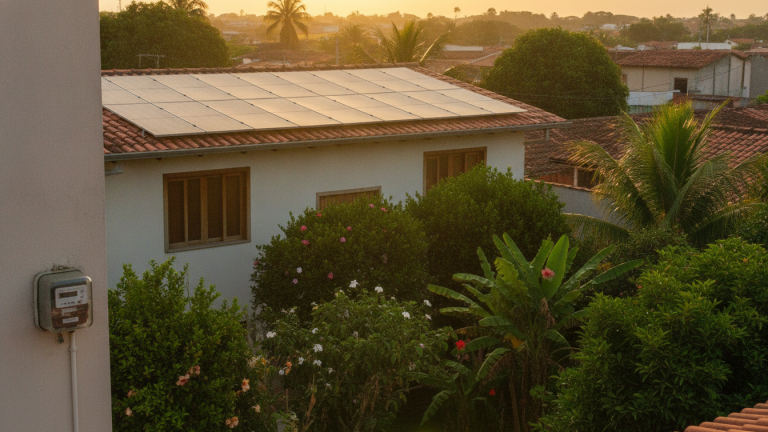
Why solar energy payback matters more than the initial price
Imagine reaching the end of the month, opening your utility company’s app, and seeing an electricity bill close to zero. For many people in Brazil, this is already reality. According to ANEEL data, the country surpassed 4 million distributed generation systems installed in 2024, the vast majority consisting of solar panels in residences and small businesses. The accelerated growth is no coincidence: with electricity rates among the highest in the world and a territory bathed in sunlight practically year-round, the investment makes financial sense in a way that’s hard to ignore.
But the doubt that blocks many decisions is always the same: “How long will it take me to recover the money I spent?” This question has a technical name, payback, and the answer depends on concrete factors that you can calculate before signing any contract. By the end of this article, you’ll know exactly what weighs on this calculation, which mistakes to avoid, and how to estimate your own return timeframe based on real data.
What is payback and why it varies from house to house
Payback is simply the time it takes for an investment to “pay for itself,” that is, for the accumulated savings to cover the amount you spent at the beginning. In the case of solar energy, the logic is direct: each month you stop paying part of your electricity bill, and this savings gradually reduces the system’s cost until it reaches zero.
The problem is that this timeframe varies considerably. A family in Fortaleza, with a rooftop facing north and monthly consumption of 400 kWh, will have a very different payback from an apartment in Porto Alegre with consumption of 150 kWh. Solar radiation, energy consumption, local rates, equipment quality, and even the financing method all enter the equation.
The numbers that define your return timeframe
To calculate payback with some precision, you need three basic pieces of information:
- Total cost of the installed system (equipment plus labor)
- Expected monthly savings on your electricity bill
- Electricity rate charged by your utility company
According to ANEEL data for 2025, the average residential rate in Brazil hovered around R$ 0.85 per kWh, but this number varies significantly by state and tariff band. In states like São Paulo and Rio de Janeiro, the rate can exceed R$ 1.00 per kWh when considering all charges. The higher your rate, the faster the system pays for itself.
The installation cost of a typical residential system, with capacity between 3 and 5 kWp (kilowatts-peak), sufficient for a house with monthly consumption between 250 and 400 kWh, varies according to industry surveys around R$ 15,000 to R$ 25,000 in 2025. With monthly savings of R$ 400 to R$ 700 on your electricity bill, payback typically ranges from 4 to 7 years, depending on the combination of factors.
A simple way to visualize:
| Monthly consumption | Estimated system cost | Estimated monthly savings | Approximate payback |
|---|---|---|---|
| 150 kWh | R$ 12,000 to R$ 16,000 | R$ 130 to R$ 200 | 6 to 9 years |
| 300 kWh | R$ 18,000 to R$ 22,000 | R$ 250 to R$ 400 | 5 to 7 years |
| 500 kWh | R$ 25,000 to R$ 32,000 | R$ 420 to R$ 650 | 4 to 6 years |
These numbers are estimates based on national averages. Request detailed quotes for your specific situation.
How Brazil’s sun works in your favor
Brazil is among the countries with the highest solar radiation incidence in the world. Data from the Brazilian Atlas of Solar Energy, published by INPE in partnership with other institutions, shows that even regions with the lowest irradiation, such as southern Brazil, receive more solar energy per square meter per year than much of Europe, where solar energy has already been mature and widespread for decades.
This has a direct effect on payback. A system installed in Cuiabá or Petrolina generates more energy per panel than the same system in Curitiba. But even Curitiba has competitive performance when compared to countries where the technology has already proven to be economically viable. In other words: in practically any point in Brazilian territory, solar panels generate enough energy to make the investment attractive.
Roof inclination and orientation also influence this. Angled rooftops facing north capture more sun throughout the day. But systems on flat rooftops with adjustable supports can compensate well for this difference. An accredited installer should simulate generation before finalizing the contract.
Step by step to calculate your payback before investing
You don’t need a complex spreadsheet to get a realistic idea of the return. Follow these steps:
- Gather your electricity bills from the last 12 months. Calculate the average consumption in kWh and the rate charged. This gives you a real foundation, not an estimate.
- Define how much you want to generate. If you intend to cover 80% of your consumption, the system needs to be sized accordingly. An installer does this calculation, but you can use online simulators made available by the Ministry of Mines and Energy.
- Request at least three quotes. Compare not only the price, but the brand of the panels, the warranty offered (quality panels have 25-year performance warranties) and whether the installer is accredited with ANEEL.
- Calculate expected monthly savings by multiplying the energy generated by the system by your current rate. Consider that rates tend to rise over time, which further shortens the real payback.
- Divide total cost by monthly savings. The result is the approximate number of months for payback. Divide by 12 to get the years.
- Consider financing. If you finance the system, part of the savings goes toward paying the installment. Payback can still be positive from the first month, but the net return timeframe changes. Simulate with and without financing.
- Check available incentives. Some municipalities and state governments offer property tax exemptions or VAT reductions for those who install solar energy. Check with your state’s Finance Department.
Common mistakes that extend payback unnecessarily
Many people make decisions that slow returns more than necessary. The most frequent ones:
- Undersizing the system to save money at first, and then realize the electricity bill stays high because the system doesn’t cover actual consumption.
- Buying at the lowest price without evaluating quality. Low-efficiency panels generate less energy over the years, and cheap inverters may fail before payback happens.
- Ignoring maintenance. Panels dirty with dust, leaves, or soot lose efficiency significantly. Periodic cleaning is simple and inexpensive, and makes a real difference in generation. If you want to better understand what’s involved in maintaining the system over time, it’s worth consulting specific content about solar panel maintenance and the annual cost involved.
- Not registering the system with the utility correctly. The Legal Framework for Distributed Generation, established by Law 14,300/2022, guarantees important rights to consumers with solar energy, including the use of energy credits. Without proper registration with ANEEL, you lose these benefits.
What happens after payback arrives
This is the point that most surprises those evaluating the investment: after payback, the system continues generating energy for another 15, 20 years. The lifespan of panels is long, and manufacturers guarantee they maintain at least 80% generation capacity after 25 years of use.
Translating to your wallet: if your payback happens in 6 years and the system lasts 25 years, you have approximately 19 years of cheap or nearly free energy. The accumulated savings over this period is usually three to five times the initially invested amount, depending on how rates evolve.
Families that installed systems between 2018 and 2020, when equipment prices had already fallen significantly but rates were still high, are already reaching payback in 2025 and 2026. For these people, the electricity bill became practically a small fixed cost, referring only to the grid connection minimum fee.
Frequently asked questions about solar energy payback
Can apartments have solar energy and achieve real payback?
Yes, but the path is different. Apartment residents can join remote solar plants or shared generation systems, modalities regulated by ANEEL. In this model, you invest in shares of a solar plant and receive credits directly on your electricity bill. Payback exists, but depends on the contracted model and local utility.
Does financing the system significantly delay payback?
Not necessarily. In many cases, the financing installment is less than the savings generated on your electricity bill, so the balance is already positive from the first month. The “net” payback, counting interest costs, takes longer, but the monthly cash flow can be favorable from the start. Compare simulations before deciding.
What happens to my energy credits when I don’t use everything I generate?
Under the Legal Framework for Distributed Generation (Law 14,300/2022), energy credits generated and not consumed remain available for 60 months to be used on other electricity accounts, such as family members’, or in months of higher consumption. It’s one of the most important guarantees of Brazilian legislation for those with solar energy.
Is it worth installing now or waiting for prices to fall more?
Solar panel prices fell significantly over the past decade. The speed of decline has slowed in recent years. While you wait, you pay full rate every month. In general, financial analysis favors acting soon, especially with current rates.
Start with a diagnosis today, at no cost

The first step costs nothing: get your electricity bills from the last 12 months and calculate how much you paid in total. This number is your starting point. With it in hand, you can request quotes with clarity, compare proposals with criteria, and understand how long the system really pays for itself in your reality.
Solar energy is no longer a niche thing or for those with lots of money. With accessible credit, tax incentives in various states, and rising rates, payback is getting shorter all the time. And those who act in 2026 are one step ahead of those who will wait another year paying full bills.
