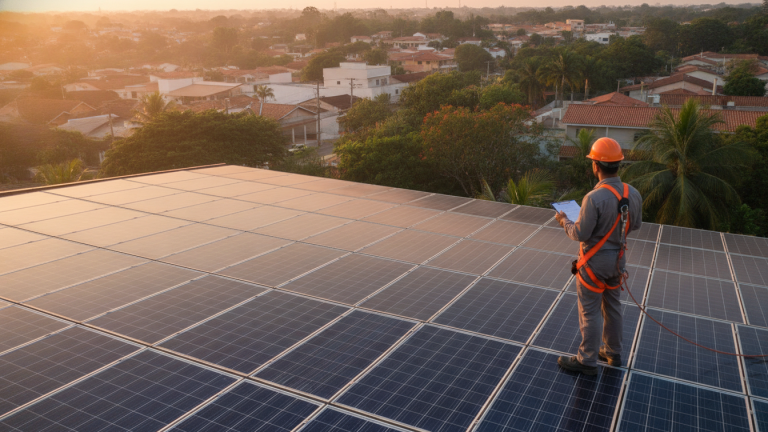
You installed solar panels, now what?
Imagine you just saw your electricity bill cut in half after installing solar panels. It feels great, but then a doubt creeps in—one many people don’t research before signing the contract: how much will it cost to keep this system running smoothly over the years?
The short answer is that solar panel maintenance is cheaper than most people think, but it does exist and needs to be planned. Ignoring this step can reduce system efficiency by up to a third, according to technical data published by manufacturers and distributors in the photovoltaic sector. In this article, you’ll understand what needs to be done, how often, what it costs on average in Brazil in 2026, and how to avoid unnecessary expenses.
If you’re still evaluating whether it’s worth installing solar energy at home, you can start by reading about how solar energy reduces your electricity bill year-round before diving into maintenance details.
What makes up a residential solar system
Before talking about costs, it’s worth understanding what you’re maintaining. A typical residential photovoltaic system has four main components:
- Solar panels (photovoltaic modules): capture sunlight and generate electrical current
- Inverter: converts the current generated by the panels to the standard used in homes
- Mounting structure: metal support that secures the panels to the roof or ground
- Wiring and protective devices: conductors and circuit breakers that ensure electrical safety
Each of these components has different lifespans and maintenance needs. Panels typically last 25 years or more, but the inverter usually needs to be replaced between 10 and 15 years of use. Knowing this helps you predict costs over time, not just in the first year.
Why maintenance directly affects your savings
A dirty or technically faulty solar system doesn’t stop working overnight. It simply produces less energy than it should, and you may not notice for months.
Dirt accumulated on the panels, especially in cities like São Paulo, Belo Horizonte, or Brasília, where there’s a lot of soot and dust, can reduce generation by 15% to 25% depending on the season and roof inclination. In regions near farms, harvest dust makes the situation even worse. The presence of leaves, bird droppings, or even growing shadows from branches in front of a panel can cause “partial shading effect,” which compromises an entire string of connected modules.
The good news is that preventing these problems doesn’t require much effort or money. What it does require is regularity.
What annual maintenance actually costs
Costs vary depending on system size, the region of Brazil, and whether you contract a specialized company or handle part of the maintenance yourself. For a typical residential system of 3 kWp to 5 kWp, which serves a medium-consumption household, annual expenses break down as follows:
| Maintenance type | Frequency | Average estimated cost (2026) |
|---|---|---|
| Panel cleaning | 2 to 4 times per year | R$ 150 to R$ 350 per visit |
| Electrical and inverter inspection | Once per year | R$ 200 to R$ 500 |
| Mounting structure verification | Once per year | Included in technical visit |
| Replacement of fuses or connectors | When necessary | R$ 50 to R$ 200 per part |
| Inverter replacement (every 10 to 15 years) | One-time | R$ 2,500 to R$ 6,000 |
Adding up cleanings and annual inspection, a Brazilian homeowner spends between R$ 600 and R$ 1,800 per year on regular maintenance. This represents a small fraction of the savings generated by the system, which for a family with electricity bills over R$ 400 monthly can reach R$ 3,000 or more per year in energy credits, according to estimates from the photovoltaic sector.
What you can do yourself
Not everything requires a specialist. Some tasks are safe and simple for the homeowner to perform, as long as the system is on an easily accessible roof and you take basic safety precautions.
Panel cleaning:
- Choose a cloudy day or early morning when panels are cool. Cold water on a hot panel can cause microcracks
- Use clean water and a soft cloth or rubber squeegee, without abrasive products or chlorine-based detergents
- Wet the panel first to loosen dirt, then gently wipe with the cloth
- Rinse with clean water and let dry naturally
- Never use pressure washing directly on edges or connectors
This procedure takes about 30 minutes for a system of 8 to 10 panels and costs only the water used. Do this at least twice a year, or after long dry periods.
Inverter app monitoring:
Most modern inverters have their own app showing daily, monthly, and historical generation. Getting into the habit of checking this data once a week takes less than two minutes and allows you to identify sudden production drops before they become a bigger problem.
What only a certified technician should do
Some interventions involve high-voltage electricity and should not be attempted on your own. Calling a certified professional is mandatory in these situations:
- Inspection of the electrical panel and protective devices
- Verification of cables and MC4 connectors (industry standard)
- Analysis of inverter performance with measurement equipment
- Any repair or replacement of internal components
- Readjustment of mounting structure after strong winds or storms
ANEEL regulates the connection of photovoltaic systems to the electrical grid in Brazil, and any modification to the system must follow current technical standards. Working outside this standard can void your warranty and create real risks of fire or shock.
Warranties and what to expect from manufacturers
Leading solar panel manufacturers offer two types of warranty: product warranty, which covers manufacturing defects for 10 to 12 years on average, and performance warranty, which ensures the panel will generate at least 80% of its original capacity after 25 years.
Keep all installation documents, equipment receipts, and technical visit reports. Without these records, claiming a warranty can be difficult. If your installer belongs to a sector association, such as ABSOLAR (Brazilian Association of Solar Photovoltaic Energy), that’s also a good sign that quality standards were followed.
A practical tip: take photos of the panels right after installation and repeat this once a year. Having a visual record helps identify damage and prove the system’s condition in case of an accident or warranty claim.
Frequently asked questions about solar panel maintenance
Doesn’t rain clean the panels by itself?
Light rain helps, but doesn’t replace manual cleaning. It removes some dust but leaves mineral residue that forms stains and thin layers that are hard to see. In cities with moderate to high pollution, periodic manual cleaning is still necessary.
What happens if I don’t do any maintenance?
The system keeps working, but with reduced efficiency over time. Accumulated dirt and unidentified small defects will gradually erode generation. After five years without maintenance, it’s common to see systems producing 20% or 30% below expected, which undermines your investment’s financial return.
Does solar panel maintenance have any deductible costs or tax incentives in Brazil?
As of 2026, there is no specific federal tax incentive program for residential photovoltaic system maintenance. The main benefit continues to be the energy compensation system regulated by ANEEL, which allows using generated credits to offset grid consumption. Some municipalities and states have local solar energy incentive programs—it’s worth checking in your region.
Does the inverter need special maintenance?
The inverter is the most sensitive component of the system. It should be installed in a well-ventilated area, away from direct moisture, and never blocked by objects. External cleaning with a dry cloth can be done by the homeowner, but any internal analysis or component replacement requires a specialist.
Start with monitoring today
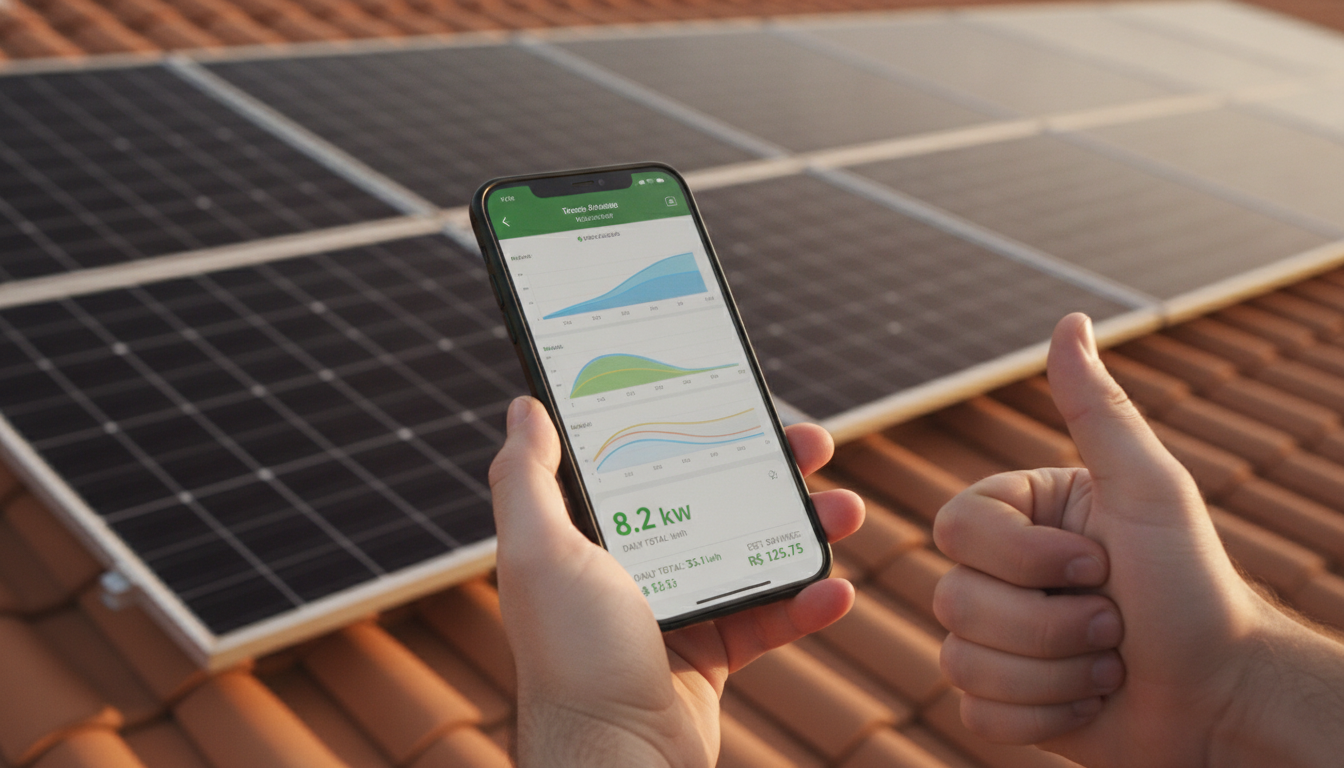
If you already have panels installed, the simplest and most effective action you can take now is to open your inverter app and look at your generation history for the last three months. Compare it with the same period last year. If the drop is greater than 10% without a clear reason like prolonged cloudy periods, it’s time to schedule a technical visit.
Keeping your system running well doesn’t require much, but it does require consistency. With regular cleanings, app monitoring, and one technical inspection per year, you protect your investment, maintain your electricity bill savings, and ensure your system continues contributing to cleaner energy consumption for many years to come.
