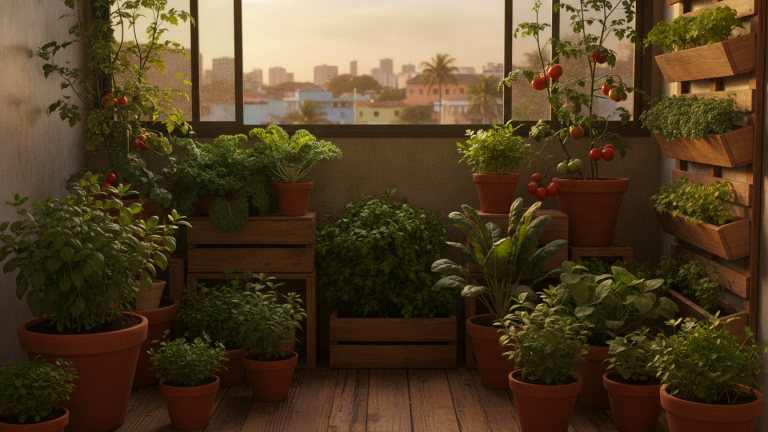
Why a handful of soil in a pot can change your routine
Have you ever looked at the space by your kitchen window and thought “I could plant something there”? Many people have this impulse but delay it thinking they need a yard, greenhouse, or some special agricultural talent. None of the three are necessary.
A small apartment vegetable garden starts with a pot, a bag of substrate, and a seedling or seed. The practical results appear in weeks: you cut what you need at cooking time, reduce trips to the market for fresh herbs, and stop throwing away half-used bunches of herbs. According to Embrapa, plants like chives, parsley, and basil have short harvest cycles and adapt well to container growing, making them ideal for beginners.
By the end of this guide you’ll know exactly what to buy, how to set up your first bed, which mistakes to avoid, and how to keep your garden running even with the busy routine of apartment living.
What you really need to get started
The idea that gardening is expensive is one of the biggest myths on the subject. The initial investment can be less than a week of herbs bought at the market.
The basic materials are:
- Containers: terracotta or plastic pots with drainage holes, reused wooden crates, cut 2-liter PET bottles (work well for parsley and chives)
- Substrate: mix of potting soil with organic compost; avoid pure garden soil, which compacts easily in closed containers
- Light: window or balcony with at least 4 to 6 hours of direct sun per day for most herbs; leafy greens like arugula tolerate partial shade
- Watering can or bottle: nothing fancy needed; a PET bottle with holes in the cap does the job
Estimated cost for a simple starter kit:
| Item | Budget option | Estimated cost |
|---|---|---|
| Medium pot (14 cm) | Plastic from local market | R$ 5 to R$ 12 |
| Substrate (5 L) | Popular brand at garden center | R$ 15 to R$ 25 |
| Seeds (packet) | Common herbs at stationery or market | R$ 3 to R$ 8 |
| Ready seedling | Street market or local nursery | R$ 5 to R$ 15 |
With less than R$ 60 you already have a garden with three or four species functioning.
Which plants to choose first
Starting with the right plants prevents frustration. Some species forgive watering neglect, grow quickly, and produce a lot in little space.
For first-time growers:
- Chives and parsley: both resist temperature variations common in Brazilian apartments, from the humid heat of Belém to the colder winters of Curitiba
- Basil: needs plenty of sun, but rewards with leaves in less than three weeks after transplanting a seedling
- Mint: grows so well it’s worth putting it in a separate pot so it doesn’t crowd out its neighbors
- Arugula: great for a partially shaded balcony; ready to harvest in 30 to 40 days
For those wanting to go further:
- Iceberg or curly lettuce: takes up more space, but a 20 cm pot is enough for one plant
- Cherry tomato: needs full sun and a pot at least 30 cm deep; production starts around 70 to 90 days
- Pepper: very well adapted to Brazilian climate, produces well in pots and lasts months in the same plant
A practical tip: start with the herbs you use most in the kitchen. If you make lots of recipes with cilantro, start with cilantro. The garden needs to make sense on your plate to keep you motivated.
Step-by-step guide to setting up your first garden
Time needed: about 30 minutes to set up; 5 minutes a day to maintain.
- Choose the brightest location. Observe during a day which window or balcony gets sun the longest. Herbs need at least 4 hours; cherry tomato wants 6 to 8 hours.
- Prepare the containers. Check if they have drainage holes at the bottom. Without drainage, the root rots. Put a layer of coarse sand, small stones, or broken tile 2 to 3 cm before the substrate to help water drain out.
- Mix the substrate. Use two-thirds potting soil and one-third organic compost (worm castings or homemade compost, if you have it). This mixture retains moisture without waterlogging.
- Plant the seedling or sow. For seedlings: make a hole with your fingers, place the plant without pressing the substrate too tightly around the roots. For seeds: distribute over the surface and cover with a thin layer of substrate; gentle misting with a spray bottle until it germinates.
- Water gently. Frequency depends on climate. In São Paulo in summer, small pots may need daily watering; in winter, every two or three days. Simple test: stick your finger 2 cm into the substrate. If you feel moisture, wait a bit longer.
- Position and observe. If leaves turn yellow or become etiolated (long and thin), it’s lacking light. If they wilt right after watering, it could be too much water or direct heat reflected in a dark plastic pot.
- Harvest smartly. Always cut the oldest outer leaves or lateral shoots, never the center of the plant. This stimulates continuous growth.
Common mistakes that kill the garden too early
The most frequent problem isn’t lack of care: it’s overwatering. The root needs oxygen as much as water, and permanently waterlogged soil suffocates the plant.
Another classic mistake is using garden or construction soil in the pot. This type of soil was made for open fields, where it has space to loosen up. In a pot, it compacts and prevents roots from penetrating. Commercial potting substrate exists exactly for this context.
There’s also the problem of glass sun. In apartments with closed windows, the glass can concentrate heat and burn the leaves of plants pressed against it. If you notice leaf edges turning brown even with good watering, move the plant away from the glass a bit.
Finally, many people forget that plants grow. Basil, for example, wants to flower after a while. When that happens, leaves get smaller and more bitter. Cut the flowering stems before they open to extend the phase of producing tasty leaves.
The connection to healthy eating and conscious consumption
Having fresh herbs at home changes the way you cook. You start using what you have, cutting fresh, and avoiding waste from the bunch you bought that wilts in the fridge in two days.
This habit connects to something bigger: valuing seasonal foods, which cost less and are good for your health, also reducing the carbon footprint of transport and refrigeration of food that reaches your table. When you grow part of what you consume, even if it’s just seasoning, you start thinking differently about the origin of everything you eat.
From an environmental perspective, container growing can also connect to home composting. The compost generated from kitchen food scraps becomes fertilizer for the garden, closing a cycle that Law 12.305/2010 (National Solid Waste Policy) encourages by providing for shared responsibility in the product life cycle. In everyday practice, this means less organic waste going to landfills and more nutrients going back to your basil pot.
How to keep your garden alive with a busy routine
The biggest barrier for those who work outside and have a full schedule isn’t planting: it’s maintaining. But a small herb garden, well set up, requires just a few minutes a day.
An effective strategy is to associate watering with something you already do: making breakfast, washing dishes after dinner. Watering becomes part of the routine without requiring extra mental effort.
For those who travel frequently, a slow-release watering bottle (the upside-down type buried in the pot) lasts up to five days without attention for medium pots. Another option is capillary irrigation systems, which you set up with a fabric wick and a cup of water, spending almost nothing.
If light is the problem (apartment without a sun-facing window), LED lighting with the right spectrum for plants is a real alternative. The energy cost is low for lighting two or three small pots, and you can check how much this represents on your bill using the simulator available on the ANEEL website.
Frequently asked questions about apartment gardening
What is the minimum pot size to start?
For herbs like parsley, chives, and basil, a pot 14 to 18 cm in diameter is sufficient. For cherry tomato or lettuce, prefer pots with at least 25 to 30 cm depth for roots to develop well.
Can I use soil from the square or the building’s garden?
Not recommended. Garden soil may contain pests, fungi, and weed seeds adapted to open soil. It also compacts inside the pot and damages drainage. Commercial potting substrate is formulated to solve exactly these problems.
How often should I fertilize potted plants?
In pots, substrate nutrients deplete faster than in soil. Once a month, add a small amount of worm castings or granulated organic fertilizer to the surface. Read the label to avoid overdoing it: excess fertilizer burns roots.
What if my apartment has no balcony or sun-facing window?
Some leafy greens, like mint and chives, tolerate partial shade and grow reasonably well near windows without direct sun. For more demanding species, the solution is LED lighting for plants, which already has accessible prices at Brazilian garden shops and e-commerce.
Your first pot can be ready by this week
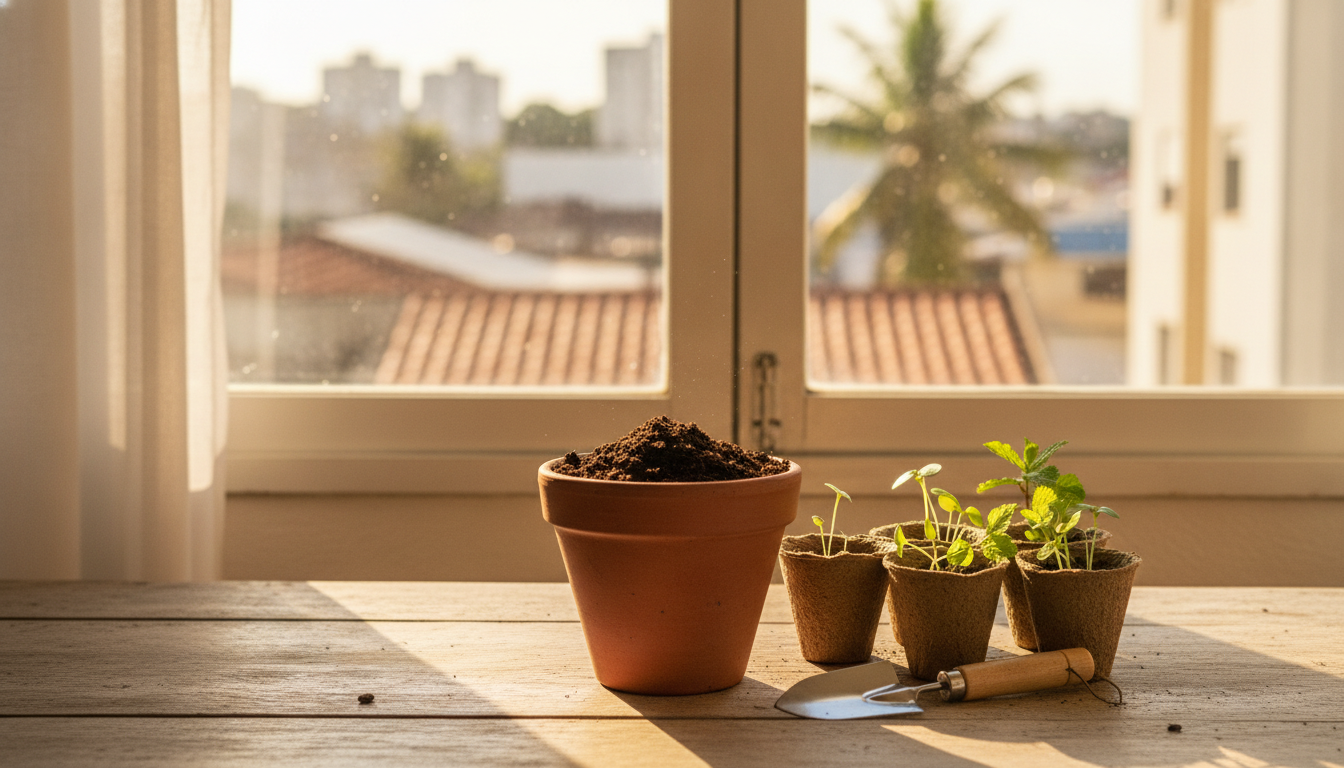
You don’t need to renovate the kitchen, buy expensive equipment, or take a course. A pot with substrate and a chive seedling bought at the market already counts as a garden. Very small, yes. But functional, alive, and capable of growing at whatever pace you want.
Start with one plant. Observe, feel the soil, harvest the first leaves, and use them at lunch. When you see it works, the second plant comes naturally.
