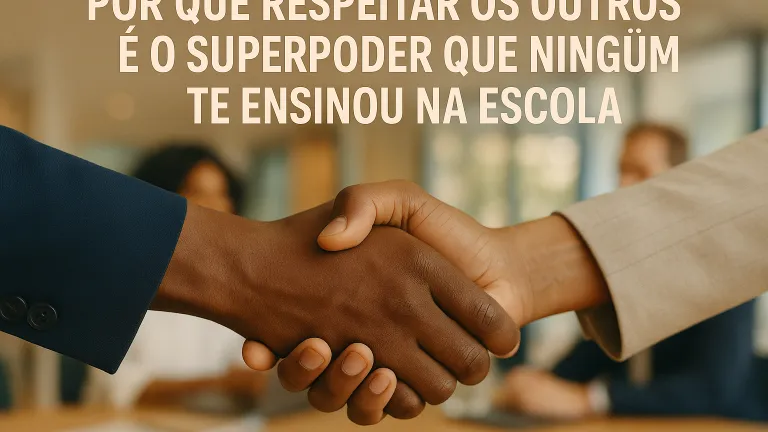
# Why Respecting Others is the Superpower You Weren’t Taught in School
We live in a society that values diplomas, certificates, and technical skills but forgets to teach something fundamental: genuine respect for others. While we learn math, history, and science, we rarely receive structured lessons on treating people with dignity, empathy, and consideration. However, this seemingly simple skill can be the most powerful differentiator in your personal and professional life.
Respect is not just about good manners or superficial social etiquette. It’s about recognizing the intrinsic value of every human being, regardless of their differences, opinions, or social standing. It’s about creating authentic connections that transform environments, relationships, and even entire communities. This article explores why respect is a true superpower and how cultivating it can radically change your life trajectory.
## The Educational Gap: What Schools Don’t Teach
The traditional educational system was primarily designed to prepare individuals for the job market, focusing on technical skills and academic knowledge. Math, languages, sciences, and technology dominate school curricula, while socio-emotional skills often take a backseat or are completely ignored.
This educational gap creates generations of technically competent professionals but emotionally unprepared to deal with human diversity. Many people reach adulthood without understanding basic concepts like active listening, non-violent communication, or the importance of validating others’ experiences.
The result? Toxic work environments, fragile relationships, social polarization, and an epidemic of loneliness even among billions of digitally connected people. The absence of education on mutual respect contributes to unnecessary conflicts that could be avoided with simple adjustments in how we relate.
Just as we need to understand the hidden treasures of the Earth to protect our planet, we need to discover the hidden treasures in human relationships to build a more harmonious society.
## Respect as a Foundation for Authentic Connections
In an increasingly digital and superficial world, authentic connections have become a rare and precious commodity. Respect is the foundation upon which these connections are built. Without it, relationships remain empty, transactional, and easily disposable.
When we genuinely respect someone, we communicate through our actions that this person matters, that their opinions have value, and that their existence enriches the world. This recognition creates a safe space where vulnerability can flourish, allowing honest conversations and deep bonds.
Authentic connections based on mutual respect generate measurable benefits. Studies show that people with meaningful relationships have better mental health, lower incidence of depression and anxiety, and even greater longevity. Therefore, respect is not just an abstract moral virtue but an essential component of human well-being.
Furthermore, respect allows differences to be celebrated rather than feared. When we approach others with genuine respect, we can learn from diverse perspectives, expanding our understanding of the world in ways impossible within homogeneous bubbles.
## The Impact of Respect in the Professional Environment
In the professional context, respect becomes a significant competitive advantage. Organizations with cultures based on mutual respect have higher talent retention, greater productivity, and better innovation capacity.
Employees who feel respected show greater engagement with their roles, willingness to go beyond their basic responsibilities, and loyalty to the organization. Conversely, disrespectful environments generate high turnover, internal conflicts, and a toxic atmosphere that stifles creativity.
Leaders who demonstrate genuine respect for their teams build trust, an intangible but extremely valuable asset. Teams that trust their leaders communicate more openly, admit mistakes without fear of retaliation, and collaborate more effectively towards common goals.
Respect is also crucial for effective networking. Professionals known for treating others with dignity and consideration build strong, lasting relationship networks. These networks often translate into career opportunities, strategic partnerships, and accelerated professional growth.
Interestingly, respect in the workplace functions similarly to natural ecosystems. Just as fascinating creatures in the animal kingdom depend on balance and interdependence to thrive, healthy professional environments require mutual respect to function optimally.
## Respect and Emotional Intelligence: A Powerful Connection
Emotional intelligence, a concept popularized by psychologist Daniel Goleman, refers to the ability to recognize, understand, and manage our own emotions and the emotions of others. Respect is both a component and a result of developed emotional intelligence.
People with high emotional intelligence naturally demonstrate more respect because they can perceive how their words and actions affect others. They practice active empathy, putting themselves in others’ shoes before judging or reacting hastily.
Conversely, consciously practicing respect also develops emotional intelligence. When we strive to treat others with dignity, even in challenging situations, we exercise emotional self-control, empathy, and social awareness.
This skill is particularly valuable in conflict contexts. Emotionally intelligent individuals can disagree respectfully, keeping the focus on ideas instead of attacking people. They understand that it is possible to hold strong convictions while acknowledging the humanity of those who think differently.
Research indicates that emotional intelligence often surpasses IQ as a predictor of professional success and personal satisfaction. Considering that respect is a tangible manifestation of emotional intelligence, cultivating it becomes a strategic investment in one’s future.
## Respect Across Cultural and Social Differences
In a globalized world, the ability to respect cultural, religious, and social differences has become essential. Respect transcends agreement; we can deeply respect someone whose beliefs radically differ from ours.
This form of respect requires intellectual humility — the recognition that our perspective, no matter how valuable, does not exhaust the entirety of human truth or experience. Different cultures have developed distinct solutions to universal challenges, and each offers unique insights.
Disrespect for cultural differences not only harms individual relationships but also perpetuates systems of oppression and inequality. When we fail to respect other cultures, we are essentially declaring that only our way of living holds value, a stance both arrogant and destructive.
However, respecting differences does not mean absolute moral relativism or absence of personal values. It means recognizing the inherent dignity of each person while maintaining honest conversations about complex ethical issues, always seeking points of convergence and mutual understanding.
Just as we must respect the diversity of fascinating creatures in the animal kingdom, each with its unique role in the ecosystem, we must value the human diversity that enriches our collective experience.
## Respect as a Tool for Social Transformation
Successful social movements often use respect as a strategic tool for transformation. Leaders like Mahatma Gandhi, Martin Luther King Jr., and Nelson Mandela demonstrated that it is possible to fight firmly against injustices while maintaining respect for the humanity even of oppressors.
This counterintuitive approach reveals a profound truth: disrespect, even when directed at perpetrators of injustices, often hardens positions and perpetuates cycles of violence. Respect, on the other hand, opens doors for dialogue, mutual humanization, and eventual reconciliation.
At the community level, cultures of mutual respect create environments where people feel safe to contribute, innovate, and express concerns. Respectful communities are more resilient in the face of crises, as trust bonds facilitate cooperation and mutual support.
Respect is also fundamental to healthy democracies. When citizens of different political positions maintain basic respect for each other, it becomes possible to have productive debates that strengthen institutions rather than destroy them. The extreme polarization we currently observe results, in large part, from the collapse of respect in public discourse.
Transforming societies requires transforming individuals. When each person takes responsibility for treating others with respect, a ripple effect is created that gradually changes the culture as a whole. Small acts of respect accumulate into significant social transformations.
## Practicing Respect: Concrete Strategies for Everyday Life
Recognizing the importance of respect is just the first step; incorporating it as a daily practice requires intention and conscious effort. Fortunately, there are concrete strategies that anyone can implement.
**Active listening** is fundamental. This means genuinely listening when others speak, without planning your response while the person is still talking. It involves asking clarifying questions, validating emotions, and demonstrating through body language that you are present and engaged.
**Non-violent communication**, developed by Marshall Rosenberg, offers a powerful framework. This approach emphasizes expressing observations instead of judgments, identifying feelings, articulating underlying needs, and making clear requests instead of demands.
**Practicing intentional empathy** means making a conscious effort to understand others’ experiences, especially those very different from your own. This can involve
