# Fascinating Creatures: Uncover the Astonishing Secrets of the Animal Kingdom
The animal kingdom is a universe full of mysteries, extraordinary adaptations, and behaviors that challenge our understanding. From the deepest oceans to the highest mountains, fascinating creatures inhabit every corner of our planet, developing unique abilities that ensure their survival in extreme environments. In this article, we will explore some of the most surprising secrets of the animal world, revealing how these remarkable species have evolved and adapted over millions of years.
Earth’s biodiversity is an invaluable treasure that deserves our admiration and protection. Understanding the peculiarities and special capabilities of animals not only broadens our scientific knowledge but also raises awareness about the importance of preserving these extraordinary beings and their natural habitats. As our ecological footprint directly impacts ecosystems, it is crucial to better understand the creatures that share this planet with us.
Masters of Camouflage: Animals That Disappear in Plain Sight
Camouflage is one of the most impressive survival strategies developed by nature. Many animals possess the extraordinary ability to become virtually invisible in their natural environments, either to protect themselves from predators or to ambush their prey with deadly efficiency.
The mimic octopus (Thaumoctopus mimicus) is considered one of the greatest masters of camouflage in the animal kingdom. This cephalopod mollusk, found in Southeast Asian waters, not only changes its color and texture to blend into the environment but is also capable of mimicking the shape and behavior of at least 15 different species, including sea snakes, lionfish, and jellyfish. Its transformation ability is so precise that it can deceive both predators and prey, demonstrating remarkable intelligence.
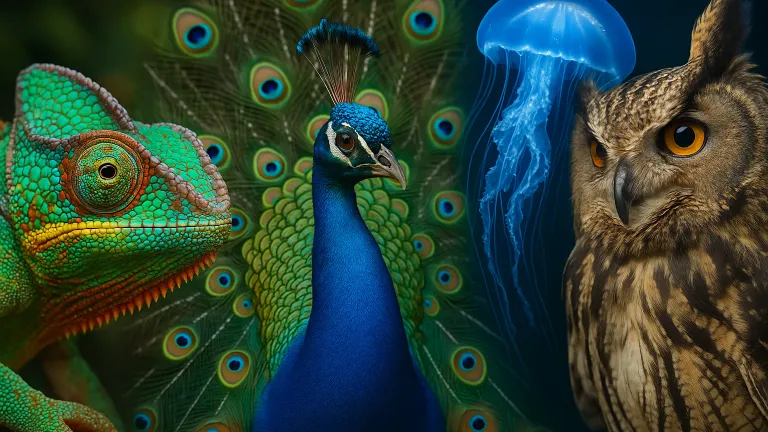
Another fascinating example is the chameleon, famous for its ability to change colors. Contrary to popular belief, chameleons do not change color solely for camouflage but also for social communication, temperature regulation, and expression of emotional states. Research from National Geographic reveals that this color change is possible due to specialized cells called chromatophores, which contain pigments and nanoscale crystals that reflect light in different ways.
The orchid mantis is another master of disguise worth highlighting. This insect, found in the tropical forests of Southeast Asia, perfectly mimics an orchid flower, deceiving both predators and unsuspecting pollinating insects. Its pink and white coloration, combined with its adapted body shape, creates such a convincing illusion that even human observers may have difficulty distinguishing it from a real flower.
Real Superpowers: Abilities Beyond Imagination
Some animals possess abilities that seem straight out of science fiction stories but are entirely real and the result of millions of years of adaptive evolution.
The axolotl, also known as the Mexican salamander, has a regenerative ability that fascinates scientists worldwide. This aquatic creature can regenerate not only lost limbs but also parts of the heart, brain, and spinal cord without forming scar tissue. Researchers from Science Magazine intensely study the axolotl in hopes of uncovering the secrets of its regeneration and applying them to human medicine.
The pistol shrimp (Alpheidae) holds a truly explosive superpower. With its specialized claw, this small crustacean can snap shut so quickly that it creates a cavitation bubble that, upon imploding, generates a deafening sound of over 200 decibels and temperatures that can reach approximately 4,700°C for a fraction of a second – hotter than the surface of the sun. This explosion is enough to stun or kill small fish, making the pistol shrimp one of the most efficient predators in the oceans.
Sea turtles possess an extraordinary navigation ability that has intrigued scientists for decades. These marine reptiles can travel thousands of kilometers across the oceans and return with impressive precision to the same beach where they were born to lay eggs. Studies suggest they use the Earth’s magnetic field as a natural GPS, along with other environmental cues such as ocean currents and even specific chemical odors for orientation.
Animal Communication: Nature’s Secret Languages
Communication in the animal kingdom goes far beyond the sounds we can hear. Many species have developed complex systems of signals, gestures, and even chemical languages to convey vital information.
Dolphins are known for their remarkable intelligence and sophisticated communicative abilities. Research reveals that each dolphin develops a unique “signature whistle,” essentially functioning as a personal name. They use these whistles to identify and call each other, demonstrating self-awareness and individual recognition. Additionally, dolphins convey complex information through a combination of clicks, whistles, and body language, forming a communication system comparable in complexity to some primitive human languages.
Bees perform one of the most fascinating forms of communication in the animal world: the bee dance. When a scout bee finds an abundant nectar source, it returns to the hive and performs an elaborate dance known as the “waggle dance” to inform other bees of the exact location of the flowers. The angle of the dance relative to the sun indicates direction, while the duration and intensity of the movements communicate distance. This symbolic communication system demonstrates a surprising level of cognition and social organization.
Elephants communicate through infrasonic sounds – frequencies so low that they are beyond human hearing capability. These sounds can travel kilometers through the ground and air, allowing separated herds to maintain contact even over great distances. Elephants also demonstrate complex emotions, mourning, and exceptional memory, remembering other individuals and locations for decades.
Extreme Adaptations: Surviving the Impossible
Life on Earth exists in the most extreme environments imaginable, and some creatures have developed extraordinary adaptations to thrive where others could not survive.
The water bear, or tardigrade, is often called the most resilient animal on Earth. This micro-animal, measuring less than a millimeter, can survive conditions that would kill almost any other known form of life. Tardigrades can withstand temperatures close to absolute zero (-273°C) and as high as 150°C, endure pressures six times greater than those found in the deepest ocean trenches, survive ionizing radiation in doses hundreds of times lethal to humans, and even survive in the vacuum of space. They achieve this resilience through a process called cryptobiosis, where they completely dehydrate their bodies and enter a state of suspended animation that can last decades.
The Antarctic icefish has developed a unique adaptation to survive in the freezing waters of Antarctica: its blood contains antifreeze proteins that prevent ice crystal formation in its bodily fluids. Surprisingly, these fish lack red hemoglobin in their blood, making them the only known vertebrates without this vital component. Instead, they absorb oxygen directly through their skin and transport dissolved oxygen in the blood plasma.
The camel is emblematic of adaptations to the extreme heat of deserts. These remarkable creatures can go weeks without water, losing up to 40% of their body weight through dehydration without severe effects. Their humps store fat (not water, as many believe) that can be metabolized to produce water and energy. Additionally, they have nostrils that can close completely to block sandstorms, double eyelashes to protect their eyes, and wide feet that act like “snowshoes” to prevent sinking into the sand.
Animal Intelligence: Brilliant Minds Beyond the Human
Animal intelligence is a fascinating field of study that continues to reveal surprising cognitive abilities in various species.
Crows and their related species (corvids) are considered among the most intelligent birds on the planet. Studies have shown that crows can solve complex puzzles, use tools creatively, plan for the future, and even hold grudges against specific individuals for years. In a remarkable experiment, crows were able to solve an eight-step puzzle that required sequential planning – a cognitive ability comparable to that of seven-year-old human children.
Octopuses represent a form of intelligence entirely different from ours. With two-thirds of their neurons distributed in their tentacles rather than in the central brain, these mollusks possess a decentralized form of cognition. Octopuses demonstrate remarkable problem-solving skills, observational learning, and even distinct personalities. There are records of octopuses in aquariums learning to open complex containers, recognize individual human faces, and even disassemble underwater equipment out of apparent curiosity.
African grey parrots exhibit impressive linguistic capabilities. The famous Alex, an African grey parrot studied by Dr. Irene Pepperberg for 30 years, could identify more than 50 different objects, seven colors, five shapes, quantities up to six, and understand abstract concepts such as “bigger,” “smaller,” “same,” and “different.” This research revolutionized our understanding of avian cognition and interspecies communication.
Symbiotic Relationships: Unlikely Partnerships in Nature
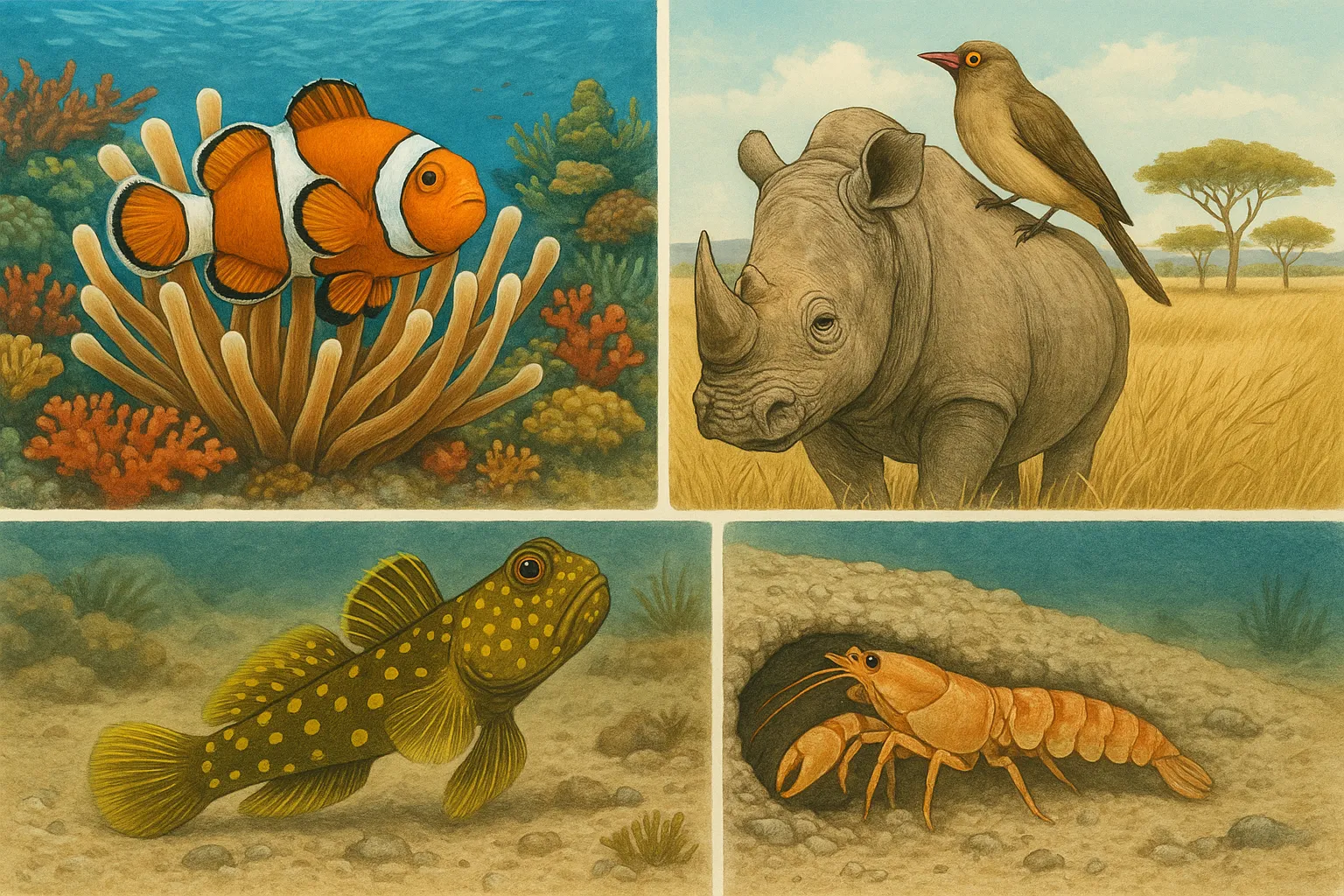
Nature is full of fascinating collaborative relationships where two or more different species work together for mutual benefit.
The relationship
