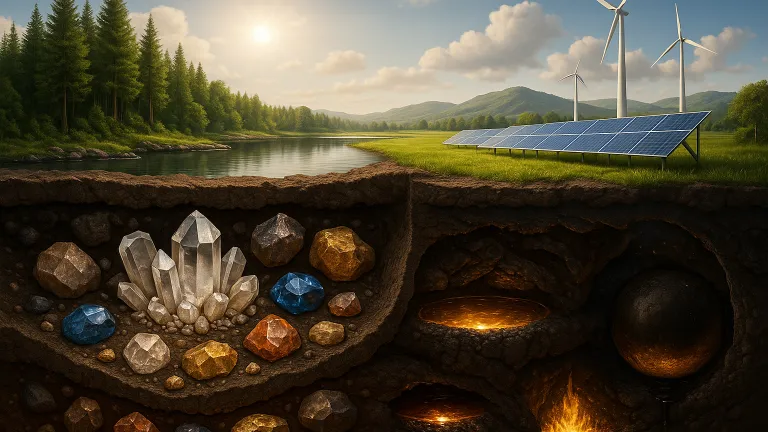
# Hidden Treasures of the Earth: How Natural Resources Shape Our Future
## Introduction
Since the dawn of human civilization, our relationship with natural resources has defined not only our survival but also our economic, technological, and social development. The hidden treasures of the Earth — from precious minerals buried deep underground to vast reserves of freshwater, lush forests, and fossil fuels — represent the fundamental foundation upon which we have built our modern society. As the global population surpasses 8 billion and the demand for resources continues to grow exponentially, it becomes increasingly crucial to understand how these natural resources shape our present and will determine our collective future.
This article explores the diversity of natural resources available on our planet, examines how they have been utilized throughout history, analyzes contemporary challenges related to their extraction and management, and discusses future prospects for more sustainable use of these precious terrestrial treasures. Understanding this complex dynamic is essential for anyone interested in the environmental, economic, and social issues that will define the coming decades.
## Classification of Natural Resources: Renewable and Non-Renewable
Natural resources can be classified into two main categories that determine how we should manage them: renewable and non-renewable resources. This fundamental distinction directly affects global strategies for exploration, conservation, and economic planning.
**Renewable resources** are those that regenerate naturally on human timescales. They include solar, wind, and hydro energy, as well as forests, fauna, fertile soil, and water resources. When properly managed, these resources can provide continuous benefits without depletion. For example, a sustainably managed forest can provide timber, regulate the climate, protect the soil, and harbor biodiversity indefinitely.
**Non-renewable resources**, on the other hand, exist in finite quantities and form over millions of years. Fossil fuels such as oil, coal, and natural gas, as well as metallic minerals (gold, silver, copper, iron) and non-metallic minerals (diamonds, phosphates, salt), belong to this category. Once extracted and used, these resources cannot be replenished on timescales relevant to humanity, making their management a critical long-term sustainability issue.
According to the United Nations, the extraction and use of fossil fuels are responsible for more than 75% of global greenhouse gas emissions, highlighting how our dependence on non-renewable resources has profound environmental consequences that will shape the planet’s future climate.
## Water: Humanity’s Most Precious Resource
Although three-quarters of the Earth’s surface is covered by water, only 2.5% of it is freshwater, and most of it is frozen in glaciers or inaccessible in deep aquifers. Accessible freshwater represents less than 1% of all the water on the planet, making it one of the most valuable and contested resources today.
Agriculture consumes approximately 70% of all freshwater used globally, followed by industry (20%) and domestic use (10%). With population growth and the expansion of emerging economies, the demand for water continues to rise, while climate change alters precipitation patterns, making some regions drier and others more prone to flooding.
Water scarcity already affects more than 2 billion people worldwide, according to World Health Organization data. Regions such as the Middle East, North Africa, and parts of Asia face severe water stress, contributing to political conflicts and forced migration. Sustainable water resource management, including desalination technologies, water recycling, and efficient irrigation, will be crucial to ensuring food security and geopolitical stability in the coming decades.
## Minerals and Metals: The Foundation of Technological Civilization
From the Bronze Age to the digital era, minerals and metals have been fundamental to human progress. Today, our technological society depends more than ever on a vast array of elements from the periodic table. Smartphones, computers, electric vehicles, wind turbines, and solar panels require dozens of different minerals, including rare earth elements such as neodymium, lithium, and cobalt.
Lithium, essential for electric vehicle batteries, has become so strategic that it is often called “white gold.” Global demand for lithium has increased by more than 300% in the last decade, driven by the energy transition. Countries like Chile, Australia, and China control most of the global reserves and production, creating new geopolitical dynamics similar to those historically surrounding oil.
However, mineral extraction presents significant environmental challenges. Mining can cause deforestation, river and soil pollution, habitat destruction, and greenhouse gas emissions. Additionally, many mining operations are associated with human rights violations, child labor, and conflicts in regions such as the Democratic Republic of the Congo, where essential minerals for electronics are extracted.
The circular economy, which emphasizes recycling and material reuse, emerges as a partial solution. It is estimated that only 1% of rare earth elements are currently recycled, indicating a huge potential to reduce dependence on virgin mining through better electronic waste collection and processing systems.
## Forests: More Than Just Wood
Forests cover approximately 31% of the Earth’s surface and represent much more than a source of wood. They are complex ecosystems that provide invaluable environmental services: they regulate the global climate by absorbing carbon, produce oxygen, protect soils from erosion, regulate the hydrological cycle, and harbor about 80% of terrestrial biodiversity.
The Amazon Rainforest, often called the “lungs of the planet,” stores approximately 150-200 billion tons of carbon. Its preservation is crucial not only for Brazil and neighboring countries but for global climate stabilization. Unfortunately, deforestation continues at an alarming rate, with more than 10 million hectares of forest lost annually worldwide, according to data from the Food and Agriculture Organization of the United Nations (FAO).
Forests also provide direct livelihoods for more than 1.6 billion people, including indigenous communities whose traditional knowledge of sustainable forest management is increasingly recognized as essential for conservation. The unique biodiversity of tropical forests, in particular, represents a treasure trove of potential medicines, foods, and materials yet to be discovered.
## Fossil Fuels: The Era of Transition
For over a century, fossil fuels — oil, coal, and natural gas — have been the backbone of the global economy, powering industrialization, transportation, and energy generation. It is estimated that 84% of the world’s primary energy still comes from fossil sources, despite growing efforts to transition to renewable energies.
Oil, in particular, has transformed not only the energy sector but also the chemical industry, providing raw materials for plastics, fertilizers, medicines, and countless other products. The economies of oil-producing countries, especially in the Middle East, have been fundamentally shaped by this resource, creating vast wealth but also problematic economic dependencies.
However, the era of fossil fuels faces a turning point. Scientific evidence on climate change, widely documented by the Intergovernmental Panel on Climate Change (IPCC), has made it clear that continued intensive use of fossil fuels is incompatible with a stable climate. The concept of “stranded assets” — fossil fuel reserves that may become economically unviable as climate policies strengthen — is reshaping the calculations of investors and governments.
The energy transition to renewable sources like solar and wind is accelerating but presents its own challenges. The global energy infrastructure has been built around fossil fuels over decades, and transforming it requires massive investments, technological innovation, and sustained political will.
## Soil: The Invisible Foundation of Food Security
Often underestimated, fertile soil is a critical natural resource that sustains agriculture and, by extension, human civilization. Only about 11% of the Earth’s surface is suitable for cultivation, and this limited portion must feed a growing population while facing pressures from degradation, erosion, salinization, and urbanization.
The formation of just 2.5 centimeters of fertile soil can take up to 500 years, making it effectively a non-renewable resource on human timescales. Intensive agricultural practices, which heavily rely on chemical fertilizers and monoculture, have degraded soils worldwide, reducing their natural fertility and capacity to retain water and carbon.
It is estimated that one-third of global soils are already degraded, threatening future food security. Agroecology, which integrates ecological principles into agriculture, and practices such as crop rotation, no-till farming, and cover cropping, emerge as alternatives that can regenerate soil health and ensure sustainable food production.
