The water bill you could pay much less on
Imagine heavy rain falling all afternoon in your neighborhood. All that water runs off the roof, falls into the yard, goes down the drain and disappears. The next day, you turn on the tap to wash the car, water the plants or flush the toilet, and you’re paying for treated water from the utility company as if yesterday’s rain never existed. It seems wasteful, and it is.
Rainwater harvesting is one of the oldest and most direct ways to reduce potable water consumption without sacrificing comfort. It’s not cutting-edge technology nor does it require expensive renovations: any house with a roof and gutters already has the basic structure to get started. By the end of reading this article, you’ll understand how the system works, what you need to buy, how much it costs to set up a simple system, and which uses are safe without any additional treatment.
Brazil is fortunate in this regard. According to the National Institute of Meteorology (Inmet), the country’s average annual precipitation is around 1,700 millimeters, well above the global average. Even drier regions like the semi-arid Northeast have established public programs, such as the Cistern Program (One Million Cisterns Program). In other words, capturing rainwater isn’t exotic: it’s taking advantage of what nature already delivers.
Why it makes sense to capture rainwater in Brazil today
Water supply in Brazil faces real pressure. The IBGE indicates that a significant portion of Brazilian municipalities experienced water scarcity situations in the last decade, and IPCC projections indicate that extreme climate events, including prolonged droughts and concentrated rainfall, are expected to intensify in the coming decades.
From a financial perspective, the logic is also straightforward. Water rates charged by utilities vary by state and consumption level. Those who use more pay a higher progressive tariff per cubic meter. Replacing part of consumption with captured rainwater reduces the billed volume, especially for those with gardens, vegetable plots or swimming pools.
Another point that few people consider is the quality of rainwater for specific uses. It is naturally soft, with very low mineral concentration, making it excellent for watering plants. Plants irrigated with highly calcareous water can have hardened soil over time. Anyone with a vegetable garden in an apartment or garden bed at home already has a practical and immediate reason to start capturing.
How the rainwater harvesting system works in practice
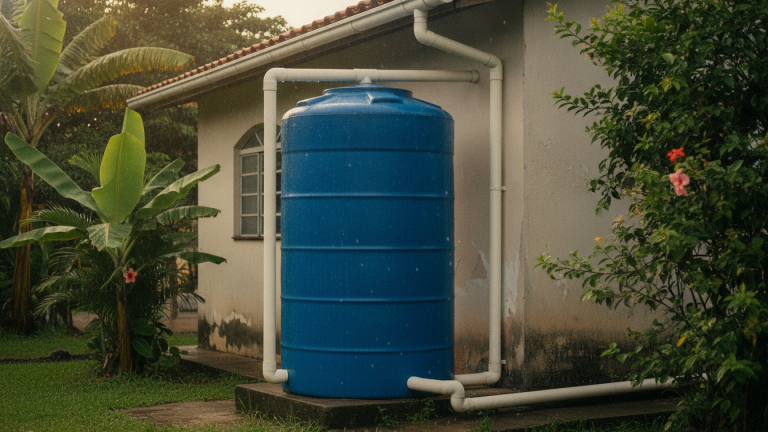
The operation is simple once you understand the components. Water falls on the roof, runs through the gutters, descends through the vertical conductor (the pipe that goes from the roof to the ground) and, instead of going directly to the soil or street, is diverted to a reservoir. From that reservoir, water can be withdrawn manually with a bucket or pumped to a point of use.
Domestic systems have basically four main components:
- Collection area: the roof. The larger and less porous, the better. Fiber cement, ceramic, metal or PVC tiles work well.
- Gutters and downspouts: gutters collect water from the roof; downspouts carry it to the reservoir. They need to be clean and free of accumulated leaves.
- First flush diverter device: the first rain washes the roof and carries dust, bird droppings and debris. A simple diverter automatically discards the first liters before directing water to the reservoir.
- Reservoir: can be a common water tank, a plastic barrel, a polyethylene cistern or a buried concrete cistern. Size depends on intended use.
What is the first flush diverter and why does it matter
The first flush diverter is the component most people forget when setting up the system, and it’s one of the most important. It works as a diversion: when it starts raining, the first liters of water, which drag everything that was on the roof, are directed to a side pipe that fills and closes automatically. After that pipe fills, the following water, already cleaner, goes to the reservoir.
A practical rule used by technicians is to discard about 1 liter per square meter of roof in the first minutes of rain. For a 50 m² roof, that means discarding the first 50 liters. You can buy ready-made diverters at building supply stores or assemble one with a 100 mm PVC pipe.
Step-by-step guide to set up a basic system at home
This setup is suitable for non-potable use: watering plants, washing sidewalks, supplying toilets or washing external-use clothes. The cost varies by region and the capacity of the chosen reservoir.
Materials needed:
- Installed gutters (or check if existing ones are in good condition)
- 100 mm PVC pipe for downspout
- First flush diverter (or parts to assemble: pipe, cap and adapter)
- Reservoir (water tank from 500 to 1,000 liters to start)
- Outlet tap and valve for control
Step-by-step:
- Inspect and clean existing gutters. Remove leaves, soil and any obstruction.
- Identify the vertical downspout that receives the most water. It will be the collection point.
- Install the first flush diverter about 1.5 meters from the ground on the downspout. The diverter diverts water to a closed pipe that fills and automatically stops the diversion.
- Connect the clean outlet of the diverter to a pipe leading to the reservoir. Use a fine screen at the reservoir entrance to prevent insects and smaller leaves.
- Position the reservoir in a shaded location. Direct sunlight heats the water and favors algae growth.
- Install a tap at the bottom of the reservoir for water withdrawal and a valve at the top for easy cleaning.
- Completely cover the reservoir to prevent mosquito entry, especially Aedes aegypti.
- After the first rains, inspect all connections and verify that the diverter is working correctly.
Estimated installation time: a weekend for those with basic plumbing skills. Or a day’s work for a plumber.
Approximate reference cost: a simple system with a 500-liter reservoir, diverter and connections ranges from R$400 to R$900 depending on the region and materials chosen. Larger cisterns and systems with hydraulic pumps have higher costs.
Safe uses and uses requiring caution
Rainwater captured without treatment is not recommended for direct human consumption, food preparation or teeth brushing. This doesn’t limit its usefulness much, because a large part of household consumption goes to purposes that don’t require potable water.
Safe uses without treatment:
- Watering gardens, vegetable plots and pots
- Washing sidewalks, patios and cars
- Flushing toilets
- Washing garden tools and equipment
- Washing heavy-duty clothes (floor cloths, external rugs)
Uses requiring additional treatment:
- Direct human consumption (drinking, cooking)
- Personal hygiene of mucous membranes
- Irrigation of vegetables consumed raw directly from the soil
For those who want to use captured water for potable purposes, it’s necessary to include filtration with activated carbon filter, disinfection with chlorine or UV light and, ideally, periodic laboratory water analysis. This level of system is more complex and expensive, but it exists and is used in rural communities and some properties away from the public network.
Common mistakes that compromise the system
The biggest mistake is setting up the reservoir without a proper lid. An open or poorly sealed water tank becomes a mosquito breeding ground in just days. Funasa and the Ministry of Health make this clear in their materials on water storage.
Another common mistake is not installing the first flush diverter. Water going straight from the roof to the reservoir without this initial filter carries contaminants that accelerate biofilm growth on the reservoir wall.
Neglecting periodic cleaning is also a problem. The reservoir should be emptied and washed at least twice a year, or whenever it sits unused for more than 30 days. Sediments accumulate at the bottom and can compromise water quality even for external uses.
Finally, many people underestimate the gutter as a critical point. A clogged or improperly sloped gutter wastes a good portion of the harvest before water reaches the system.
Brazilian legislation and what you need to know
In Brazil, there is no federal law requiring the use of rainwater harvesting in residences, but several states and municipalities have their own legislation encouraging or even requiring the system in new construction. São Paulo, for example, has already had bills in this direction applied to large buildings.
The technical standard ABNT NBR 15527 establishes requirements for rainwater harvesting in urban areas for non-potable purposes. It defines quality parameters, reservoir sizing and system care. It’s not mandatory for simple home use, but serves as a reliable reference for those wanting to set up something more structured.
From the perspective of food safety and health, it’s worth combining this practice with other conscious habits at home. Just as properly storing food at home prevents waste and saves money, using captured water for the vegetable garden reduces production costs and public network consumption at the same time.
Frequently asked questions about rainwater harvesting
Can I use rainwater to wash dishes?
It’s not recommended without prior treatment. Water captured from the roof may contain bacteria, dust particles and other contaminants that aren’t eliminated without filtration and disinfection. For uses in contact with food and utensils, stick with treated water from the utility company.
How long can water be stored in the reservoir?
Ideally, use the water within 30 days of capture. After that period, even in a closed reservoir, there’s risk of bacterial growth. If the reservoir sits longer, empty it, clean it and wait for the next rain before using it again.
I live in an apartment. Can I capture rainwater?
It depends on the type of property and condo rules. In apartments with a balcony or terrace, it’s possible to install small collectors connected to buckets or barrels to capture local rainwater, enough to water plants. Capturing from the building’s roof requires condo approval and, generally, a specific project.
Does the system require constant maintenance?
Maintenance is simple and periodic. Clean gutters every three months, check the first flush diverter every six months and wash the reservoir at least twice a year. In total, it takes just a few hours of attention per year to keep the system running well.
A good start for this week
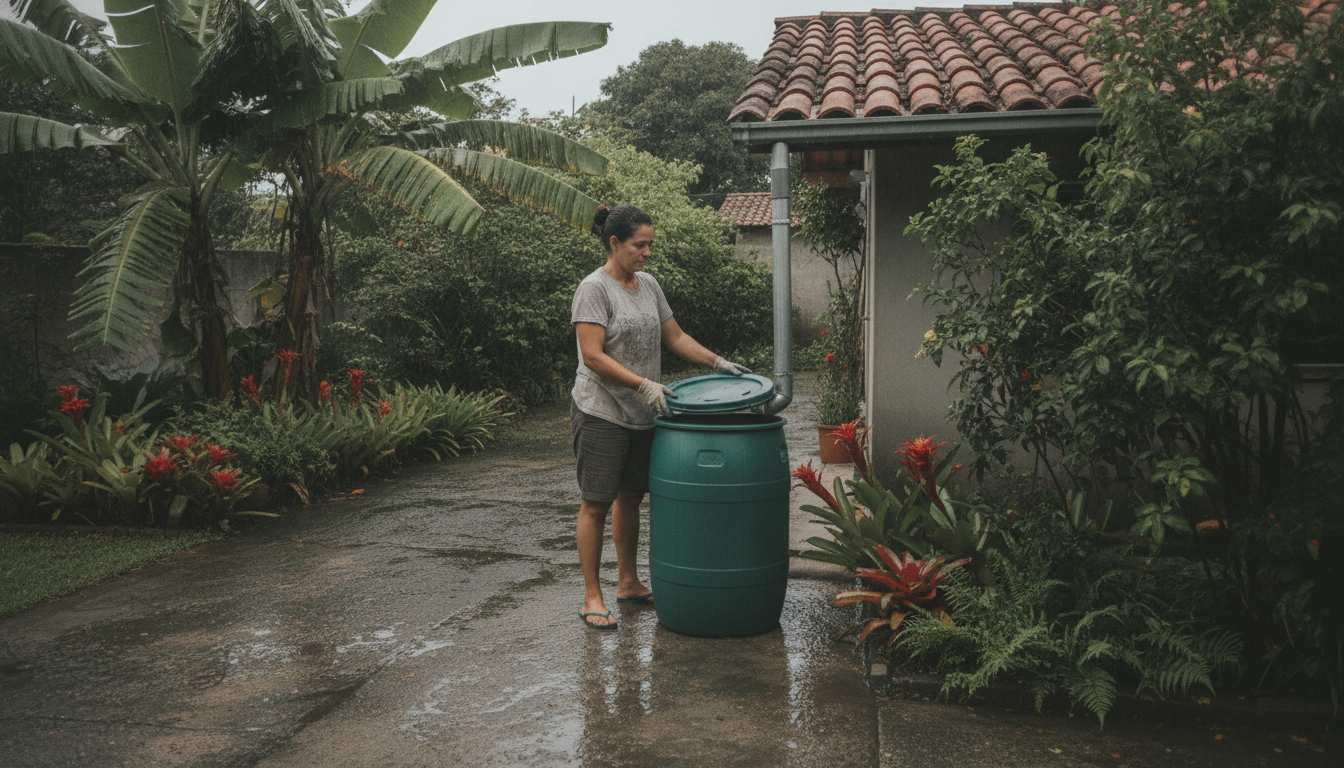
If you have a garden, a vegetable plot or even a few pots at home, you don’t need to wait for the complete system to get started. Place a bucket under the gutter during the next heavy rain, observe how much volume you collect in an afternoon and multiply that by the weeks of the year. This simple exercise already shows the potential that exists in your roof.
The next step is to install a covered reservoir and a basic diverter. With that, you already have a functional system. From there, it’s just using the water where it makes the most sense for your routine and tracking the difference in your bill at month’s end.
