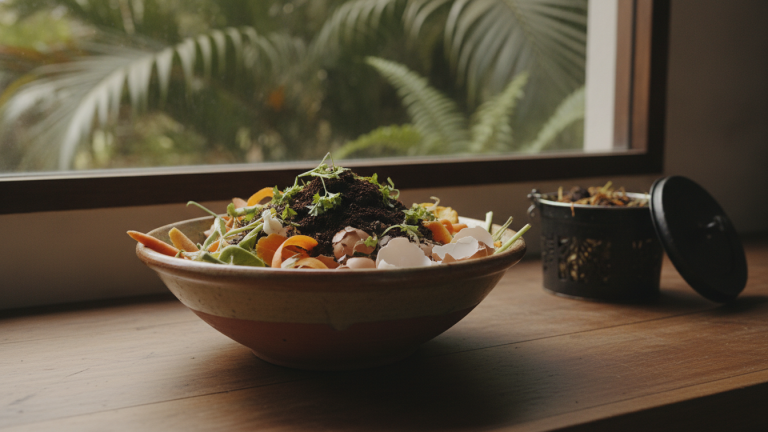
What you throw away in the kitchen might be costing you more than you think
Think about the trash you generate during a typical week of cooking: banana peels, coffee grounds, kale stems, leftover rice, the end of bread no one wanted. It seems like little, but according to Abrelpe data, organic waste represents more than half of everything that goes to Brazilian sanitary landfills. This means that most of what we discard could have another destination, and in most cities it still goes straight to the landfill, losing all the value it could have.
The good news is that reducing organic waste in your kitchen doesn’t require renovation, doesn’t need enormous space, and fits into any routine, whether you live in an apartment in downtown São Paulo or a house with a backyard in the interior of Paraná. By the end of this text, you’ll know exactly where to start, which mistakes to avoid, and how to transform kitchen leftovers into something useful, or at least into much less trash.
Why organic waste deserves special attention
When carrot peel or pasta scraps go to the sanitary landfill, it doesn’t disappear in a neutral way. Buried with plastic, paper, and other materials, organic material decomposes without oxygen and produces methane, a gas with global warming potential much higher than carbon dioxide, as highlighted by the IPCC in its assessment reports. In Brazil, the decomposition of waste in landfills is one of the sources of greenhouse gas emissions mapped by the Ministry of Environment.
Law 12.305/2010, known as the National Solid Waste Policy (PNRS), already provided for the separation of organic materials and composting as priority strategies for municipalities. In practice, however, most Brazilian cities still don’t offer structured selective collection for organic waste. That is, much of the solution needs to come from the citizen themselves.
This isn’t a criticism, it’s an opportunity. When you act in the kitchen before trash exists, you reduce volume, eliminate odors in the bin, use fewer trash bags, and can still transform leftovers into fertilizer or useful input. The gain is immediate and goes beyond the environment.
What really is organic waste in the kitchen
Before acting, it helps to know exactly what we’re dealing with. Organic waste is any material of animal or plant origin that can be decomposed by microorganisms. In a typical Brazilian kitchen, this includes:
- Fruit and vegetable peels (banana, orange, potato, onion)
- Coffee grounds and tea bags
- Eggshells
- Stems, leaves, and tips of greens
- Leftovers of ready-made food (rice, beans, pasta)
- Scraps of meat, fish, and chicken
- Stale bread and other expired food
- Paper towels used with food scraps
What doesn’t fall into this category but tends to mix with kitchen trash: plastic packaging, aluminum foil, glass jars of sauce, cans. These need different disposal, through selective collection in your neighborhood.
Reduce before discarding: the most efficient step
The hierarchy of any waste management starts with prevention. Before thinking about composting or recycling, it’s worth asking: did this waste really need to exist?
A significant portion of domestic organic waste comes from food purchased but not consumed. The IBGE has already pointed out in family budget surveys that food waste weighs on Brazilian families’ wallets. Buying more than you use, letting vegetables wilt in the fridge, not using stems and peels are habits that generate trash that simply didn’t need to exist.
Some practical changes that work in everyday life:
- Make a shopping list before going to the market or farmers market, and stick to it
- Store each food the right way: carrots go in the bottom drawer of the fridge, bananas don’t go in the fridge, herbs stay in a cup of water
- Plan meals for the week in advance, even if simply
- Put what needs to be consumed first at the front of the fridge
- Learn to use what usually goes in the trash: broccoli stems become a stir-fry, banana peels can be used in recipes, coffee grounds serve as a scrub or fertilizer
This set of simple attitudes reduces the volume of organics before any other measure.
How to compost at home, even without a yard
Composting is the process of transforming organic waste into fertilizer through the action of microorganisms, worms, and fungi. It can be done in an apartment with a worm bin, which is a compact composter with California worms.
Here’s how to start from scratch:
- Choose the container: a store-bought composter, or one made from stacked plastic buckets with holes. The cost varies, but DIY solutions can run for less than R$ 50.
- Get the worms: California worms (Eisenia fetida) are the most recommended. You can find them at urban gardens, trade groups on social networks, or at specialty stores.
- Build the layers: place an initial bed of soil or dry material (shredded leaves, torn cardboard). Add organics in thin layers.
- Alternate wet and dry: each time you add food scraps, cover with a layer of dry material to balance moisture and prevent odors.
- Avoid meat and dairy at first: for beginners, it’s safer to work only with fruits, vegetables, and coffee grounds. Meat requires more careful handling.
- Wait and harvest: within weeks, the worms produce humus, a dark and rich fertilizer. Use it on houseplants or donate it to a community garden.
The process may seem intimidating, but after two weeks of practice it becomes routine. Besides learning how to make organic fertilizer at home and reduce waste, you also save money on buying fertilizer for plants.
Common mistakes that hinder beginners
Much abandonment happens due to problems that have simple solutions. Knowing the most frequent mistakes helps you not give up in the first week.
Bad odor almost always indicates excess wet material without dry cover. The solution is to add more shredded cardboard, leaves, or sawdust on top of the scraps.
Flies and mosquitoes appear when organics are exposed. Burying the scraps in the bottom layer and keeping the lid tightly closed solves the problem in a few days.
Composter too wet soaks the worms and impairs decomposition. Tilting the container slightly and checking if the drainage holes are unobstructed helps a lot.
Dumping everything at once overloads the system. The ideal is to feed the composter in small quantities, several times a week.
Another alternative for apartment dwellers without interest in a composter is to find the nearest organic waste voluntary drop-off point. Many city halls and farmers markets already provide these points, and you just need to keep the organics in a closed container in the fridge until the day you take them.
Integral use: getting more out of each food
Before any discard, there’s reuse. The concept of integral food use is simple: use parts that normally go in the trash as part of cooking.
Some concrete examples for everyday Brazilian life:
- Pineapple peel: fermented with water and sugar becomes homemade vinegar or probiotic ferment
- Kale and spinach stems: sautéed with garlic taste similar to the leaf
- Chayote tip and peel: works well in soups and broths
- Orange and lemon peel: can be used in recipe zest, homemade multi-purpose cleaning, or to scent spaces
- Coffee grounds: serve as fertilizer directly in plant pots or as a natural scrub
These swaps don’t require complicated recipes. Sometimes it’s just not throwing away what you already have. And the less you discard, the more you save at the market the following week.
Frequently asked questions about organic waste in the kitchen
Can I store organics in the fridge before composting?
Yes, and that’s one of the best strategies for those who don’t want trash accumulating on the counter. A closed container in the freezer or fridge keeps scraps odor-free for several days. When full, you take them to the composter or a voluntary drop-off point.
Can eggshells go in the composter?
Yes, and they’re welcome. Eggshells take longer to decompose but contribute calcium to the final compost. If you want to speed up the process, just crush the shell before adding it.
What to do with meat and fish scraps if I don’t have a composter?
Without a proper composter, the most practical approach is to wrap well in paper and take with regular trash to prevent odors. Some Brazilian municipalities are implementing specific collection for organic waste, so it’s worth checking if your neighborhood already offers this option.
Does a small apartment have space for composting?
Yes, it does. A worm bin fits under the sink or in a corner of the balcony. Compact models are designed for urban environments and don’t produce odor when properly managed. Many studio dwellers in Brazilian capitals have already adopted this practice successfully.
A small step that makes a real difference
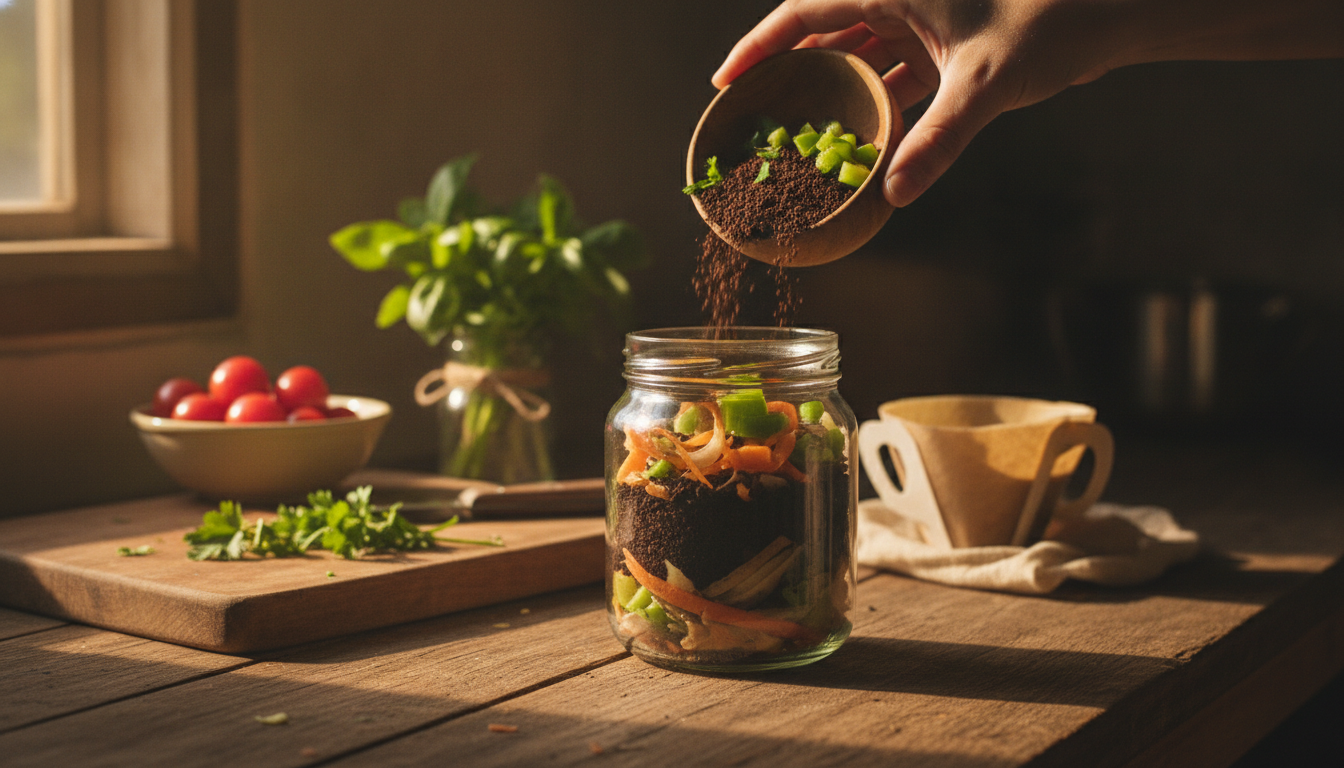
You don’t need to transform your kitchen all at once. Start with a single change this week: set aside a small container to keep coffee grounds and eggshells, and use them in your houseplants. That’s already organic waste that stops going to the landfill.
When that becomes a habit, you move on to the next step. Just as preserving the environment starts with simple and effective actions, reducing organic waste from your kitchen is a path you build gradually, without guilt and with real gains for your wallet, your home, and the planet.
