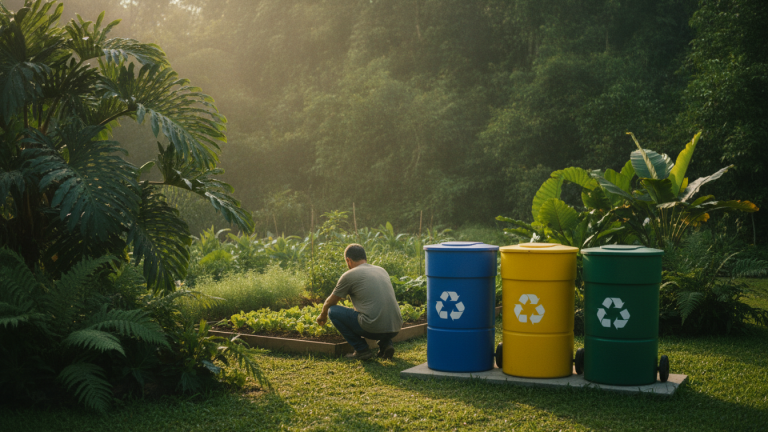
Have you ever stopped to think about how much trash your house produces in a week? A typical Brazilian family generates, on average, more than two kilos of waste per day, according to Abrelpe data. Multiplied by months and years, that volume is impressive, and most of it still ends up in landfills or dumps, with no use at all.
The good news is that preserving the environment doesn’t require you to change everything overnight, give up comfort, or spend a fortune. Small daily decisions, made consistently, build real impact. By the time you finish reading this article, you’ll have a practical set of actions to apply to your routine, from the kitchen to your electricity bill, without needing technical jargon or a second income to get started.
The secret is in the combination: each habit reinforces the other. Those who reduce food waste also produce less trash. Those who save water at the tap also relieve the sanitation system. Everything connects, and you’re already part of this chain.
Why your daily life matters to the planet
Brazil holds a unique position in the global environment. The country is home to the world’s largest tropical forest and holds a huge share of global biodiversity, according to the IUCN. At the same time, it faces serious challenges: deforestation in the Cerrado and the Amazon, growing solid waste generation, and intense water consumption in regions already living under water stress.
According to the IPCC, climate change already affects rainfall patterns, agricultural harvests, and the frequency of extreme events like droughts and floods—something that residents of the Southeast and Northeast are already beginning to feel in their pockets and daily lives. This isn’t alarmism; it’s verifiable reality in the panel’s latest reports.
The central point is that individual behavior, added to that of millions of Brazilians, carries weight. It’s not naïve to believe this: it’s what decades of studies on consumption changes and their consequences on entire production chains show. When demand for products without plastic packaging grows, industry responds.
How to reduce the trash you produce at home
Brazil has advanced waste legislation: the National Solid Waste Policy, established by Law 12.305/2010, provides for shared responsibility among manufacturers, distributors, merchants, and consumers. In practice, this means you have both the right and the responsibility to dispose of waste correctly.
Separate before throwing away
Selective collection exists in many Brazilian municipalities, but adoption is still low. Before anything else, find out if your neighborhood has selective collection and on which days it passes. Basic separation is simple:
- Dry recyclables: paper, cardboard, plastic, glass, and metal, clean and dry
- Organic waste: food scraps, fruit and vegetable peels
- Rejects: what has no use, like used toilet paper and foam
Do composting even in an apartment
Those who live in an apartment tend to think composting is impossible, but it’s not. There are compact countertop composters that turn organic scraps into fertilizer in a few weeks, without smell and without mess, as long as they’re maintained correctly. If you have a garden or potted plants, the result is high-quality free fertilizer. For a detailed step-by-step guide on how to set up and maintain this process, the guide on how to make organic fertilizer at home and reduce waste explains everything with simple materials and nearly zero cost.
Water: the resource we waste without noticing
Brazil is one of the countries with the greatest availability of fresh water in the world, according to IBGE and Ministry of Environment data. Paradoxically, regions like the Northeastern semiarid and parts of the interior of São Paulo face real scarcity. This happens because distribution is unequal and waste in urban systems is huge.
In your home, the most common losses happen in predictable places:
- Tap running while brushing teeth or washing dishes
- Showers with prolonged heating before entering
- Leaks in taps and sanitary valves that “drip” all day
- Washing machines used with incomplete loads
A small leak, that trickle of water that seems harmless, can waste hundreds of liters per month. Checking and replacing a tap washer costs less than ten reais and takes less than twenty minutes, even for those who’ve never held a wrench.
Step-by-step to reduce water consumption
- Close the tap while brushing teeth and applying shampoo
- Install an aerator on the kitchen sink tap: the device costs around fifteen reais and reduces flow without loss of pressure
- Reuse the rinse water from laundry to wash the yard or sidewalk
- Check the water tank every six months and verify there are no leaks in the float
Electricity: real savings on your electric bill
Brazil’s electricity matrix is predominantly renewable, with hydroelectric plants providing a very significant portion of generation, according to ANEEL. This is an environmental advantage, but it doesn’t eliminate the cost of waste: wasted energy requires more generation, more infrastructure expansion, and more pressure on rivers.
In addition to environmental impact, there’s the direct impact on your wallet. Electricity tariffs in Brazil have risen consistently in recent years, and any reduction in consumption appears immediately on your bill.
Simple measures that work:
- Unplug appliances when not in use, especially televisions and chargers on standby, which continue to consume energy even without active use
- Prefer LED bulbs to fluorescent or incandescent ones: consumption can drop dramatically with the switch
- Set your air conditioner to 23 degrees Celsius, the temperature recommended by Procel to balance comfort and consumption
- Use natural light to the fullest during the day, especially in apartments with good solar orientation
If you live in a house and are thinking of going beyond habit savings, it might be time to consider photovoltaic solar energy. Even in cities with more cloudy days, the system can be advantageous, as explained in this article about solar energy in cloudy cities still worth it.
Sustainable eating: what you put on your plate makes a difference
The global food system is responsible for a relevant portion of greenhouse gas emissions, according to the IPCC. In Brazil, livestock and deforestation associated with it represent significant sources of emissions, according to Inpe and Ministry of Environment data.
This doesn’t mean you need to abandon meat overnight. It means more conscious choices at the market and fair already contribute:
- Reduce food waste: according to Embrapa, Brazil wastes a significant amount of food throughout the entire production chain, and a considerable part of this loss occurs within homes
- Prefer seasonal and local products: a mango bought at a neighborhood fair has traveled much less than an imported one and is usually cheaper
- Eat more plant protein: beans, lentils, chickpeas, and eggs have a smaller environmental footprint than beef
- Plan your shopping: a well-made shopping list avoids impulse purchases and reduces what goes to trash before its time
Common mistakes that sabotage good intentions
Many people start motivated and end up discouraged by wrong expectations. Knowing the most common pitfalls helps keep the pace.
Trying to change everything at once is the most frequent mistake. Behavioral research shows, in a consistent and qualitative way, that lasting changes happen when they’re gradual and fit into existing routines. Start with one habit, consolidate it, move to the next.
Confusing recycling with a complete solution is another illusion. Recycling is important, but it comes after reducing and reusing in the sustainability hierarchy provided by PNRS. A reusable cup prevents much more than a hundred recycled disposable cups.
Ignoring what already exists in your neighborhood is wasting resources. Many Brazilian municipalities have voluntary drop-off points for electronics, batteries, used cooking oil, and packaging. Check your city’s municipal website or the collection company’s app.
Frequently asked questions about sustainable daily actions
Do I need to spend a lot to adopt more sustainable habits?
No. Most of the actions described here generate savings, not expenses. Reducing water, energy, and food consumption means less money leaving your account. Investments, when they exist, tend to have quick returns, like switching to LED bulbs.
The selective collection in my neighborhood doesn’t work right. What do I do?
You can look for voluntary drop-off points near your home that accept recyclables regardless of collection day. Another option is to organize with neighbors to accumulate volume and deliver to waste picker cooperatives, which receive the material directly.
How long does it take to feel the results of the changes?
It depends on the habit. Savings on the electricity bill appear on the next bill after changes in energy consumption. Composting starts producing usable fertilizer in about two to three months. The feeling of consuming more consciously, according to frequent reports from those who adopt these practices, usually appears well before that.
Does it make sense to act individually if companies pollute much more?
It does, and in two ways. First, because your consumption choices have real effect on the market over time. Second, because many of these actions improve your quality of life and reduce your expenses now, regardless of what others do. Individual engagement and pressure for public policies and business regulation are not mutually exclusive.
Start today, with what you already have
There is no perfect time to start. If you’ve made it this far, you already have enough information to take the first step today. It could be unplugging an appliance before bed, separating organic waste in a different bag, or checking for leaks in the bathroom tap.
Each action is real. Each action adds up. And the best one is the one you can maintain.
