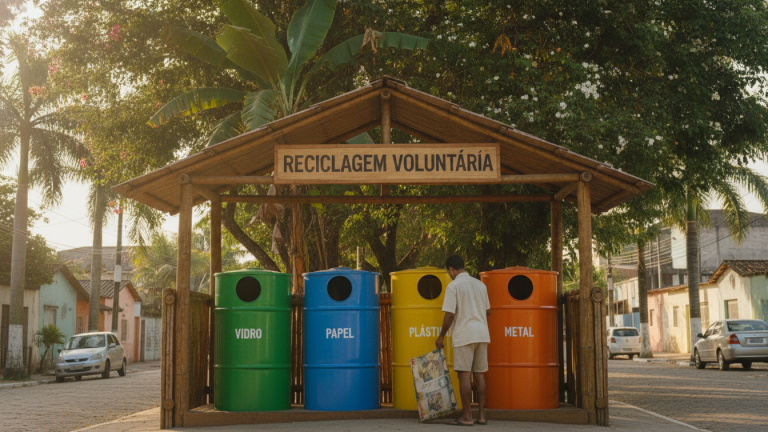
What to do with batteries, oil and old electronics when selective collection doesn’t pick them up
Have you ever had a used battery sitting in your drawer for months without knowing where to dispose of it? Or tried to throw away an old phone and wasn’t sure if you could put it in regular trash? This situation is more common than it seems, and the answer lies in a system that has existed in Brazil for over a decade, but many people still don’t know about: the voluntary drop-off point, or simply PEV.
Law 12,305/2010, called the National Solid Waste Policy (PNRS), created the legal framework for manufacturers, importers and distributors to be responsible for the final destination of certain products after use. The practical result is a network of locations spread across the country where you can bring materials that common selective collection doesn’t accept or doesn’t know how to handle properly. By the end of this text, you’ll know exactly how this system works, what can be brought, where to find the closest points and how to fit this habit into your routine without hassle.
Best of all, using a PEV requires no registration, has no cost to the citizen, and is often located in places you already visit, such as pharmacies, supermarkets and appliance stores.
What is a voluntary drop-off point and how did it start
A PEV is a physical location, with a container, collection box or designated area, where anyone can deposit specific waste for free. The central idea is to separate from the regular trash stream materials that need special treatment, whether because they are toxic, like batteries, or because they have high recycling value, like used vegetable oils and pesticide containers.
The PNRS defined product categories subject to mandatory reverse logistics, which is precisely the mechanism by which companies organize and finance the collection and treatment of this waste. Batteries, tires, lubricating oils, pesticide containers, fluorescent lamps and electronic products are among the items covered by sectoral agreements regulated in the years following the law. The PEV system is one of the practical ways to operationalize this obligation.
In practice, companies organize themselves into associations or collective systems to set up and maintain the points. The productive sector pays for the infrastructure, not the end consumer. You simply drop off the material and leave.
What you can (and cannot) bring to a PEV
Not every PEV accepts everything. Each point has a specialty, usually linked to the sector that finances it. So before leaving home with a bag full of various items, it’s worth checking what that specific location receives.
Items accepted at the most common PEVs in Brazil:
- Batteries of all types (cell phone, laptop, alkaline, automotive)
- Used vegetable cooking oils (sunflower, soy, canola, olive)
- Electronics and small appliances (cell phones, chargers, tablets, radios)
- Fluorescent and LED lamps
- Pesticide containers (at specific rural points)
- Printer cartridges and toners
- Expired medicines (at specific points in partner pharmacies)
- Used lubricating oil
What is normally not accepted at PEVs:
- Organic waste (food scraps)
- Regular glass packaging (that goes to selective collection)
- Construction materials
- Clothing and shoes (these have specific points, but are not PEVs in the sense of PNRS)
- Infectious waste (such as home syringes, which have their own protocol)
If you’re trying to reduce the organic waste you generate before it even gets to disposal, the article Organic waste in the kitchen: how to generate less trash brings practical tips for everyday kitchen life in Brazil.
Where to find a PEV near you
This is the part many people don’t know about. Voluntary drop-off points are in much more accessible places than you might imagine. Here’s where to look:
Pharmacies and drugstores: large chains like Raia, Drogasil and Ultrafarma participate in expired medication and battery collection programs. Look for the collection box usually near the checkout or entrance.
Supermarkets and hypermarkets: large chains usually have containers for used cooking oil, batteries, and sometimes electronics. In neighborhood supermarkets, the presence is less guaranteed, but it’s worth asking.
Electronics and appliance stores: because of sectoral reverse logistics agreements, brands and retailers in the sector are required to offer collection points for the products they sell.
Gas stations: many accept used lubricating oil and automotive batteries.
City halls and recycling cooperatives: several municipalities maintain their own PEVs in public squares, eco-points and sorting centers. In São Paulo, for example, the City’s network of eco-points receives a wide variety of materials.
Sectoral systems with online location: the Sinir system (National Information System on Solid Waste Management), maintained by the Ministry of Environment, is the official reference for consulting collection points by waste type and ZIP code. Recicla Eletro, a sectoral program for electronics, and the Battery Disposal Program, maintained by manufacturers, also have location search tools.
Step by step to use a PEV for the first time
The process is simple, but following an order avoids unnecessary trips and ensures your waste gets to the right place.
- Identify what you need to dispose of. Separate items into groups: batteries, electronics, oil, medicines.
- Consult the Sinir or the website of the sectoral program corresponding to the type of waste to find the point closest to your home or your usual route.
- Confirm the operating hours of the location, especially if it’s at a pharmacy or store with restricted hours.
- Package the material safely. Cooking oil should be in a sealed PET bottle. Batteries can go in a bag or small box. Electronics don’t need special packaging.
- Drop off the material at the point. No need to present a receipt, register or justification. Just deposit it in the collection box.
- Repeat frequently. It’s ideal not to accumulate large volumes. Once a month is enough for most households.
Estimated time for the actual drop-off: less than 5 minutes. Cost: zero.
Common mistakes that ruin all the effort
Using a PEV seems simple, and it is. But some frequent slips compromise the result.
Mixing types of waste when dropping off. Each collection box has a purpose. Putting batteries in the oil box or medicines in the electronics box creates contamination and can ruin the entire batch for recycling.
Delivering oil in inadequate packaging. Cooking oil dropped in an open plastic bag spills and contaminates other materials during transport. Always use a PET bottle with a tightly sealed cap.
Assuming any colored trash bin is a PEV. Common selective collection bins (paper, plastic, metal, glass) are not PEVs. They are not prepared to receive batteries or electronics, and mixing these materials there causes more problems than solutions.
Not checking if the point is still active. Sometimes, especially in smaller cities, an online-listed point may have been deactivated. A quick call to the establishment saves frustration.
The real impact of taking waste to the right place
It may seem small, one battery or a bottle of oil, but the cumulative effect is considerable. According to data from Abrelpe (Brazilian Association of Public Cleaning and Solid Waste Companies), Brazil generates tens of thousands of tons of electronic waste per year, and a small portion of that total is properly recycled. Batteries and cells discarded in regular trash release heavy metals like lead, mercury and cadmium into soil and water.
Cooking oil has a specific impact that few know about: one liter of oil dumped in sewage can contaminate up to a thousand liters of water, according to estimates from sanitation institutes. When that same liter goes to a PEV, it can be transformed into biodiesel or soap, generating income for cooperatives and reducing dependence on fossil fuels.
Small actions added to simple and effective daily attitudes create a positive cycle that goes far beyond disposal.
Frequently asked questions about voluntary drop-off points
Do I need to pay anything to use a PEV?
No. The use of voluntary drop-off points is free for consumers. Collection, transportation and recycling costs are financed by companies participating in reverse logistics agreements, as determined by PNRS.
Can I bring any amount of material?
At most PEVs, yes, as long as it’s household volume. Companies that need to dispose of large amounts of waste, such as offices with many electronics, should contact sectoral programs directly, as common points are sized for residential use.
What happens to the material after I drop it off?
Each category has a specific destination. Batteries go to accredited recyclers who extract metals in a controlled manner. Vegetable oils proceed to biodiesel or soap production. Electronics go through disassembly for component and precious metal recovery. The reverse logistics system requires traceability, so companies are required to prove proper destination.
What if there’s no PEV in my city?
In smaller cities, the network still has gaps. In that case, you can contact the city hall to ask about municipal eco-points, contact product manufacturers directly (many have return channels through the mail), or wait for collection drives promoted by municipalities and NGOs on specific dates, which are usually advertised on local environmental department social media.
Start today: one bottle of oil is already a start

If you have a bottle of used oil waiting by the sink, or a handful of old batteries in a drawer, you already have everything you need to take the first step. Open the Sinir website, enter your ZIP code, choose the type of waste and see how many points are along your usual route.
It doesn’t have to be perfect or cover everything at once. Start with the item you already have at home and know shouldn’t go in regular trash. A new habit is built on a small, repeated action, not a radical change.
