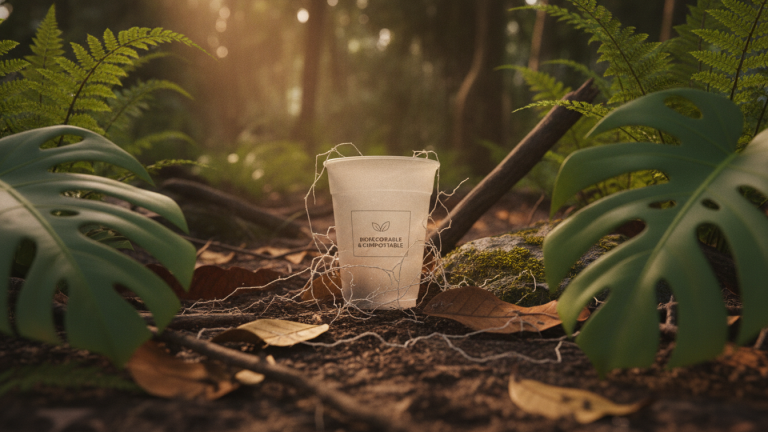
The label that can deceive: what “biodegradable” really means
You’re at the supermarket, looking at two liquid soap options and choose the one that says “100% biodegradable” on the packaging. Mission accomplished, right? Maybe not. This label, found on sponges, plastic bags, packaging and even clothing, has become one of the most misunderstood in the consumer market. And understanding what it actually says, and what it omits, can significantly change how you spend your money and care for the planet.
The word “biodegradable” describes only one characteristic: a material’s ability to be broken down by microorganisms. It says nothing about where this decomposition happens, how long it takes, what substances are released in the process, or how the product was manufactured. An item may decompose in a laboratory under ideal temperature and humidity conditions, but last for decades in a landfill without light, oxygen, or the right microorganisms. It’s this gap between the label and reality that this article will help you navigate.
By the time you finish reading, you’ll know how to identify when “biodegradable” is a real advantage, when it’s just marketing, and what questions to ask before putting a product in your cart.
Why “biodegradable” became an empty sales argument
The problem starts with the absence of a single legal definition. In Brazil, Law 12.305/2010 (National Policy on Solid Waste, or PNRS) establishes obligations for manufacturers regarding product lifecycle, but does not set a minimum timeframe or condition for something to be called biodegradable. This opens space for broad and uncritical use of the term.
In practice, a manufacturer can stamp “biodegradable” on a product that takes 400 years to decompose under real conditions, as long as decomposition eventually happens. The comparison matters: a dry leaf decomposes in weeks; an oxibiodegradable plastic bag, which became fashionable in the mid-2010s, fragments into smaller pieces, but those pieces are microplastics, not harmless biomass. UNEP (United Nations Environment Programme) has already warned that oxibiodegradable plastics may be more harmful than conventional plastics precisely because they accelerate microplastic generation.
What determines whether biodegradation actually happens
Decomposition requires specific conditions. The three factors that influence it most are temperature, presence of oxygen, and humidity. A landfill, the destination for a significant portion of Brazilian waste according to Abrelpe data, is a compacted environment with little air circulation and temperature variation. Under these conditions, even genuinely organic materials, such as food scraps, can take years to decompose.
Materials certified as industrially compostable only degrade properly in composting facilities operating between 55°C and 70°C. If that “compostable” bag ends up in regular trash, and in most Brazilian cities it will, the benefit disappears. Composting infrastructure is still limited in the country: IBGE records that only a fraction of Brazilian municipalities have any composting structure, and specific collection for this material is the exception, not the rule.
The trap of the ignored life cycle
Think about a t-shirt made from bamboo fiber, sold as “natural and biodegradable.” Bamboo grows quickly and absorbs carbon, great. But the industrial process to transform bamboo into textile fiber usually involves chemical solvents. The t-shirt may be biodegradable at the end of its life, but production generated effluents, consumed energy and water in considerable volumes.
This is called life cycle analysis, and it’s exactly what the “biodegradable” label doesn’t cover. The analysis looks at raw material extraction, manufacturing, transportation, use, and disposal. A product can have a clean end of life and a quite polluting beginning of life. Without seeing this complete picture, any product comparison becomes guesswork.
The same reasoning applies to packaging. A bioplastic bottle made from sugarcane may be biodegradable and, at the same time, have required intensive monoculture, pesticides, and long-distance transportation to reach the shelf.
How to read environmental labels without falling into traps
The good news: there are ways to distinguish marketing from substance. You don’t need to become an expert; you just need a few practical questions.
Verify the type of biodegradation:
- Biodegradable under environmental conditions: decomposes in the open air, in soil or water, without requiring special infrastructure. More useful in the real world.
- Industrially compostable: requires a composting facility with controlled temperature. Useful only where this infrastructure exists.
- Home compostable: decomposes in a common home compost bin. The most practical category for those living in apartments or homes with small spaces.
Questions to ask before buying:
- Does the product have third-party certification? In the international market, seals like TÜV Austria OK Compost HOME or the Seedling from DIN CERTCO are references. In Brazil, the market for environmental product certification is still developing, but the presence of any external audit is better than an unsupported claim.
- Does my city have collection or infrastructure for proper disposal of this material?
- Does the product have smaller packaging, or can it be purchased in bulk, reducing the problem at the source?
Reducing consumption and choosing products with less packaging still has the greatest impact, before even thinking about whether the material is biodegradable or not.
Greenwashing: when “green” is just the color of the packaging
Greenwashing is the term for when a company uses environmental language or visuals to convey a sustainable image that doesn’t match reality. “Biodegradable,” “eco,” “natural,” and “green” are the most used words in this type of communication.
UNEP published reports showing that a significant portion of environmental claims on consumer products lack verifiable evidence. In Brazil, the National Advertising Self-Regulation Council (Conar) has already judged and disapproved campaigns with deceptive environmental appeals, but enforcement is still insufficient to keep up with the volume of products on the market.
A practical way to protect yourself: be skeptical of vague claims and prefer brands that explain the process. “Made with 30% post-consumer recycled material” is more credible than “planet-friendly.” Transparency about what isn’t perfect is also a positive sign: companies that acknowledge limitations tend to be more honest than those that promise perfection.
What really makes a difference in your daily life
Sustainable consumption has a simple hierarchy, but one the market loves to ignore because selling less isn’t an attractive business model. This hierarchy, present in PNRS logic itself, places non-generation first, followed by reduction, reuse, recycling, and only then proper disposal. Biodegradable is at the tail end of this chain.
Applying this to real life:
- Buying less and choosing durable products has greater impact than replacing conventional disposables with biodegradable ones.
- Taking a reusable bag to the market eliminates the bag problem, biodegradable or not.
- Buying in bulk at markets that allow it reduces packaging at the source.
- Composting food scraps at home transforms actual waste into fertilizer, without depending on any label.
If you’re thinking about setting up a compost bin or even a vegetable garden in your apartment, that’s a concrete step that actually solves the fate of organic waste, without needing to trust what’s written on the trash bag packaging.
And when it comes to reducing environmental impact at home, the logic applies to other areas too. Small habit changes, like the ones you’ll find in the article about how to use less water in the shower without sacrificing comfort, tend to have more consistent results than switching one product for another with a green label.
Frequently asked questions about biodegradable products
Is oxibiodegradable plastic better than conventional plastic?
Not necessarily. Oxibiodegradable plastic fragments into smaller pieces through exposure to light and heat, but these fragments are microplastics that persist in the environment. UNEP indicates that this type of material can be problematic precisely because it increases the dispersal of plastic particles in soil and water.
If I throw a biodegradable product in regular trash, will it decompose in the landfill?
Generally, not in the expected way. Landfills have little oxygen and temperature variation, which inhibits the action of microorganisms responsible for decomposition. Materials that decompose well in exposed soil or a compost bin may take decades in a landfill.
Is there any reliable certification for biodegradable products in Brazil?
The Brazilian market is still developing this system. International compostability certifications like OK Compost are used by some brands that export or follow global standards, but there is no mandatory and recognized national seal for this category. The absence of certification doesn’t mean the product is bad, but the presence of external audit is a positive sign.
Is a natural product automatically biodegradable and sustainable?
No. “Natural” describes the origin of the raw material, not the manufacturing process or the product’s fate. A soap made with natural oils may contain preservatives that take time to degrade. And the extraction of natural ingredients, such as certain vegetable oils, can involve deforestation or intensive water use.
Start with a question before your next product
The next time a green label catches your eye on the shelf, pause for a second and ask: “Where will this product end up after I use it?” If the answer is “in regular trash, which goes to a landfill,” the environmental benefit of the label probably won’t materialize. This simple question, asked before purchase, is more powerful than any seal.
You don’t need to be perfect or know everything. You just need to start looking beyond the label.
