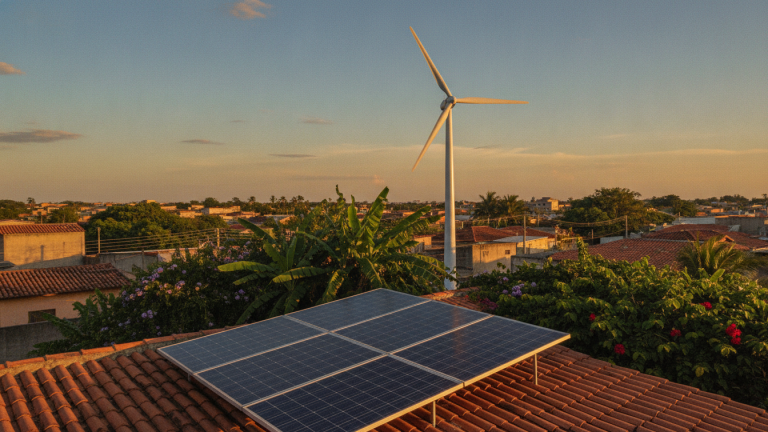
Wind or Solar Energy: Which is Better for Your Home
You received another high electricity bill this month and thought: “I need to do something about this.” That’s the reality for many Brazilians in 2026, with energy tariffs continuing to pressure household budgets. The good news is that two clean technologies are already within reach for those living in Brazil: photovoltaic solar energy and small-scale wind energy. But which one makes more sense for your home?
The answer is not the same for everyone. It depends on where you live, the size of your roof, the wind in your region and, of course, how much you want to invest. By the end of reading this article, you’ll know how to compare the two options clearly, understand what’s viable for your situation and take a concrete first step toward energy independence.
Brazil’s Energy Scenario in 2026
Brazil has one of the cleanest electricity grids in the world, with a significant share of hydroelectric power. Even so, according to data from the National Electric Energy Agency (ANEEL), distributed generation through solar panels has grown rapidly in recent years, surpassing historic records of installed capacity in the country. This movement comes from ordinary consumers who realized that producing their own energy is more accessible than it seemed.
Wind energy, in turn, has always been strong in Brazil as a large-scale solution, especially in the Northeast. But residential wind systems, which use small turbines installed on private properties, are still a niche option in the country. Understanding why this happens helps you make a more informed decision.
How Each Technology Works in Practice
Photovoltaic solar energy uses panels installed on the roof that capture sunlight and convert it into electricity. This energy can be used directly in your home or fed into the electrical grid, generating credits that reduce your electricity bill. The system is silent, has no moving parts and requires little maintenance.
Residential wind energy uses small turbines, usually installed on poles or elevated structures on the property. They convert wind movement into electricity in a similar way. The main difference is what the system needs to work well: constant wind and clear land, which already limits use significantly in urban environments and on small lots.
For those living in apartments, residential wind energy is practically out of the question. Solar energy also doesn’t allow individual installation on building roofs, but there are legal alternatives such as remote self-consumption and solar condominiums, regulated by ANEEL, which allow apartment residents to participate in a shared solar facility and receive credits on their bill.
Where Each System Works Best in Brazil
Brazil has a huge advantage for solar energy: it is one of the countries with the highest solar radiation incidence on the planet, according to data from the National Institute of Space Research (INPE). This applies to practically the entire national territory, from the Northeast to the South, even with climate differences between regions.
The residential wind potential, on the other hand, is much more irregular. Regions with the most consistent winds suitable for small turbines are the Northeast coast and interior, parts of the South and some plateau areas. In large cities like São Paulo or Belo Horizonte, the wind profile in residential areas is rarely sufficient to justify the investment in a home turbine.
See a quick comparison between the two systems:
| Criteria | Photovoltaic Solar | Residential Wind |
|---|---|---|
| Works in apartments | Yes, via consortium/remote | No |
| Requires large land | No (just roof) | Yes |
| Noise level | Silent | Low, but present |
| Best region in Brazil | Entire country | Northeast, coast, South |
| Maintenance | Low | Moderate (moving parts) |
| Installation cost (residential) | More affordable | Higher |
| Investment payback time | Estimated between 4 and 7 years | Estimated between 8 and 12 years |
The payback times indicated above are estimates based on industry references and vary according to consumption, local tariffs and system size installed.
What You Need to Analyze Before Deciding
Before calling any company and asking for a quote, it’s worth taking an honest look at your situation. Here are the points that really matter:
- Type of property: own house with a roof is the most favorable scenario for both technologies. Rental or apartment requires looking for alternatives like solar consortiums.
- Current electricity bill: the higher the monthly consumption, the faster the return on investment in own generation. Solar systems tend to pay off better for consumption from a certain level.
- Location and climate: check the solar irradiation data for your city in the atlas provided by INPE. For wind energy, consult the Brazilian Wind Energy Potential Atlas, produced by the Reference Center for Solar and Wind Energy Sérgio de Salvo Brito (CRESESB).
- Available area: solar panels need a clean roof with no shade from trees or neighboring buildings. Wind turbines need height and clear space around them.
- Investment capacity: the initial cost of residential solar systems has dropped significantly in recent years, and financing lines are available from Brazilian public banks such as Caixa Econômica Federal and Banco do Brasil.
Common Mistakes by Those Just Starting Research
Many people give up before they start because they believe the investment is unaffordable. Others do the opposite and hire a system without researching properly, and end up with undersized or oversized equipment for the home’s consumption.
A frequent mistake is ignoring roof orientation. Solar panels installed facing geographic north generate significantly more than those facing south in the southern hemisphere. Another mistake is not considering the loss of efficiency caused by dirt accumulated on the panels: periodic cleaning (without harsh chemicals, just water) makes a real difference in generation.
In the case of wind energy, the most common mistake is underestimating the need for wind. A turbine that works well with weak wind still needs reasonably constant wind. In regions with erratic winds, generation is irregular and investment return can take much longer than expected.
Steps to Install Solar Energy at Home
If you’ve made it this far and concluded that solar makes sense for your reality, the process is simpler than it seems:
- Analyze your last 12 electricity bills to understand your average monthly consumption in kilowatt-hours (kWh).
- Request at least three quotes from accredited companies. Check if the company has installers with certifications recognized by the industry.
- Choose equipment with solid warranties: panels with 25-year performance warranty and inverters with at least 10-year warranty are reasonable standard in the current market.
- Register the system with your local utility (such as Enel, Cemig, Copel or Coelba, depending on your region). This process is mandatory for you to be able to feed energy into the grid and accumulate credits.
- Monitor generation monthly through the inverter app or your utility’s portal. This helps identify any performance drop quickly.
The process from hiring to the start of operation usually takes between two and four months, considering installation and utility approval.
Adopting clean energy at home is part of a more conscious lifestyle that goes beyond the electricity bill. If you also want to reduce the impact of your diet, it’s worth learning about sustainable diet: what it is and how to adopt it in daily life, which brings practical and accessible changes to your everyday life.
Frequently Asked Questions About Residential Solar and Wind Energy
Can I use both systems together in the same house?
Yes, hybrid systems that combine solar panels and small wind turbines exist and are used in rural areas with good potential for both resources. For most urban Brazilian homes, however, solar alone already covers demand well and the cost of adding wind rarely justifies itself.
Does solar energy work on cloudy or rainy days?
It works, but with reduced efficiency. The panels capture diffuse light even without direct sunlight, so they continue generating on cloudy days, although in smaller amounts. The grid credit system compensates for periods of lower generation.
Is there any law or tax benefit for those who install solar energy at home?
Several Brazilian states grant exemptions or ICMS reductions for the purchase of solar generation equipment. Some municipalities also offer IPTU benefits for properties with systems installed. It’s worth consulting the legislation of your state and local city hall, as the rules vary greatly.
Is residential wind system regulated in Brazil?
Yes. ANEEL regulates microgeneration and distributed minigeneration, which includes small-scale wind systems connected to the grid. Connection, metering and compensation rules are the same as those that apply to solar.
Your Next Step Starts Today
You don’t need to make a final decision now. The simplest beginning is to grab your latest electricity bills and calculate your average monthly consumption. With that number in hand, any reputable company in the industry can size an appropriate system for your home and present a real return projection.
If you want to go further and think about other ways to reduce natural resource consumption at home, the content on how to capture rainwater at home and reduce expenses shows another practical solution in the same direction: spend less, depend less and live better. Every small change counts, and your electricity bill can be the starting point.
