The right destination for the cooking oil you use every day
You fried chicken, made Sunday pastries or prepared french fries for the family. When you finished, you were left with a pan or skillet full of dark oil and the same question as always: what do I do with this now? Pouring it down the sink seems like the easiest path, but one liter of oil dumped into the sewage system can contaminate up to one million liters of water, according to estimates from the Ministry of Environment (MMA). A single household gesture, repeated in millions of Brazilian homes, accumulates enormous impact.
The good news is that there is a simple, accessible solution that can even generate income for recycling cooperatives and biodiesel producers in your municipality. By the end of this text, you will know exactly where to take used oil, how to store it at home without odor or mess, and what mistakes to avoid so as not to compromise the process.
Why cooking oil is a serious environmental problem
Brazil is one of the world’s largest consumers of vegetable oil. According to IBGE data, household consumption of oils and fats in Brazilian residences is significant, concentrated mainly in soybean oil. A considerable portion of this volume is disposed of improperly, going directly to sinks, drains or regular garbage bags.
When oil reaches the sewer, it forms an impermeable layer over the water. This prevents oxygen from entering, hindering the work of microorganisms that naturally treat effluents. In sewage networks, oil solidifies over time and blocks pipes, which generates maintenance costs that end up appearing in the sanitation fees you pay. In rivers and streams, contamination compromises aquatic life and the quality of water collected for supply.
In the landfill, throwing oil inside a regular garbage bag doesn’t solve it either. The liquid drains through the discarded material, interferes with the decomposition process and can contaminate groundwater. The Law 12.305/2010, the National Solid Waste Plan (PNRS), establishes that special waste, including cooking oil, must have appropriate disposal. In other words, disposing correctly is not just an environmental choice: it is a responsibility provided for by law.
How to store used oil at home without complications
Before talking about collection points, the first step happens within your own kitchen. You don’t need to run out with a hot skillet. The idea is to save the oil until you gather a reasonable amount to take for disposal.
What you will need:
- A PET bottle of soda or juice (preferably with a screw cap)
- A small funnel (or improvise with aluminum foil rolled into a cone)
- A cloth or fine strainer to strain food residue
Step by step to store:
- Let the oil cool completely before any handling. Hot oil can deform the PET bottle and poses a burn risk.
- Strain the oil with the cloth or strainer to remove food scraps. This prevents bad odors during storage.
- Use the funnel to transfer the oil to the PET bottle. Close the cap tightly.
- Store in a cool place away from direct sunlight. In small apartments, inside a low kitchen cabinet works well.
- When the bottle is full (or every two to four weeks), take it to the nearest collection point.
The cost of this process is zero: you reuse a bottle that would go to the trash. The preparation time per disposal is less than five minutes.
Where to take used oil: real options in Brazil
This is the central point. Finding a collection point near home has become easier in recent years, thanks to municipal programs and partnerships with supermarkets and cooperatives. If you want to delve deeper into how proper disposal fits into a routine of lower waste generation, the article Zero waste: what it is and how to start in practice provides a good overview.
Main disposal locations:
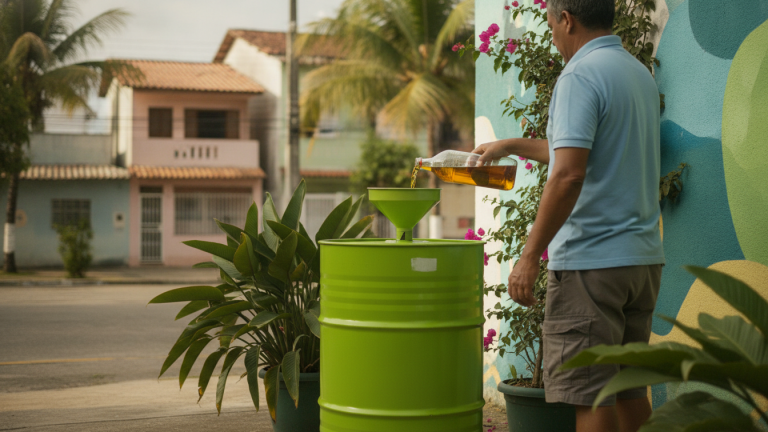
- Supermarkets and hypermarkets: chains like Extra, Carrefour and Pão de Açúcar maintain, in many stores, oil collection bins at the entrance or near the produce section. Check on the website or at the reception of your nearest store.
- Street fairs and municipal markets: some city halls install collection drums on fair days. In São Paulo, for example, the municipal oil collection program operates in partnership with collector cooperatives.
- Health centers, schools and churches: in smaller municipalities, community facilities frequently serve as voluntary delivery points.
- Recycling cooperatives: many collector cooperatives have already included vegetable oil among the materials collected, as it is sold to biodiesel plants, generating income.
- Municipal ecopoints: ecopoints, infrastructure provided for by the PNRS, receive various special waste. Check your municipality’s website or citizen service.
- Disposal location apps: platforms like Ciclo Ponto and state mapping initiatives allow you to search for collection points by ZIP code. By 2026, several Brazilian states expanded these digital tools after targets from the National Basic Sanitation Plan.
If you live in a smaller city and can’t find a fixed point, an alternative is to contact your municipal environmental department. Many municipalities have seasonal collection campaigns or can refer you to local cooperatives that buy oil.
What happens to used oil after collection
Used cooking oil has a noble destiny: it becomes biodiesel. Brazil has one of the world’s largest biodiesel programs, RenovaBio, coordinated by the Ministry of Mines and Energy, which encourages the use of renewable raw materials in fuel generation. The collected oil undergoes transesterification at plants, where it reacts with alcohol and transforms into biodiesel, which supplies fleets of buses, trucks and agricultural machinery.
A portion of the collected oil is also used in the production of artisanal soap by cooperatives and community groups, which generates local income. Some city halls organize soap-making courses for groups of women, transforming household waste into marketable products.
Knowing that your oil will generate fuel or soap changes the perception of the gesture. It’s not just “not pouring it down the drain”; it’s delivering an input that has real market value.
Common mistakes in disposing of used oil
Even with good intentions, some practices are still common and need to be avoided:
- Mixing with water before pouring down the drain: water does not neutralize oil. It continues to form a film and clog pipes.
- Pouring into toilets: the effect is the same as in the sink, with the added problem of damaging the condominium’s grease trap.
- Throwing in the trash without wrapping: the oil leaks through the bag, contaminates other recyclable materials and prevents reuse.
- Mixing with mineral or motor oil: vegetable oil mixed with other types loses the characteristics necessary to become biodiesel and complicates the industrial process.
- Storing for excessive time: more than two months at room temperature can make the oil go rancid and create bad smells. Dispose regularly.
Frequently asked questions about cooking oil disposal
Can I mix different types of vegetable oil in the same bottle?
Yes, no problem. Soybean, sunflower, canola and corn oil can be mixed in the same container. What cannot be mixed is vegetable oil with motor or mineral oil, as this makes it unsuitable for biodiesel reuse.
What about animal fat, such as lard and bacon grease? Does it go in the same place?
Solid animal fats follow similar logic, but not all vegetable oil collection points accept them. Check with the collection point before taking it. In some municipalities, animal fat collection is done separately or by specialized companies.
What if there are no collection points near my home?
A practical alternative is to coordinate with neighbors to gather oil from several apartments or houses and make a joint disposal when someone travels to a more distant point. Another option is to contact your municipality’s environmental department asking for information about seasonal collections or the implementation of a permanent collection point.
Can I reuse the frying oil at home before disposing of it?
Yes, within limits. Oil can be reused a few times, as long as it is not very dark, has excessive foam or a rancid smell. Consumption of highly degraded oil produces compounds harmful to health, according to the National Health Surveillance Agency (Anvisa). When the oil is no longer suitable for cooking, then it goes into the storage bottle.
Start today: a PET bottle and a simple decision
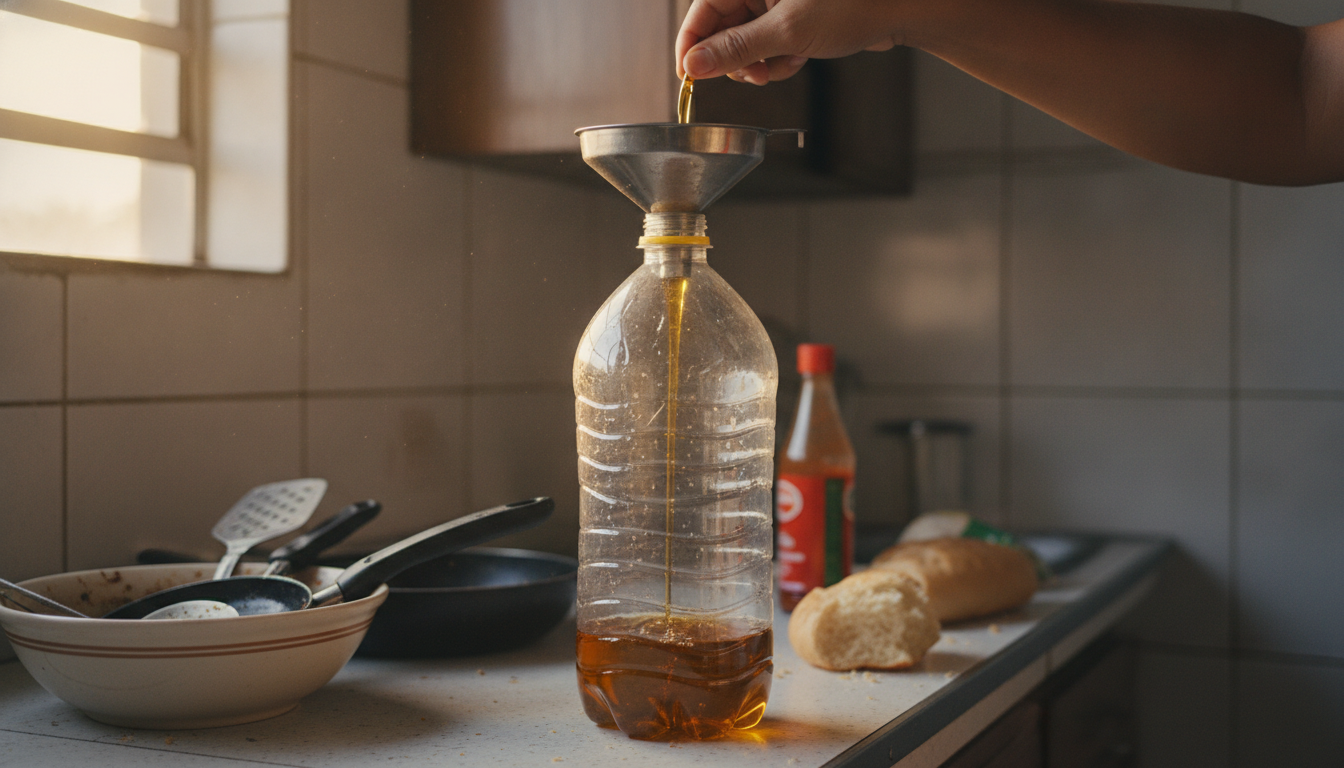
You don’t need to change your entire routine to make a difference on this issue. The first step is to take a PET bottle that would go to the trash, place it in a corner of your kitchen and use it to store used oil from your next frying session.
Then, spend ten minutes finding the collection point closest to you, whether at your neighborhood supermarket, municipal ecopoint or local cooperative. Once you do that, the habit becomes easy to maintain. Over time, you realize that the oil that once went down the drain now becomes biodiesel or soap, and that the condo maintenance bill, which sometimes rises due to clogs, has a cause that begins in your kitchen.
