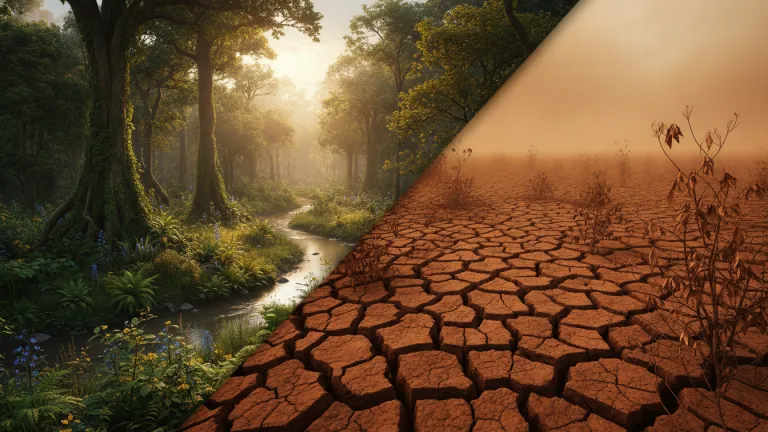
Imagine waking up one day and realizing that summer has gotten hotter than last year — and that last year was already the hottest on record. This isn’t a metaphor: according to the World Meteorological Organization (WMO), recent years have broken successive global temperature records, and 2024 was the first year to exceed the 1.5°C mark above pre-industrial averages for 12 consecutive months. Global warming has shifted from a distant prediction to an everyday experience — in droughts, floods, and the cost of your grocery bill.
But what exactly causes global warming? The scientific answer exists, is solid, and is available for anyone to understand. The problem is that it’s often presented in technical language, full of acronyms and data that seem to belong to another world. This article exists to change that. We’ll explain, in simple and precise terms, what is heating up the planet — and what you can do about it.
This isn’t about blaming individuals for systemic problems, nor about painting an apocalyptic picture. It’s about understanding the mechanism so you can act more intelligently — in voting, in consumption, in conversations with neighbors and colleagues.
The greenhouse effect: the natural process that became a problem
The greenhouse effect itself is not the villain. It’s the process by which Earth’s atmosphere retains part of the heat from the Sun, keeping the planet at temperatures compatible with life. Without it, the average global temperature would be approximately -18°C — a frozen and uninhabitable planet.
Here’s what happens: solar energy enters through the atmosphere, heats the Earth’s surface, and part of that heat is radiated back into space. Certain gases present in the atmosphere — called greenhouse gases (GHGs) — absorb part of that heat before it escapes, functioning like a blanket around the planet.
The problem begins when we artificially increase the concentration of these gases. The blanket gets thicker, retains more heat, and the planet’s average temperature rises. This is what we call anthropogenic global warming — caused by human action.
The main greenhouse gases and where they come from
Not all greenhouse gases are equal. Each one has a different warming potential and a specific origin. Knowing the main ones helps understand where the biggest problems are — and the greatest opportunities for change.
Carbon dioxide (CO₂): the most abundant
CO₂ is the most discussed greenhouse gas, and for good reason. According to the Intergovernmental Panel on Climate Change (IPCC), it’s responsible for the largest share of warming caused by human activities since the Industrial Revolution. Its main source is the burning of fossil fuels — coal, oil, and natural gas — for energy generation, transportation, and industry. Deforestation is also a significant source: when a tree is cut down and burned, all the carbon stored in its trunk, branches, and leaves is released at once.
In 2023, the concentration of CO₂ in the atmosphere exceeded 420 parts per million (ppm), the highest level in at least 800,000 years, according to data from the Mauna Loa Observatory and confirmed by the IPCC.
Methane (CH₄): short-lived but potent
Methane is less abundant than CO₂, but has a much greater warming power in the short term. According to the IPCC, over 20 years, methane warms the climate about 80 times more than CO₂ in the same quantity.
Its main human sources are:
- Livestock — the digestion of ruminants (cattle, cows, sheep) releases methane directly
- Landfills — organic waste decomposed without oxygen produces methane
- Oil and natural gas extraction — leaks during extraction and transportation
- Rice paddies — fermentation in flooded fields
Nitrous oxide (N₂O): the forgotten gas
Less talked about, but responsible for a relevant share of warming. N₂O has a warming potential much higher than CO₂ over 100 years. Its main source is the use of nitrogen fertilizers in agriculture — when applied to soil, part of the nitrogen converts to N₂O and is released into the atmosphere.
Fluorinated gases: human-made
Fluorinated gases (HFCs, PFCs, SF₆) don’t exist in nature — they were created by industry. They’re used in refrigeration systems, air conditioning, and the production of some plastics. In terms of warming potential, they’re the most potent of all, but their concentration in the atmosphere is still relatively low.
The central role of deforestation in Brazil and worldwide
Deforestation deserves its own section because it is simultaneously a source of emissions and the destruction of one of the planet’s main carbon sinks.
The Brazilian Amazon, the world’s largest tropical forest, stores enormous amounts of carbon in its biomass. When it’s deforested — whether for cattle ranching, agriculture, logging, or land speculation — that carbon goes into the atmosphere. Brazil’s National Institute for Space Research (INPE) continuously monitors deforestation in the Amazon through the PRODES system, providing annual data that guides public policies.
Besides emitting CO₂, deforestation reduces the planet’s capacity to reabsorb what has already been emitted. It’s a double problem: it increases the source and decreases the filter.
Fossil fuels: the root of the industrial problem
If there’s one dominant factor in global warming since the Industrial Revolution, it’s the burning of fossil fuels. Coal, oil, and natural gas were formed over millions of years through the accumulation of organic matter under pressure. When we burn them, we release in decades the carbon that nature took eons to bury.
The energy sector — electricity and heat generation — is historically the largest global emitter of CO₂, followed by transportation (cars, planes, ships) and heavy industry (cement, steel, chemicals). This doesn’t mean the individual consumer is irrelevant: our choices in mobility, food, and energy add up and create demand that sustains these industries.
Agriculture and food: emissions that reach your plate
The global food chain is responsible for a significant share of greenhouse gas emissions. According to the IPCC, the global food system — including production, processing, transportation, and waste — accounts for about one-quarter of global GHG emissions.
Within this, livestock stands out: besides the methane produced by ruminant animals, there are emissions associated with deforestation for pasture, transportation, and meat processing. Beef production, in particular, has a much higher carbon footprint than plant-based proteins or even other meats.
Food waste is another critical point. When we throw food away and it goes to a landfill, its decomposition releases methane. Reducing waste is one of the most efficient actions a person can take in daily life — and easier than it seems. Check out some practical tips in our guide on how to reuse food scraps and reduce waste.
What you can do today: practical and real actions
Understanding the causes of global warming doesn’t need to generate paralysis. On the contrary: this knowledge points directly to concrete actions. None of them solves the problem alone, but together — and multiplied by millions of people — they create real pressure on systems and markets.
High-impact everyday actions
- Reduce beef consumption, especially. It doesn’t have to be overnight — gradual substitutions already make a difference. Our article on how to reduce meat consumption gradually and healthily can help.
- Avoid food waste: plan purchases, use leftovers creatively, and learn to preserve food better.
- Prefer public transportation, bicycles, or walking whenever possible. If you have a car, consider carpooling.
- Reduce consumption of single-use products, especially plastics, which require energy-intensive production.
- Support clean energy sources: if you can, consider solar energy for your home; if you can’t, pressure your provider and elected representatives for more renewables in the energy mix.
- Vote and stay informed: public policies have much greater impact than any individual choice. Knowing candidates’ positions on climate is part of civic engagement.
- Talk about the topic: normalizing conversations about climate change with family, at work, and on social media expands the reach of solutions.
Conclusion: understanding is the first step to action

Global warming has identified, measured, and widely confirmed causes by science: the burning of fossil fuels, deforestation, intensive agriculture and livestock, and the waste of natural resources. It’s not a mysterious or inevitable phenomenon — it’s the accumulated result of human choices, which means other choices can change its trajectory.
IPCC science makes clear that there’s still room to limit the worst climate impacts, but the window for action is open now, in 2026, not in some abstract future. Every ton of CO₂ that isn’t emitted matters. Every preserved forest matters. Every person who understands the problem and acts — in consumption, in voting, in conversation — matters.
You don’t need to be perfect or solve everything alone. You need to start. And you’ve already started, by reading this article to the end.
