Why your electricity bill and trash say more about the planet than you think
Did you know that in 2025 alone, Brazil generated over 80 million tons of urban solid waste, according to Abrelpe data? Most of this material went to landfills or dumpsites, when it could have had a different destination. At the same time, electricity consumption in Brazilian homes represents a significant portion of national demand, according to ANEEL’s reports. These two facts together show that daily life at home has real weight on the environment.
The good news is that changing this scenario doesn’t require renovations, high investment, or sacrifice. Small decisions, repeated consistently, add up to concrete results: less money spent, less trash produced, less pressure on natural resources. By the end of this text, you’ll have a practical list of habits, organized from simplest to those requiring a bit more planning, to start right now.
Sustainability in everyday Brazilian life smells like an open-air market, it’s about the electrical outlet left plugged in unnecessarily and the cooking oil going down the drain. That’s what we’re going to talk about.
What happens when we ignore small waste
Waste of energy, water, and food rarely seems serious when looked at in isolation. A shower running two minutes longer, a dripping faucet, an old refrigerator that uses double what’s needed. But when these behaviors multiply across millions of homes, the collective impact is enormous.
The IPCC, the UN’s scientific climate panel, points out that changes in household consumption patterns are among the most efficient levers for reducing greenhouse gas emissions in the short term. In Brazil, deforestation is the main source of emissions, according to Inpe, but the energy and waste sectors also contribute significantly and are directly influenced by consumer behavior.
Understanding this isn’t about creating guilt. It’s about showing you have real power to act. And that acting well almost always means saving money too.
How to reduce electricity consumption without giving up comfort
The electricity bill is one of the most troublesome for Brazilian budgets, especially after changes in tariff rates. According to ANEEL, the residential sector accounts for a significant portion of total electricity consumption in the country. The good news is you can cut costs without suffering.
Habits that make a difference on the meter
- Replace incandescent and fluorescent bulbs with LED: consumption drops by up to 80% compared to incandescent bulbs, according to Procel information (federal government energy efficiency program)
- Unplug devices when not in use, especially televisions, chargers, and microwaves in standby mode
- Use air conditioning with temperature between 23 and 24 degrees Celsius, the range recommended by Procel to balance comfort and consumption
- Wash clothes with a full load and prefer cold water cycles when possible
- Defrost your refrigerator regularly: ice buildup forces the motor to work harder
If you live in an apartment and don’t have space for a solar panel, these simple measures already represent visible savings on your monthly bill. For those with a house, ANEEL provides simulators for calculating the financial return of photovoltaic systems, worth researching.
Water: the resource Brazil wastes more than it should
Brazil holds one of the world’s largest freshwater reserves, but this doesn’t guarantee abundance forever. IBGE data shows that a considerable portion of Brazilian households face some type of water supply restriction, and Amazon deforestation, monitored by Inpe, compromises the so-called flying rivers that feed rainfall across much of the national territory.
Inside the home, the biggest waste points are showers, leaving the faucet running while brushing teeth, and undetected leaks. A dripping pipe can waste dozens of liters per day—a real number that shows up directly on your water bill.
Four simple adjustments to start now
- Turn off the faucet while soaping dishes, brushing teeth, or shaving
- Reduce showers to five minutes: use a phone timer until it becomes habit
- Check toilets and faucets regularly to identify leaks
- Reuse the cold water that comes out before the shower warms up to water plants or clean the bathroom
Less trash starts before the purchase
The National Solid Waste Policy (Law 12.305/2010) establishes shared responsibility between manufacturers, distributors, merchants, and consumers for the product lifecycle. In practice, this means you as a consumer have an active role in this chain.
Most household trash that goes to landfills could have a different destination if there were more attention at the moment of purchase and disposal. Unnecessary packaging, disposable products when durable versions exist, food thrown away unnecessarily—all of this adds up to trash before serving any useful purpose.
To better understand how to make choices that reduce trash volume even before it’s generated, the article Smaller household trash starts with simple choices provides a practical and well-detailed path.
List of substitutions with quick returns
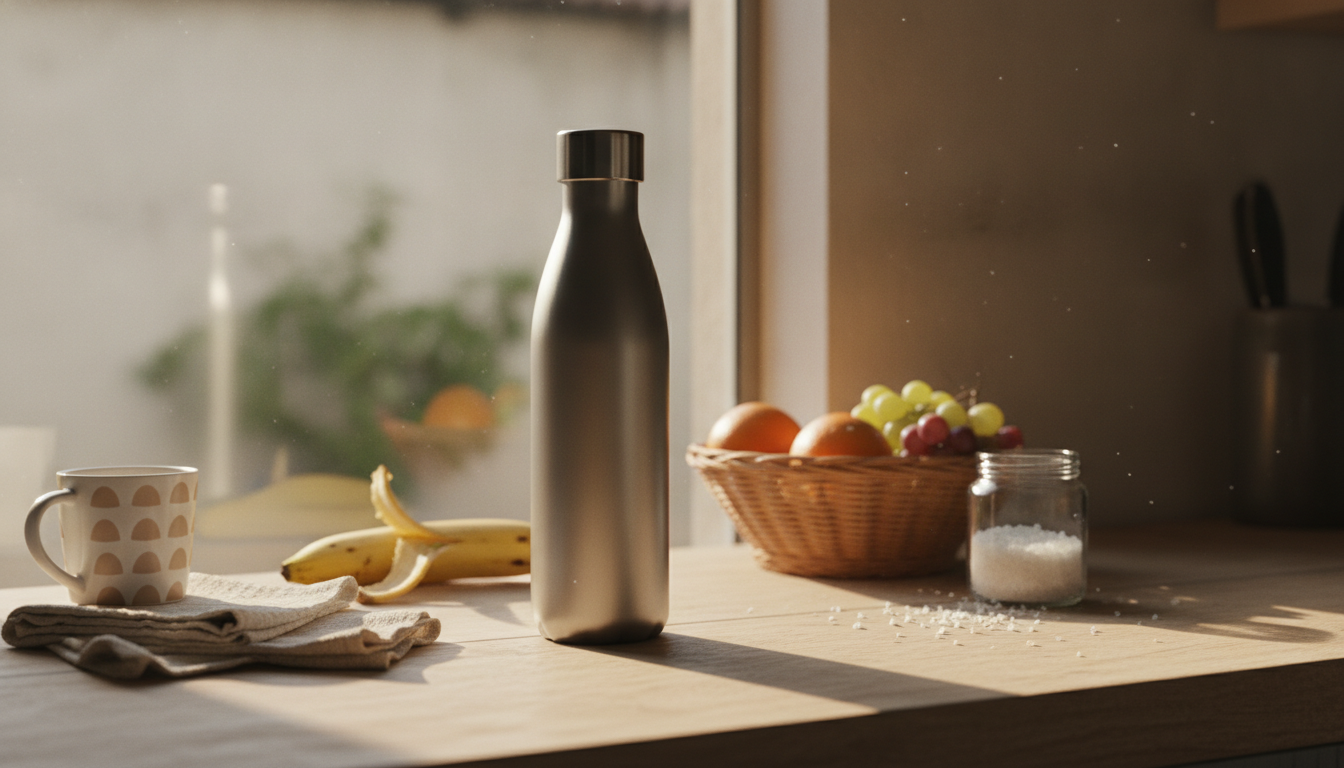
- Swap disposable cups and bottles for a reusable water bottle made of steel or glass
- Take cloth bags or baskets to the farmer’s market and supermarket
- Prefer refills of cleaning products, available at markets and convenience stores
- Use old kitchen towels instead of paper towels for general cleaning
- Buy in bulk when possible, especially at farmer’s markets and general stores
Selective collection: how to use what your neighborhood already offers
Selective collection exists in many Brazilian municipalities, but a small portion of recyclable material actually reaches sorting cooperatives. Part of the problem is incorrect disposal: glass mixed with paper, packaging with food residue, batteries thrown in common trash.
Abrelpe monitors the expansion of selective collection in Brazil and data shows growth, but there’s still much to advance, especially in smaller cities. If your neighborhood has selective collection, use it. If not, it’s worth researching voluntary drop-off points for recyclables, batteries, electronics, and cooking oil in your city.
Speaking of oil: this is one of the most problematic residues when it goes down the drain because it contaminates water. Collecting used oil in PET bottles and taking it to collection points is simple and free. Even better, you can turn this oil into homemade soap. The process is easier than it seems, as shown in the guide on homemade soap with used oil, which is even cheaper than buying bar soap.
Food: the most underestimated link in sustainability
The global food system accounts for a significant portion of greenhouse gas emissions, according to UNEP. In Brazil, Embrapa has studied ways to make agriculture and livestock more efficient, but consumers also have a direct role in this equation.
Buying with planning reduces food waste, which is enormous in the country. Preferring seasonal and locally-sourced products, when possible at your neighborhood market, reduces transportation and supports regional farmers. Reducing red meat consumption a few times a week is one of the changes with the greatest documented individual impact in scientific literature.
This doesn’t mean becoming vegetarian overnight. It means, for example, including a meal with beans, lentils, or eggs as the main protein source a few times a week. Rice and beans, a classic combination in Brazilian cuisine, is an example of a dish with good protein and much smaller environmental footprint than beef.
Frequently asked questions about sustainable habits in daily life
Do I need to spend money to live more sustainably?
Not necessarily. Much of the habits described here, like turning off the faucet, unplugging devices, or separating trash, cost nothing. Some substitutions, like a reusable water bottle or cloth bag, have small upfront costs and pay for themselves quickly by avoiding repeated purchases of disposables.
How do I know if my neighborhood has selective collection?
You can call your city hall or visit your city’s environmental department website. Many city halls also provide this information through apps or institutional WhatsApp. If there’s no selective collection, ask about voluntary drop-off points for recyclables.
Does it make a difference to change if others don’t?
Yes, in two ways. First, because your waste, your energy bill, and your water consumption are real and have concrete impact. Second, because behaviors change in networks: when neighbors, colleagues, and family observe practical changes and notice the benefits, adoption tends to grow. Collective change starts somewhere.
What do I do with batteries, expired medicines, and old electronics?
These items shouldn’t go in common trash. Batteries have collection points at supermarkets and pharmacies. Expired medicines can be returned at participating pharmacies in the Correct Disposal program. Electronics have specific drop-off points; manufacturers are required by law to offer this reverse logistics, according to PNRS.
Start with just one thing
Taking on everything at once rarely works. The strategy that gets the best results is choosing a single habit from this list, the easiest one for your routine right now, and maintaining it for three weeks until it becomes automatic. Then you add another.
Today, it could be just turning off the faucet while brushing your teeth. Tomorrow, you’re already thinking about the next step. Sustainability isn’t about perfection, it’s about direction.
