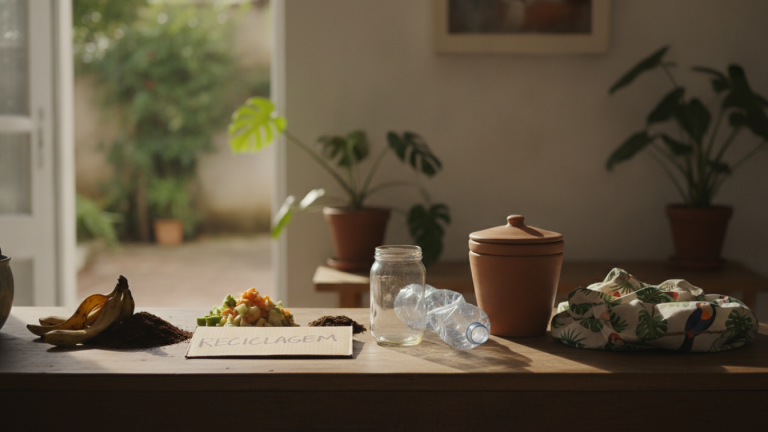
The trash bag that keeps growing
Have you ever stopped to count how many trash bags your household throws away per week? Two bags, three, four? For many Brazilian families, this number seems inevitable, as if producing waste were simply a natural consequence of living. But the truth is that a significant portion of what goes into the trash could have never gotten there, and another part could have a completely different destination.
According to data from Abrelpe (Brazilian Association of Public Cleaning and Solid Waste Companies), Brazil generated more than 80 million tons of urban solid waste in recent years, and only a small portion of that total is effectively recycled. This is not an abstract problem for government or industry: it starts inside the home, in the supermarket cart, in the refrigerator and on the kitchen counter.
The good news is that reducing household waste doesn’t require renovations, high expenses or radical lifestyle changes. By the end of this article, you’ll have a clear path to decrease your trash volume gradually, with actions you can start today, without guilt and without complications.
Why so much waste starts before you buy
The biggest mistake most people make is believing that waste is a disposal problem. Actually, it starts with choice. When you buy something packaged in unnecessary plastic, accept a bag at checkout without needing it, or bring home a product that will spoil before use, the waste is already generated, even if it’s not yet in the bag.
The Law 12.305/2010, the National Policy on Solid Waste, establishes a clear hierarchy for waste management in Brazil: the first step is not to generate; then comes reducing, reusing, recycling and, only last, proper disposal. This order matters. Recycling is better than throwing away, but not generating is better than recycling.
Thinking about waste before you buy is a turning point. You don’t need to be perfect, you just need to start asking yourself: will this last? Will it be used? What’s the fate of the packaging?
The three categories that make up most household waste
To act practically, it helps to understand what actually fills the Brazilian trash bag. In general, household waste breaks down into three major groups:
- Organic waste: food scraps, peels, coffee grounds, leaves. They represent a major portion of waste generated in Brazilian homes, according to Abrelpe estimates.
- Dry recyclable waste: cardboard, PET bottles, cans, glass, long-life packaging. These are materials that have a recycling chain in Brazil, but often end up mixed with organic waste and lose value.
- Rejects: what’s left over, what really has no reuse: disposable diapers, toilet paper, dirty foam, cigarettes. This is the real garbage.
Knowing this changes your strategy. Much of what goes into the bag can be diverted before, whether through food recovery, organic composting or proper recyclable separation.
How to reduce organic waste: accessible composting for apartments and homes
The organic waste is at once the most voluminous and the easiest to solve, because it has a proven solution: composting. Many people think composting requires a big yard and free time. It requires neither.
Composting in a home worm bin
A worm bin can sit on a balcony, in the kitchen or in a service area. You need a plastic box with a lid (can be adapted from a storage box), California earthworms (sold in fishing and gardening stores, for about R$ 20 to R$ 50 depending on the region) and food scraps without animal protein or too much oil.
Basic step by step:
- Drill holes in the lid and upper sides of the box for ventilation.
- Place a layer of soil or humus at the bottom (about five centimeters).
- Add the worms and let them adapt for a day before adding food.
- Add organic scraps in thin layers, always covering with some moist soil or torn wet cardboard.
- Keep moist, but not waterlogged. In apartments, odor doesn’t appear when the carbon/nitrogen ratio is balanced.
- In two to three months, you start to harvest humus for plants.
The worm bin eliminates most of the food scraps from the house and still generates fertilizer. For those with container gardens, it’s a closed cycle within the apartment itself.
Other paths for organic waste
If the worm bin isn’t viable, look for organic collection points at city hall. Municipalities like São Paulo and Curitiba maintain selective collection programs that include organics in some neighborhoods. Check your city hall website or call the customer service center.
Buying less waste: concrete habits at the supermarket and farmers market
Reducing what enters the house is just as important as managing what leaves. Some simple swaps have a direct impact on trash volume:
- Carrying reusable bags is already law in many Brazilian states; the cost of a cloth bag lasts years.
- Preferring bulk products at markets and groceries eliminates packaging without giving up the product.
- Buying vegetables and fruits at farmers markets reduces plastic and supports local producers.
- Choosing larger packages instead of several small ones decreases waste volume per product quantity.
- Using cloth kitchen towels and durable sponges instead of paper towels and disposables reduces waste immediately.
One swap many people underestimate: replacing the synthetic dish sponge with a vegetable fiber one. The synthetic sponge is not recyclable and takes decades to decompose. The compostable vegetable fiber sponge goes straight to the worm bin when it’s no longer usable.
Sorting for recycling: what works and what doesn’t in Brazil
Selective collection exists in many Brazilian municipalities, but the system is still heterogeneous. According to Abrelpe, the coverage of selective collection in Brazil has grown in recent years, but still leaves out a relevant portion of the population. Before sorting, it’s worth knowing if your neighborhood has selective collection and on which days.
What is recyclable and accepted by most programs:
- Dry and clean paper and cardboard
- PET bottles and clean plastic packaging
- Aluminum cans
- Glass (bottles, jars, containers)
- Long-life packaging (milk carton, for example)
What is not recyclable and should not be mixed:
- Toilet paper and tissue paper
- Packaging dirty or with food residue
- Foam (in most municipalities)
- Tape, mirrors, tempered glass
Dirty packaging contaminates the batch and makes recycling all the material unfeasible. Quickly rinsing a can before disposal makes a real difference.
Common mistakes that increase trash without you noticing
Some practices seem neutral, but add volume to the trash bag unnecessarily:
- Storing plastic bag inside plastic bag until an entire cabinet is full, without using them. The accumulated bag becomes trash sooner or later.
- Buying “stockpile” products that expire before use: wasted food is organic waste and money thrown away.
- Not checking expiration dates before putting food in the refrigerator causes newer items to go in front and older ones to be forgotten in the back.
- Printing unnecessarily: unnecessary paper disappears in the trash in days.
- Accepting freebies and samples that won’t be used: they become trash before serving a purpose.
Organizing the refrigerator with items closest to expiration in front is a small gesture that prevents food waste, one of the biggest generators of organic waste at home.
Frequently asked questions about household waste and waste reduction
Do I need to buy special products to reduce my waste?
No. Most changes depend on behavior, not new products. Using what you already have at home, avoiding the superfluous and better organizing what enters already reduces trash volume significantly.
Does apartment composting create bad smells?
When done correctly, no. The smell appears when there’s excess wet material without balance with dry material (cardboard, dry leaves, sawdust). Maintaining this proportion and not putting animal protein in the worm bin solves the problem in most cases.
What do I do with waste that doesn’t have selective collection in my neighborhood?
Look for city hall ecopoints, which exist in many municipalities to receive materials like electronics, batteries, used cooking oil and debris. Supermarkets and pharmacies also usually have collection points for batteries and oil containers. You can also participate in collective neighborhood initiatives, as described in How to participate in a neighborhood cleanup.
Does reducing waste really make an individual difference?
It does, in two ways. The first is direct: less waste generated means less material going to landfills, which in Brazil still receive most waste according to Abrelpe. The second is indirect: the consumption behavior of many people together signals to the market, which responds with less packaging and more bulk products.
Start with just one thing
Reducing household waste doesn’t have to be a life project starting tomorrow morning at six o’clock. It can be one thing, chosen now. Buying fruits at the farmers market without a plastic bag on your next visit. Saving the coffee grounds for the plant pot. Rinsing the can before putting it in the recyclables.
Each small choice has real effect, and it tends to pull others along. Those who start composting find they start looking at the supermarket cart differently. Those who switch bags discover that the farmers market has more to offer than the supermarket aisle.
The smaller trash bag starts before you tie the knot. It starts with choice. And the next choice is just a few hours away.
