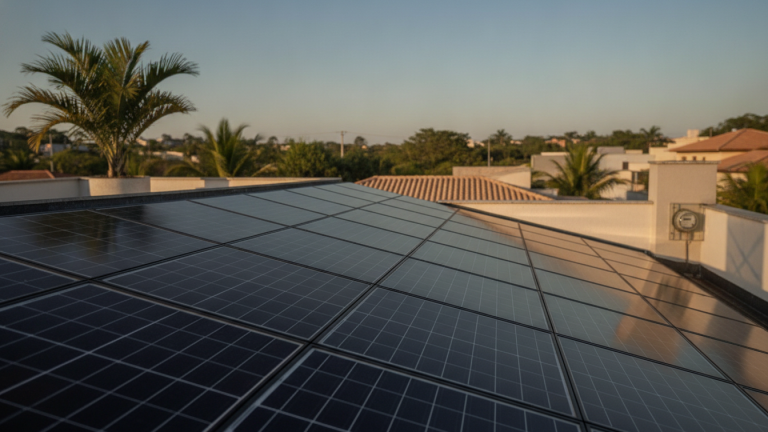
Imagine opening your electricity bill at the end of the month and seeing a value that fits your budget, even during the scorching summer when the air conditioning runs non-stop. For many Brazilians, this still seems like a dream. But those who installed solar panels at home in recent years know that this reality exists and is quite concrete.
According to ANEEL data, Brazil has surpassed the 3 million mark in distributed solar generation systems in operation, significant growth that has occurred over the past five years. The country has one of the best solar irradiation rates in the world, meaning that harnessing the sun to generate energy here is more efficient than in much of Europe or North America.
By the end of this text, you’ll understand how solar energy works in practice, how much it costs to install, what the law guarantees, what mistakes to avoid, and how to calculate whether this change makes sense for your house or apartment.
How solar energy works in everyday Brazil
The most common system for residences is called distributed photovoltaic generation. Solar panels capture sunlight, convert it into electricity, and power your home’s appliances. Any surplus goes to the utility company’s electrical grid and becomes a credit on your bill.
These credits are valid for 60 months, according to rules established by ANEEL. In other words, the energy you generate in a sunny month can be used in the following months, including winter or prolonged rainy periods. It’s like an electricity savings account.
The inverter is the central piece of the system: it transforms the direct current generated by the panels into alternating current, which is the type of energy used by your appliances. Without it, the panels don’t function usefully. Most residential systems also include a bidirectional meter, installed by the utility company, which records what you consume and what you return to the grid.
What changed with legislation and what you’re entitled to
In 2022, Brazil approved Law 14.300, called the Legal Framework for Distributed Generation. It guarantees more stable rules for those who install solar energy, including condominiums and those who rent properties. One of the most relevant changes was establishing a longer transition period before any potential charges on energy fed back to the grid.
Until the end of 2045, systems installed before that date follow rules that protect consumers from tariffs on the energy they return to the grid, with a gradual structure of charges. For those installing today in 2026, conditions are still quite favorable, but it’s important to request an updated simulation from the installer, as utility tariffs vary by region and rate band.
Another important point: ANEEL requires the local utility company to connect the system within 30 days for projects up to 75 kW. In practice, delays still happen in some regions, so accounting for this timeline in your planning is a prudent measure.
How much it costs to install and how long it takes to recover your investment
The cost of a residential solar system varies depending on the size of your electricity bill, the type of roof, and the region of the country. Generally speaking, a system capable of serving a residence with a monthly bill between R$ 300 and R$ 500 requires an initial investment that can range between R$ 15,000 and R$ 25,000, depending on the quality of equipment and local labor.
The return on this investment, called payback, usually occurs between 4 and 7 years in most Brazilian residential installations, according to sector projections. After that, the energy generated by the system represents pure savings, since the panels have an estimated useful life of 25 to 30 years according to manufacturers.
See a simple scenario comparison for a residence with average consumption of 400 kWh per month:
| Situation | Estimated monthly expense | Expense over 10 years |
|---|---|---|
| Without solar energy | R$ 400 to R$ 600 | R$ 48,000 to R$ 72,000 |
| With solar energy (after payback) | R$ 30 to R$ 80 (minimum fee) | R$ 3,600 to R$ 9,600 |
The values are estimates, as they depend on local tariffs and energy inflation. But the scale difference is real and verifiable in the bills of those who have already made the transition.
Step-by-step guide to installing solar energy at home
- Gather your electricity bills from the last 12 months. This helps the installer size the system correctly. Oversized systems cost more and undersized systems don’t bring the expected savings.
- Verify that your roof is suitable. Roofs with an inclination between 10 and 35 degrees, oriented north, better take advantage of solar irradiation in Brazil. Roofs shaded by trees or neighboring buildings reduce efficiency.
- Request quotes from at least three companies. Check if the installer has INMETRO certification or accreditation with sector associations. Ask for the descriptive report with the brand and power of the panels and inverter.
- Analyze financing options. Public banks like Caixa Econômica Federal and Banco do Brasil offer specific credit lines for solar energy. Caixa’s Environmental Sustainability Financing Program (FVS) is one of the available options, typically with rates below standard personal credit.
- Sign the contract and monitor the installation. The physical process usually takes 1 to 3 days. Afterward, the company responsible requests connection to the utility company, which installs the bidirectional meter.
- Monitor generation through the inverter app. Most modern equipment has real-time online monitoring. Tracking the data helps you identify performance drops early.
Common mistakes that make the system generate less than it should
- Not cleaning panels regularly. Dust, leaves, and bird droppings reduce generation. In cities with lots of soot, such as areas near highways, semi-annual cleaning can make a significant difference in production.
- Ignoring partial shading. A single shaded panel can compromise the output of the entire array, depending on the type of inverter. Ask your installer about using optimizers or microinverters if your roof has shade at any time of day.
- Choosing equipment based on price alone. Panels from unknown brands may have lower efficiency and no technical support in Brazil. Panel warranties are typically 25 years of performance; verify that the company has local representation to honor this commitment.
- Not considering roof orientation. In apartments, the south-facing side receives less direct irradiation in Brazil. If your apartment has a rooftop, verify the orientation before ruling out the idea.
- Forgetting to update your property insurance. The solar system increases the property’s value. Notifying your insurer prevents issues in case of damage.
Does solar energy work in apartments?
Yes, and increasingly so. Law 14.300 created mechanisms for shared generation and remote self-consumption, which allow condominiums and groups of residents to install panels in common areas or on distant land and divide the credits among units. Many condominiums in São Paulo and Rio de Janeiro have already adopted this model to cover common area consumption, such as corridor lighting, elevators, and water pumps.
If you live in an apartment and your condominium hasn’t yet evaluated this possibility, bringing the issue to a residents’ assembly with a technical analysis proposal is a concrete first step. The impact can appear not only in your individual bill but also in your condominium fee. Who knows if this change doesn’t inspire other sustainable practices in the building, as happens with small everyday actions you can see in how to adopt a zero waste lifestyle at home.
Frequently asked questions about residential solar energy
Does the system work on cloudy or rainy days?
Yes, but with reduced efficiency. Panels respond to diffuse light, not just direct sunlight. On cloudy days, generation can drop between 10% and 25% compared to a sunny day, but it doesn’t stop completely. In Brazil, even in the rainiest regions, like the North and part of the Northeast during the rainy season, the annual balance is usually positive.
Do I need a battery to store energy?
For most grid-connected residential systems, no. Credits on your bill function as “virtual storage.” Physical batteries are recommended for those living in areas with frequent power outages or in locations without access to conventional electrical grid. Battery costs are still high, but they’re declining over time.
Can I install if I rent my house?
You can, but you need written authorization from the owner. Some owners accept and even assume the installation cost to increase the property’s value. Another option is to negotiate a rent discount in exchange for you covering the investment, with a contractual clause about what happens to the system at the end of the lease.
Does solar installation require a lot of maintenance?
No. The system is basically silent and has no moving parts. The main maintenance is cleaning the panels every six months and an annual electrical review by a professional. The inverter may need replacement after 10 to 15 years, depending on the brand and usage.
Take your first step this week

You don’t need to make the decision now, but you can start gathering the information that will help you decide. Separate your electricity bills from the last 12 months, observe your roof’s orientation, and request two or three free quotes from local companies. Most offer simulations with no commitment.
Solar energy is no longer future technology. It’s generating real savings in electricity bills for Brazilians from North to South, in houses, condominiums, and small businesses. The sun that warms the country year-round can, at the same time, ease your budget and reduce your home’s carbon footprint. Starting to calculate is already taking action.
