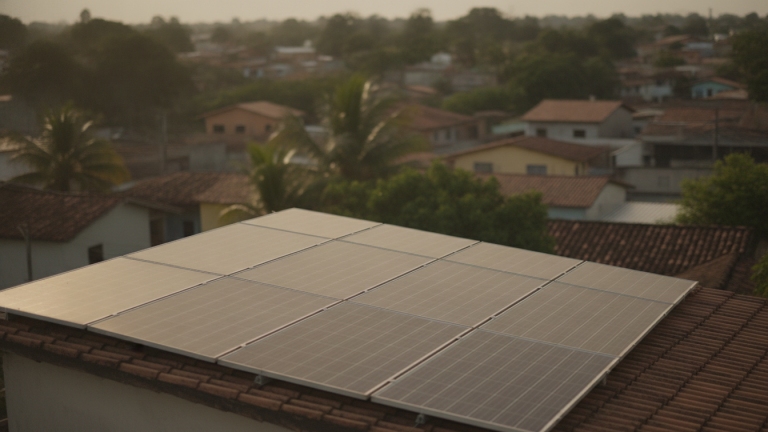
Your electricity bill arrived higher than expected this month? If you live in São Paulo, Curitiba, Porto Alegre or any city known for overcast days, you may have already considered solar energy and quickly dismissed the idea thinking that “there isn’t enough sun here”. This is one of the most common doubts that appears when it comes to photovoltaic generation in Brazil, and the answer will surprise you.
Solar panels don’t need direct sunlight to work. They capture diffuse radiation, the kind that passes through clouds and illuminates the environment even on gray days. This completely changes the viability calculation for those living in regions with lots of cloud cover. By the end of this article, you’ll know whether solar installation makes sense for your city, what real savings you can expect, and what to consider before signing any contract.
Brazil has one of the world’s electrical matrices with the highest share of renewable energy sources, according to ANEEL data, but distributed solar generation, which is produced in the consumer’s own home or building, still has plenty of room to grow. Understanding how this technology works under clouds is the first step to making an informed decision.
How solar panels work on cloudy days
Photovoltaic generation depends on global solar irradiation, an indicator that adds both direct sunlight and diffuse light scattered by clouds and the atmosphere. Even with an overcast sky, a significant amount of radiation reaches the surface of the panels.
A clear example comes from Germany. The country is a world reference in installed solar energy and has irradiation levels much lower than any Brazilian state, including those in the South. Nevertheless, photovoltaic generation represents a relevant share of Germany’s electrical matrix. Brazil, even in its cloudiest regions, receives more annual radiation than much of Europe.
According to the Brazilian Solar Energy Atlas, developed by INPE in partnership with other institutions, even the regions with the lowest irradiation in the country, such as the Rio Grande do Sul coast and parts of southern Santa Catarina, register average daily values that make solar generation economically viable. Production does drop on cloudy days, but it doesn’t make the system unviable when the project is properly sized.
Why a cloudy city isn’t the problem it seems
Many people confuse temperature with solar generation. The irony is that photovoltaic panels work better at cooler temperatures. Excessive heat reduces cell efficiency. Cities like Curitiba, which have cold winters and many overcast days, have a hidden advantage: when the sun appears, the panels operate with greater efficiency because they’re not overheated.
Florianópolis, known for its variable weather, and Belo Horizonte, with its famous weather that changes several times a day, are cities where photovoltaic systems already have a good presence and generate real returns for consumers. The key point isn’t how many days of full sun the city has, but what the cumulative irradiation is over the year.
Correct system sizing is what ensures that generation is sufficient even in the cloudiest months. A qualified installer will calculate the average consumption of the residence, roof orientation, shading, and local irradiation before proposing any solution.
What Brazilian law says about distributed generation
Law 14,300 of 2022 regulated the legal framework for micro and mini distributed generation in Brazil. It establishes rules for those who generate energy at home and inject excess into the electrical grid, accumulating credits that can be used in months of lower generation, such as winter. These credits are valid for 60 months.
This is especially important for cloudy cities. In summer, when there are more hours of sun, the system can generate more than the house consumes and accumulate credits. In winter, with lower generation, these credits cover part of the difference. The result is an annual average that generally keeps the electricity bill low throughout the year.
ANEEL regulates distributors and ensures they are obligated to accept energy generated by consumers. If your distributor creates obstacles or delays beyond the legal deadline to connect your system, you have the right to file a complaint directly with the agency. Keep all service records.
How to assess whether installation is worthwhile for your home
Before researching panel prices, answer these basic questions:
- Does your monthly electricity bill exceed R$ 200? Below that, the return on investment may take longer than expected.
- Are you the property owner or do you have authorization from the owner and the condominium?
- Is your roof more than 15 years old without renovation? If so, it’s worth getting it checked before installation.
- Are there tall trees, water tanks, or neighboring buildings that cast shadows on the roof during peak sun hours?
If you live in an apartment, the situation has changed a lot in recent years. Legislation allows condominiums to install collective systems, sharing credits among units. Another option is remote solar plants, where you sign a contract with a generator and receive credits on your bill without installing anything on the building. Research solar energy subscription companies operating in your city.
For those evaluating the pros and cons at a slower pace, the article Is solar energy worth it? Advantages and disadvantages explores these points in more detail and can help with your decision.
Step-by-step guide to installing solar energy in your home
- Calculate your consumption: Gather your last 12 electricity bills and calculate the average monthly consumption in kilowatt-hours (kWh). This number is printed on the bill.
- Research certified installers: Look for companies with professionals certified by INMETRO and registered with CREA or CFT. Request at least three quotes.
- Request the electrical project: The installer should provide a technical project with system sizing, panel and inverter power, and monthly generation estimate.
- File the request with the distributor: The installation company usually handles this, but follow up on the timeline. The distributor has a legal deadline to inspect and connect the system.
- Monitor generation through the app: Most modern inverters have remote monitoring. You can see in real-time how much you’re generating and saving.
- Keep all documents: Equipment invoices, certificates, electrical project, and distributor protocols. They’re important for warranty and potential property resale.
The cost of a basic residential system, sufficient for an average consumption home, varies widely depending on the region and installed power. Request detailed quotes and be suspicious of prices well below market average.
Common mistakes that increase costs or cause frustration
The most frequent mistake is buying equipment before hiring the installer. Panels from unknown brands without INMETRO certification may have efficiency far below what’s promised and void the system warranty.
Another mistake is ignoring partial shading. A single tree leaf casting a shadow on one panel can reduce the entire system’s generation, depending on the inverter type. Ask the installer to perform shading analysis at different times of day.
Finally, many people underestimate maintenance. Panels need to be cleaned periodically, especially in cities with lots of dust or pollution. Cleaning is simple and can be done with water and a soft cloth, but it must be done safely, avoiding climbing on the roof without proper equipment.
Frequently asked questions about solar energy in cloudy cities
Does generation drop a lot on days of heavy rain?
Yes, on days of heavy rain generation drops noticeably. But rain also cleans the panels, which improves efficiency in the following days. The system is sized taking into account the average annual irradiation, which already includes bad days.
How long does it take for the investment to pay for itself?
The payback period varies depending on your electricity bill value, your distributor’s tariff, and system cost. In general, well-sized projects in Brazil have shown returns within a few years, after which generation represents pure savings.
Can I install panels on a fiberglass roof with asbestos?
It’s not recommended. The installation process can fragment the tiles and release asbestos fibers, which are highly harmful to health. The ideal is to replace the roof before installing panels.
Does the system work during power outages?
The conventional grid-connected photovoltaic system automatically shuts down during blackouts for safety reasons for technicians working on the grid. To have energy during outages, you need a battery system, which increases installation costs.
Take the first step this week
You don’t need to close a contract tomorrow. Start simply: take your electricity bill from today and note your average monthly consumption in kWh. With that number in hand, you’ll already be able to talk to an installer much more informed and compare quotes without getting lost.
Cloudy cities do generate solar energy, and all of Brazil, from the Rio Grande do Sul coast to the interior of Pará, has real potential for this. The question isn’t whether it works. It’s when you’ll start.
