Why Plastic in the Oceans Is One of the Greatest Environmental Crises of Our Time
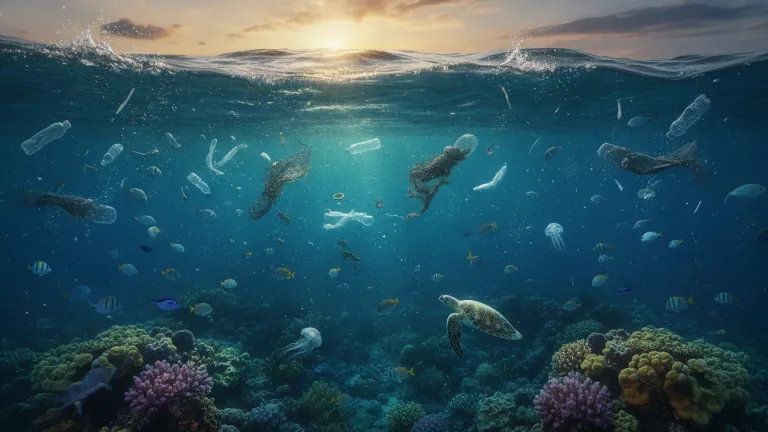
Imagine diving into a paradise beach and, at the bottom of the sea, finding not vibrant corals, but plastic bags floating like ghost jellyfish. This scene, which seemed like science fiction movie exaggeration a few decades ago, is now a documented reality in virtually every ocean on the planet — from tropical seas to the icy waters of the Arctic.
Plastic has become one of the most produced materials by humanity precisely because of its durability, lightness, and low cost. But it is exactly this durability that transforms it into an environmental nightmare: a simple plastic straw can take up to 200 years to decompose in the environment. And when it finally “disappears,” it doesn’t really vanish — it fragments into increasingly smaller particles, the so-called microplastics, which penetrate ecosystems, food chains, and increasingly, our own bodies.
Plastic pollution in the oceans is not a future problem. It is an active, silent, and growing crisis that affects marine biodiversity, human food security, and the planet’s climate balance. But the good news is that it is also a problem that begins — and can be reduced — through the daily choices each of us makes.
The Scale of the Problem: How Much Plastic Exists in the Oceans?
The numbers are difficult to visualize, but it’s important to face them. According to data from the United Nations Environment Programme (UNEP), millions of tons of plastic reach the oceans every year. It is estimated that hundreds of millions of tons of plastic have already accumulated in the seas — a quantity that continues to grow.
One of the most striking images of this crisis is the so-called “Great Pacific Garbage Patch”, a gigantic concentration of plastic debris located between Hawaii and California. Studies published in scientific journals such as Scientific Reports describe this area as larger than many countries, but it’s important to understand that it is not a “solid island”: it is a zone of high concentration of plastic fragments, many microscopic, dispersed throughout the water column.
Brazil, as a coastal country with more than 7,000 km of coastline and large river basins, also contributes significantly to this scenario. Rivers like the Tietê and bays like Guanabara Bay are known for carrying significant volumes of solid waste toward the sea, especially during periods of intense rainfall.
What Happens to Plastic Inside the Ocean
The Journey of Plastic: From Coast to Ocean Floor
When a piece of plastic enters the ocean — whether washed by rain, thrown directly, or discarded in rivers — it doesn’t stay still. It travels. Ocean currents transport debris thousands of kilometers, distributing pollution to extremely remote regions, including uninhabited islands and polar zones.
Over time, the action of the sun (photodegradation), waves, and salinity fragments larger plastics into increasingly smaller pieces. These fragments are classified by size:
- Macroplastics: pieces larger than 5 cm (bottles, bags, fishing nets)
- Mesoplastics: between 5 mm and 5 cm
- Microplastics: smaller than 5 mm
- Nanoplastics: fragments at nanometric scale, invisible to the naked eye
Microplastics and nanoplastics are particularly concerning because they distribute throughout the entire water column — from surface to ocean floor — and are practically impossible to remove at scale.
Abandoned Fishing Nets: The Invisible Danger
A particularly devastating type of marine plastic pollution is the so-called “ghost nets”: fishing equipment abandoned, lost, or discarded at sea. Made of nylon and other extremely resistant synthetic materials, these nets continue “fishing” for decades, trapping fish, turtles, dolphins, sharks, and seabirds without any human purpose. The FAO (Food and Agriculture Organization of the United Nations) recognizes ghost nets as one of the most lethal forms of marine pollution for wildlife.
Impacts on Marine Life: Who Suffers Most
Turtles, Birds, and Marine Mammals at Risk
The impacts of plastic on marine fauna are multiple and well-documented by science. The main damage mechanisms are:
- Ingestion: animals confuse plastic fragments with food. Sea turtles, for example, are known to ingest plastic bags that resemble jellyfish, their favorite prey. Plastic ingestion causes intestinal obstruction, starvation, and death.
- Entanglement: animals become trapped in nets, plastic can rings, and other objects, leading to injuries, amputations, and drowning.
- Chemical contamination: plastic in the ocean acts as a “sponge” for persistent organic pollutants (POPs) — toxic substances that adhere to fragment surfaces and are transferred to animals that ingest them.
The IUCN Red List records several threatened marine species whose decline is directly related to plastic pollution, including species of sea turtles, albatrosses, and cetaceans.
Corals and the Ocean Floor Ecosystem
Coral reefs, already pressured by global warming and climate change, suffer an additional impact from plastic. Research shows that plastic fragments deposited on corals block sunlight, reduce oxygenation, and create a favorable environment for pathogenic bacteria. The result is an increase in so-called coral diseases, further aggravating the bleaching and mortality of these fundamental ecosystems for marine biodiversity.
Microplastics in the Human Body: A Concerning Frontier
In recent years, scientific studies have begun detecting microplastics in increasingly surprising locations in the human body: blood, breast milk, placenta, lungs. This is a relatively recent area of research, and scientists are still working to understand the long-term health implications.
What is already known is that microplastics can carry chemical additives used in plastic manufacturing — such as phthalates and bisphenol A (BPA) — in addition to external pollutants they absorb in the ocean. Some of these substances are classified as endocrine disruptors, meaning they can interfere with the human hormonal system.
The main human exposure route related to the ocean is seafood consumption: shellfish, oysters, mussels, and fish filter or ingest microplastics from the marine environment. UNEP and various health agencies around the world emphasize the need for more research on human health risks — which, in itself, justifies the urgency of reducing plastic pollution at its source.
What Is Being Done: Global and Brazilian Initiatives
Global Plastics Treaty
One of the most important developments in recent years has been the negotiation process for an International Treaty on Plastic Pollution, coordinated by UNEP. Negotiations have involved dozens of countries and seek to establish binding targets for reducing plastic production and disposal. Although negotiations have faced significant impasses, the process represents global recognition of the problem’s severity.
Initiatives in Brazil
In Brazil, legislation such as the National Solid Waste Policy (PNRS), in effect since 2010, establishes important principles such as shared responsibility for product life cycles and priority for recycling. Coastal municipalities have invested in selective collection programs and beach cleanups. Civil society organizations, such as the Instituto Lixo Zero Brasil and volunteer beach cleanup groups, carry out ongoing awareness and waste removal actions.
What You Can Do: Practical and Real Actions
Systemic transformation is essential, but it does not exclude individual action. Every consumption choice has an impact. Here are concrete attitudes you can adopt today:
- Refuse single-use plastics whenever possible: straws, disposable cutlery, plastic cups. Carry your reusable alternatives.
- Use eco-bags and cloth bags instead of plastic bags at the supermarket.
- Prefer products with recyclable or bulk packaging, reducing demand for unnecessary plastic packaging.
- Dispose correctly: separate recyclable waste and use your city’s selective collection points.
- Participate in beach and river cleanup events — many NGOs organize regular events open to the public.
- Support brands and companies with real plastic reduction commitments and avoid “greenwashing” — vague promises without concrete goals.
- Stay informed and share: awareness is a powerful tool. Share reliable information with friends and family.
- Reduce fast fashion consumption: the synthetic textile industry is a significant source of plastic microfibers that reach the oceans via domestic sewage.
Conclusion: The Ocean Needs You — and You Need the Ocean
The oceans cover more than 70% of the planet’s surface, produce much of the oxygen we breathe, regulate the climate, and feed billions of people. Caring for the seas is not an altruistic act — it is a matter of collective survival.
The plastic crisis in the oceans is enormous, but it is not irreversible. Every bottle you refuse, every bag you replace, every conversation you start about the topic is a real contribution. Combined with public policies, technological innovations in sustainable materials, and international agreements, these individual actions make a difference.
To deepen your sustainability journey and discover other practical ways to live more consciously in daily life, check out our guide on sustainability in everyday life. The planet thanks you — and you’ll feel better for it too.
The sea you help protect today is the same one that will feed, inspire, and enchant future generations.
