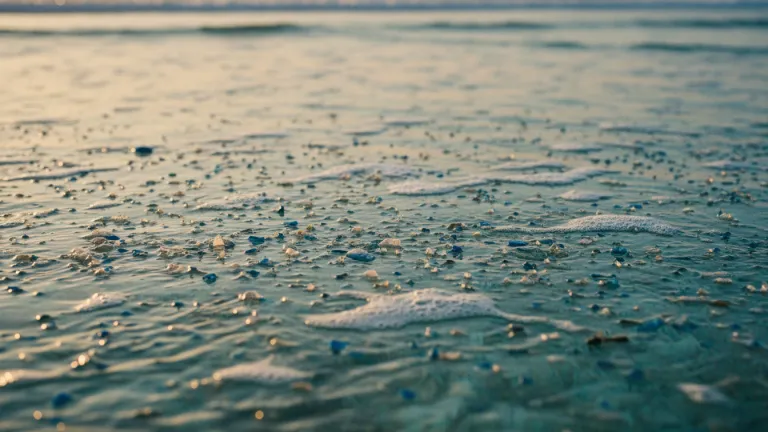
Imagine drinking a glass of water and swallowing, along with it, invisible fragments of PET bottles, synthetic clothing fibers, or plastic packaging residues. It sounds like science fiction, but it’s a reality documented by researchers worldwide. Microplastics — tiny particles derived from the degradation and production of plastics — have already been found in Arctic glaciers, in the depths of ocean trenches, in the air we breathe, in the food we consume, and even in human blood. We are facing one of the most silent and far-reaching environmental contaminations in modern history.
The topic has gained even more urgency in recent years as science advances in understanding the risks these particles pose to human health and ecosystems. If previously the debate about plastic focused on bottles and bags discarded in rivers and beaches, today it delves into a dimension that the eyes cannot see — and which, precisely for that reason, is even harder to ignore.
In this article, you will understand what microplastics are, where they come from, how they reach our bodies and the environment, and — most importantly — what each person can do to reduce their contribution to this problem.
What are microplastics and how do they form
Microplastics are solid plastic particles less than 5 millimeters in diameter. Some are so small they can only be seen with a microscope — these are called nanoplastics, measuring less than 1 micrometer. They are divided into two main categories:
- Primary microplastics: intentionally manufactured at this size, such as microbeads used in exfoliating cosmetics, toothpastes, and cleaning products, as well as plastic resin granules (called pellets or nurdles) used as raw material in industry.
- Secondary microplastics: originating from the fragmentation of larger plastic items, such as bottles, bags, fishing nets, tires, and synthetic clothing. Ultraviolet radiation, mechanical friction, ocean waves, and weather conditions break these materials into increasingly smaller pieces over time.
Relevant data comes from research on laundry: synthetic fabrics such as polyester, nylon, and acrylic release hundreds of thousands of plastic microfibers with each wash cycle, and a large portion of these fibers passes through wastewater treatment plant filters, reaching rivers and oceans.
Where microplastics circulate: air, water, soil, and food
The ubiquity of microplastics is alarming. Scientific studies published in journals such as Nature and Environmental Science & Technology have identified these particles in virtually every environment tested:
- Oceans and rivers: microplastics accumulate in water columns and marine sediments, affecting organisms at all levels of the food chain.
- Agricultural soil: sewage sludge used as fertilizer, irrigation with contaminated water, and decomposition of agricultural plastics (mulching) introduce microplastics into cultivable soil.
- Atmospheric air: plastic particles have been found in air samples in urban areas and even in remote regions, such as the Pyrenees and the Himalayas, indicating long-distance wind transport.
- Food and beverages: fish, seafood, sea salt, honey, beer, and bottled mineral water have already been identified as vectors of microplastics for human consumption.
- Human body: studies published through 2024 detected microplastics in blood, lungs, placenta, breast milk, and human organ tissues.
To better understand how plastic reaches and accumulates in the oceans — and what this means for marine life — it’s worth reading the article Plástico nos Oceanos: o que acontece com o mar.
The dangers of microplastics to human health
This is the area that is advancing the most in science currently and, at the same time, the one that still holds the most uncertainties. What is known so far is concerning:
Microplastics as vectors for toxic substances
Plastic is not just an inert material. Its manufacturing involves chemical additives such as plasticizers (phthalates), flame retardants, dyes, and bisphenol A (BPA), many of which are classified as endocrine disruptors — substances capable of interfering with the human hormonal system. Additionally, the rough surface of plastic particles acts like a “sponge” that adsorbs persistent organic pollutants (POPs), such as organochlorine pesticides and polychlorinated biphenyls (PCBs), concentrating them at levels much higher than those found in the surrounding water.
Inflammation and oxidative stress
Research with laboratory models and observational studies in humans suggests that the presence of microplastics in tissues can trigger inflammatory responses and cellular oxidative stress. A study published in the New England Journal of Medicine in 2024 identified microplastics and nanoplastics in fatty plaques of carotid arteries and associated their presence with an increased risk of cardiovascular events — although causality is still being investigated.
Risks for vulnerable groups
Children, pregnant women, and people with chronic diseases may be more susceptible to the effects of microplastics, especially through cumulative exposure over time. The detection of these particles in placentas and breast milk has raised important questions about newborn exposure from the earliest moments of life.
It is essential to highlight that science is still mapping these risks — but the precautionary principle recommends acting before all certainties are established.
The impact of microplastics on ecosystems and biodiversity
The effects on fauna and flora are already more documented than the effects on humans. Marine organisms, in particular, suffer direct consequences:
- Zooplankton and marine invertebrates ingest microplastics confusing them with food, which reduces their actual nutrient intake and compromises reproduction.
- Fish and marine mammals accumulate particles along the food chain, in a process called bioaccumulation. Cetaceans, turtles, and seabirds are found with significant amounts of plastic in their digestive systems.
- Soil and terrestrial microbiota: studies indicate that microplastics in soil can alter communities of microorganisms essential for fertility and nutrient cycling, indirectly affecting food production.
- Pollinators: preliminary research suggests that bees exposed to microplastics show behavioral and reproductive changes, which could have serious implications for agriculture.
Where microplastics come from in our daily lives
Knowing the sources is the first step to taking action. The main domestic and urban origins include:
| Source | Type of microplastic generated |
|---|---|
| Washing synthetic clothes | Polyester, nylon, acrylic microfibers |
| Tire wear | Synthetic rubber particles |
| Improper plastic disposal | Packaging and bottle fragments |
| Cosmetics with microbeads | Polyethylene microbeads |
| Paints and coatings | Polymer fragments |
| Cigarette butt disposal | Cellulose acetate filters with plastic additives |
| Heated plastic packaging | Particle migration to food |
It’s worth noting that Brazil is one of the largest producers and consumers of plastic in Latin America. Although legislative advances are underway — including discussions in the context of the UN Global Plastics Treaty, whose negotiations intensified between 2024 and 2026 — individual behavior change still plays a relevant role while broader policies mature.
What you can do now: practical actions to reduce microplastics
The good news is that small everyday changes have real impact. Here are concrete actions anyone can adopt:
In plastic consumption and disposal
- Prefer packaging made of glass, stainless steel, bamboo, or paper whenever possible.
- Avoid heating food in plastic containers — heat accelerates the release of particles and chemical substances.
- Properly dispose of plastics, separating them for recycling — this reduces fragmentation in the environment.
- Reduce consumption of disposable products: plastic straws, cutlery, cups, and bags.
In clothing and textile care
- Install microfiber filters in your washing machine (such as the Cora Ball filter or bag filters attached to the water outlet).
- Prefer clothing made of natural fibers, such as organic cotton, linen, and wool, especially for frequently washed items.
- Wash synthetic clothes at lower temperatures and with shorter cycles — this reduces fiber release.
In food and water
- Use water filters at home, especially reverse osmosis filters or activated carbon filters with fine pores.
- Reduce consumption of raw seafood if the origin is uncertain, as these are among the foods with the highest documented concentration of microplastics.
- Avoid heating food in plastic packaging and prefer storing food in glass or steel.
In cosmetic consumption
- Read labels and avoid products that list polyethylene (PE), polypropylene (PP), polymethyl methacrylate (PMMA), or nylon among ingredients — indicators of plastic microbeads.
- Prefer exfoliants with natural ingredients, such as sugar, salt, or oatmeal.
In collective pressure
- Support brands and companies with real commitments to reducing virgin plastic use.
- Participate in or support local beach, river, and park cleanup initiatives.
- Engage with political representatives to demand stricter regulations on single-use plastics and industrial effluent filtration.
Conclusion: invisible, but not inevitable

Microplastics represent a genuine challenge — but not a definitive sentence. Science is advancing rapidly in understanding the risks, civil society is more mobilized than ever, and pressure on governments and industries for systemic solutions grows each year. In 2026, the debate around a binding international treaty on plastics remains one of the most important on the global environmental agenda.
Every properly disposed bottle, every filter installed in the washing machine, every beauty product replaced with a microbead-free alternative is a choice that matters — not only for your body but for the rivers, seas, and soils that sustain life on the planet. Start with what is within your reach today, and invite those you know to do the same.
The problem may be microscopic, but the solution begins with very concrete choices.
