Imagine sitting at the dinner table and hearing your eight-year-old ask: “Mom, why do people throw trash in the river?” This simple question carries enormous weight — and also a precious opportunity. Children are naturally curious about the world around them, and that curiosity is exactly the gateway to building a more conscious, responsible generation connected to nature.
The urgency of this education has never been more real. The greenhouse effect continues warming the planet at an accelerated pace, and the IPCC (Intergovernmental Panel on Climate Change) reinforces in its most recent reports that decisions made in the coming decades will be decisive for the future of the global climate. Today’s children will be the adults making those decisions — and habits formed in childhood tend to last a lifetime.
The good news is that you don’t need a specialized course or a perfect home to teach sustainability. With simple actions, honest conversations, and practical daily activities, any family can plant this seed. In this article, you’ll find real, accessible, and effective strategies to transform your home into a living environmental education laboratory.
Why Teach Sustainability to Children at Home?
School plays an important role, but the most lasting environmental education begins — and is consolidated — at home. Researchers in environmental psychology and education point out that children who learn sustainable habits in the family environment tend to internalize them more deeply than when learning occurs only in the classroom. This happens because the home is the space where values are lived, not just taught.
Additionally, Brazil occupies a unique position in this context. The country hosts the world’s greatest biodiversity, according to data from the Ministry of Environment and Climate Change, with thousands of species of plants, animals, and microorganisms. Teaching children to value this heritage is not just an environmental issue — it’s a matter of cultural identity and collective responsibility.
Another fundamental point: engaged children influence the adults around them. It’s not uncommon for a child who learns about waste separation at home to take this practice to grandparents, neighbors, and even to school. Learning multiplies organically when it starts early.
How to Start: Honest Conversations and Age-Appropriate Language
Before any practical activity, it’s necessary to create a space for dialogue. Talking about the environment with children requires calibrating language according to age group — without oversimplifying to the point of seeming irrelevant, nor complicating to the point of generating anxiety.
Sustainability for children ages 3 to 6
At this stage, the concrete predominates over the abstract. Use images, stories, and direct experiences with nature:
- Show how tap water has a journey before reaching the house
- Read children’s books about animals and forests
- Let them touch soil, plant a seed, observe insects in the garden
- Use simple phrases like “when we leave the light on without needing it, we use energy that could be saved”
Sustainability for children ages 7 to 12
In this range, children can already understand causes and consequences. Introduce concepts such as:
- What recycling is and why it matters
- Where the trash we throw away comes from (and where it goes)
- How animals depend on healthy habitats — you can explore with them the list of endangered animals in Brazil in 2026
- The concept of ecological footprint: every choice has an impact on the planet
Teenagers
With teenagers, dialogue gains even more depth. They can research, question, and even propose changes at home. Involve them in real decisions, such as comparing products with recyclable packaging or discussing the family’s energy consumption.
Practical Sustainability Activities to Do at Home
The best way to teach is by doing it together. See activities organized by complexity level:
Simple activities (for all ages)
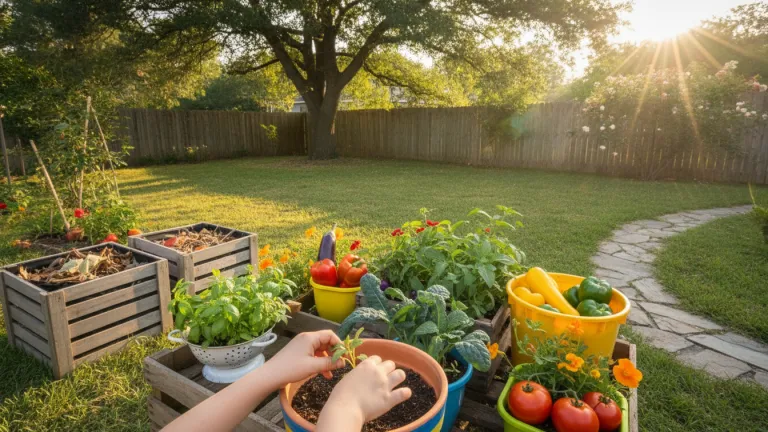
- Garden in pots or crates: planting herbs like basil, parsley, and chives teaches about natural cycles, patience, and healthy eating
- Home composting: fruit and vegetable scraps become fertilizer; many Brazilian municipalities already have programs supporting home composting
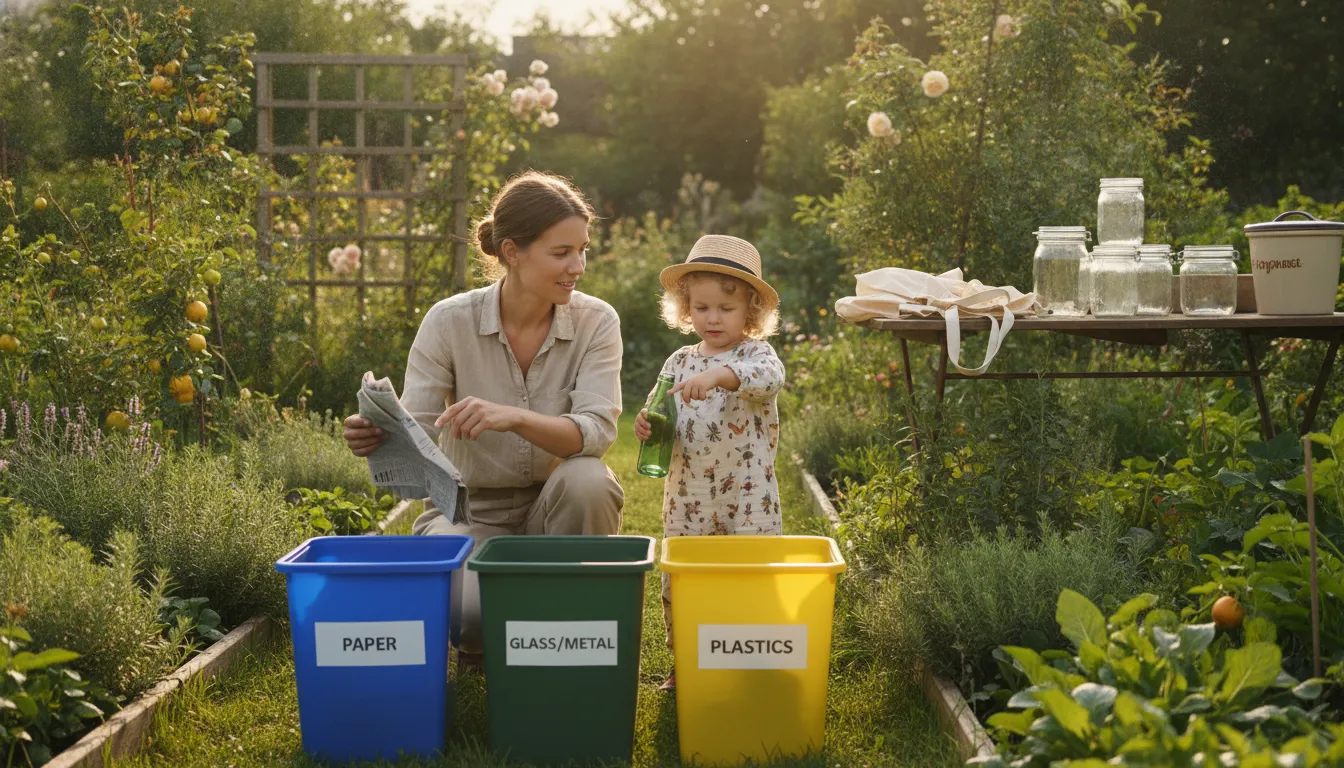
- Waste separation: make selective collection a visual and participatory routine — each child can be responsible for one type of material
- Faucet challenge: time showers and try to reduce week after week
Intermediate activities
- Neighborhood biodiversity map: observe and record plants, birds, and insects near home using free apps like iNaturalist
- Reuse workshop: transform cardboard boxes, glass jars, and old fabrics into useful or decorative objects
- Reading the energy bill: teach children to understand the electricity bill and identify where the family can save
Advanced activities (for older children and teenagers)
- Water efficiency project: measure the household’s water consumption per week and create reduction goals
- Carbon footprint research: calculate the family’s ecological footprint together using reliable online calculators
- Visit a waste treatment plant or renewable energy facility
Sustainable Habits to Incorporate into Family Routine
True sustainability doesn’t happen in one-time projects — it lives in the small daily habits. See a practical list of changes any family can adopt:
- Reduce food waste: plan meals, use leftovers creatively, and compost what remains
- Prefer reusable bags when shopping — a simple habit with real impact on reducing disposable plastic
- Turn off devices on standby: appliances in standby mode continue consuming energy; unplugging them reduces electricity costs
- Choose products with less packaging or recyclable packaging whenever possible
- Use water consciously: turn off the faucet while brushing teeth, reuse vegetable cooking water to water plants
- Prefer active transportation when possible: walk or bike on short trips
- Eat less meat on some days of the week — animal production has a significant impact on greenhouse gas emissions, according to FAO (Food and Agriculture Organization of the United Nations) data
- Talk about conscious consumption before buying new toys, clothes, or electronics
How to Use Technology for Environmental Education
In 2026, children grow up surrounded by screens — and this can be an ally, not an obstacle. There are quality digital resources for learning about the environment in a playful and engaging way:
- Documentaries: productions like BBC nature series (available on streaming platforms) are accessible and visually powerful for children from six or seven years old, especially when watched as a family
- Species identification apps: iNaturalist and Merlin Bird ID (for birds) transform any walk into a scientific exploration
- Educational YouTube channels: there are Brazilian creators dedicated to children’s environmental education with appropriate language and verified content
- Games and simulators: some games work on natural resource management concepts in a didactic way
The golden rule is always to mediate technology consumption — watching together, discussing what was seen, and connecting digital content to real experience are practices that expand learning.
Common Pitfalls When Teaching Sustainability to Children
Some well-intentioned approaches can have opposite effects. It’s worth paying attention:
- Excessive catastrophism: presenting the planet’s future as completely lost can generate anxiety and paralysis instead of engagement. Balance the reality of challenges with concrete examples of solutions and advances
- Demanding perfection: no family is 100% sustainable, and demanding this from children creates unnecessary guilt. The focus should be on progress, not perfection
- Teaching without practicing: children learn more by example than by speech. If the adult talks about saving water but leaves the faucet running, the message that remains is the behavior, not the words
- Making everything an obligation: sustainability taught as punishment or sacrifice pushes away. When presented as discovery, play, and care, it engages much more
The Role of Parents and Caregivers: Being an Example Is the Greatest Teaching
In the end, the greatest environmental education tool you have is your own behavior. Children observe, imitate, and learn from the adults they admire. You don’t need to be an expert — just be honest, curious, and consistent.
Admitting that you’re also learning, that some choices are difficult, and that no one gets it right all the time creates a psychologically safe environment for the child to also try, fail, and try again. Sustainability, like most important things in life, is a journey — not a destination.
You can start today with something small: plant a seed with your child, separate recyclable waste for the first time, or simply sit together to watch a documentary about Brazilian nature. Every step counts, and every habit built now is a gift for the future.
Change starts at home — and it starts with you. Share this article with other families, try one of the activities this week, and tell us in the comments what worked in your home. Together, we create a network of care that goes far beyond four walls.
