Have you ever stopped to think about what happens to your trash after the garbage truck picks it up? The truth is that most waste that could be recycled ends up in landfills — not because people don’t care, but because there’s still a lot of confusion about what can and can’t be recycled, and how to do it correctly.
Sorting recyclable waste seems simple at first glance: paper on one side, plastic on the other. But in practice, questions arise that stump even well-intentioned people. Does the pizza box go in the recycling? What about broken glass? The disposable coffee cup? These unanswered questions cause many people to give up or, worse, mix everything together and compromise entire loads of recyclable material.
This guide was created to end that confusion once and for all. Here you’ll find practical guidelines, organized by category, to sort waste with confidence — and truly make a difference in your daily life.
Why Proper Selective Collection Matters So Much
Recycling incorrectly can be as problematic as not recycling at all. When contaminated materials reach recycling cooperatives, they can ruin entire batches. A single container with food residue can spoil a large quantity of paper, for example.
Additionally, Brazil still faces serious challenges in waste management. According to data from the Solid Waste Panorama in Brazil, published by the Brazilian Association of Public Cleaning and Special Waste Companies (Abrelpe), a large portion of urban solid waste generated in the country still has an inadequate destination. This scenario reinforces that every individual action counts — and that sorting correctly amplifies the positive impact of those who already practice selective collection.
The good news is that with a few simple rules in mind, the process becomes automatic within a few weeks.
The Four Groups of Selective Collection
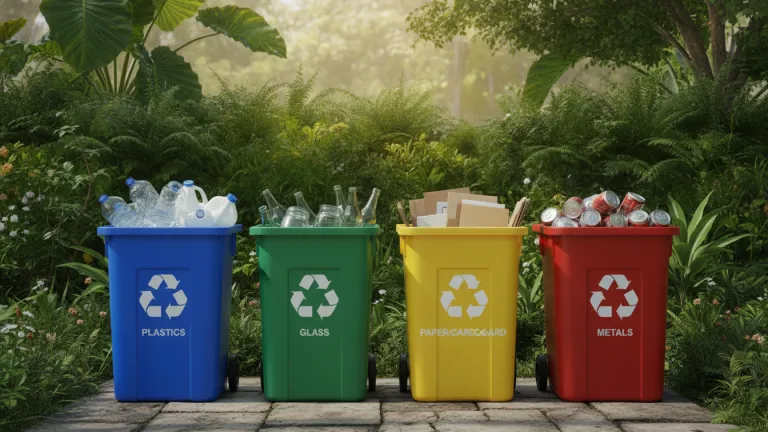
Selective collection in Brazil follows a color coding defined by CONAMA Resolution No. 275/2001, which guides the identification of collectors by material type. Knowing these colors helps a lot when disposing:
| Color | Material Type |
|---|---|
| 🔵 Blue | Paper and cardboard |
| 🔴 Red | Plastic |
| 🟢 Green | Glass |
| 🟡 Yellow | Metal |
| ⚫ Black | Wood |
| 🟠 Orange | Hazardous waste |
| ⚪ White | Healthcare waste |
| Brown | Organic waste |
| Gray | Non-recyclable waste |
In household practice, the most common approach is to work with two main groups: dry recyclables (paper, plastic, glass, and metal) and non-recyclables (organic and reject waste). But let’s detail each category to leave no doubt.
What Can and Can’t Be Recycled: Guide by Category
Paper and Cardboard: Accepted with Reservations
Can be recycled:
- Newspapers, magazines, and paper sheets
- Cardboard boxes (flattened to save space)
- Paper packaging (from rice, flour, etc.)
- Envelopes and notebooks (without the metal spiral)
- Paper towel and toilet paper rolls
Cannot be recycled:
- Used toilet paper and disposable tissues
- Carbon paper and photographs
- Waxed or laminated paper (like some fast food packaging)
- Pizza boxes with grease and food residue — this is one of the most common mistakes. If the box is very dirty, it goes in regular trash. If only the top part is clean, you can tear it off and recycle that portion.
Plastic: The Most Confusing Material
Plastic is the material that generates the most questions, and with good reason: there are many different types, not all recyclable in the same way.
Can be recycled:
- PET bottles (soda, water, juice)
- Shampoo, detergent, and cleaning product containers
- Plastic bags (many supermarkets have specific collection points)
- Margarine and yogurt containers (clean)
- Plastic caps
Cannot be recycled (in most municipalities):
- Metallized packaging (chips, cookies, ground coffee)
- Disposable diapers and sanitary pads
- Pot handles and electrical outlets
- Thin plastic straws and disposable cutlery
- Cleaning sponges
> Practical tip: Rinse containers before disposing. You don’t need to use soap — just a quick rinse to remove food residue is enough.
Glass: Heavy But Very Valuable
Glass is one of the noblest materials for recycling because it can be recycled infinitely without losing quality.
Can be recycled:
- Glass bottles (beer, wine, water)
- Preserve and jam jars
- Perfume and cosmetic bottles (without the metal cap, if possible)
Cannot be recycled:
- Broken glass — besides being dangerous for collectors, it has a different composition and contaminates the process. Wrap it in paper and dispose in regular trash, signaling the danger.
- Mirrors and window glass
- Light bulbs (have specific disposal points)
- Tempered glass (from automobiles, for example)
Metal: High Recovery Rate
Aluminum is one of the materials with the highest value in recycling and one of the best return rates in Brazil.
Can be recycled:
- Aluminum cans (soda, beer)
- Steel cans (tuna, corn, tomato paste)
- Metal lids and caps
- Aluminum foil (clean and crumpled into a ball)
- Old pans without special coating
Cannot be recycled with regular metal:
- Batteries (have specific disposal points at pharmacies and electronics stores)
- Paper clips and staples (too small for the industrial process — dispose in regular trash)
Step by Step: How to Set Up Waste Sorting at Home
Many people want to sort but don’t know where to start. Here’s a simple and efficient method:
- Choose a spot in the kitchen for two containers: one for dry recyclables and one for reject waste (regular trash). If you have space, a third one for organics is ideal.
- Label the containers with tags or colors. You don’t need to buy new bins — cardboard boxes or organized bags work just fine.
- Before throwing away any packaging, ask: is it clean? If yes, is it recyclable by type (paper, plastic, glass, metal)? If it’s dirty, rinse it quickly.
- Crush or fold packaging before disposing to save space and facilitate transport.
- Check the day and location of selective collection in your municipality. Many city halls have apps or communication channels where you can check the schedule.
- Identify nearby recycling cooperatives — taking materials directly to a cooperative ensures they reach good hands and also supports the work of collectors.
- Make it a family habit. Explain it to children in a playful way. The more people at home practice, the faster it becomes automatic routine.
What to Do with Special Waste
Some materials don’t fit into common recyclables and need special attention:
- Batteries: dispose at collection points in supermarkets, pharmacies, electronics stores, and city halls.
- Used cooking oil: don’t pour it down the sink or toilet. Many schools, supermarkets, and eco-points collect it. The oil can become biodiesel.
- Expired medications: participating pharmacies in the Medication Reverse Logistics Program accept returns.
- Electronics: laptops, cell phones, and appliances have specific collection points at stores and eco-points.
- Fluorescent bulbs: contain mercury and require special disposal at authorized points.
Composting: The Right Destination for Organic Waste
Food scraps represent a significant portion of household waste. When they go to landfills, they produce methane — a potent greenhouse gas. The alternative is composting, which transforms this waste into rich fertilizer for plants.
Even in apartments, it’s possible to compost with compact home composters. Fruit and vegetable peels, coffee grounds, dry leaves, and vegetable scraps are perfect raw material for this process. If you’re also interested in making better use of your home space to produce food, it’s worth checking out our article on Agricultura Urbana: Cultive Comida na Sua Cidade — a practice that pairs very well with composting.
Habits That Multiply the Impact of Recycling
Sorting waste is a fundamental step, but it becomes even more powerful when combined with other attitudes:
- Reduce before recycling. Recycling is important, but buying fewer disposable packages is even better.
- Prefer recyclable packaging when shopping — glass and aluminum have more established recycling chains in Brazil.
- Support farmers’ markets and bulk stores, which generate less packaging.
- Reuse before disposing — glass jars are great for storing food; cardboard boxes become organizers.
- Know and share the nearest eco-point to your home. Information is the main fuel for change.
To explore more sustainable attitudes that fit into anyone’s routine, check out our guide on Sustainable Habits You Can Adopt Today, full of practical and accessible ideas.
Conclusion: Every Action Counts
Sorting waste correctly doesn’t require perfection — it requires consistency. Making mistakes is part of learning. What matters is to keep trying, learn from doubts, and share knowledge with those around you.
You don’t need to transform your entire routine at once. Start with one thing: rinse containers before disposing. Or find out where the nearest eco-point is located. Or introduce the idea of composting to someone in your family.
Every correctly sorted package is a small vote in favor of a fairer and less wasteful system. And those votes, added together, have enormous power. You’ve already taken the first step by getting here — now it’s time to put it into practice.
