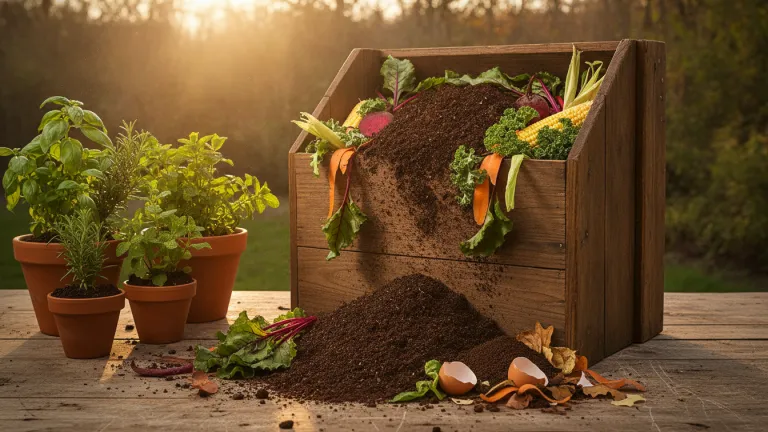
Every week, tons of banana peels, coffee grounds, kale stems, and leftover food travel the same path: from the sink straight to the trash. This material ends up in landfills, where it decomposes anaerobically and releases methane — a gas with global warming potential dozens of times greater than CO₂ over a 20-year horizon, according to IPCC data. The problem is real, but the solution can start in your own kitchen.
Home composting is one of the most accessible and transformative practices anyone can adopt, regardless of whether you live in a house or apartment. Instead of discarding organic waste, you convert it into humus — a nutrient-rich fertilizer that plants love. The process is natural, ancient, and with the right guidance, surprisingly simple.
In this article, you’ll understand why composting makes a difference, how to set up your own system at home, what can (and cannot) go into the compost bin, and how to use the fertilizer produced to transform pots, vegetable gardens, and yards into more vibrant and productive spaces.
Why organic waste is a serious environmental problem
In Brazil, organic waste represents more than half of everything discarded by families. According to data from the Brazilian Association of Public Cleaning and Special Waste Companies (Abrelpe), the country generates over 80 million tons of urban solid waste per year, and a significant portion of this total is composed of organic matter that could be reused.
When this waste reaches the landfill mixed with dry garbage, decomposition occurs without oxygen. In this anaerobic process, bacteria produce methane (CH₄), which significantly contributes to the greenhouse effect. Additionally, leachate — the liquid generated by decomposition — poses a risk of soil and groundwater contamination if not properly treated.
On the other hand, when organic waste is composted in an aerobic environment (with oxygen), carbon is released in a much more controlled manner, methane is virtually not generated, and the end result is a stable and beneficial material for the soil. Instead of polluting, you produce nutrition.
What is composting and how does the process work
Composting is the controlled decomposition of organic matter by microorganisms — fungi, bacteria, and other decomposers — that transform food scraps and plant materials into humus, a dark compound rich in nutrients with the smell of wet soil.
The process depends on four main factors:
- Moisture: the pile should be moist, but not waterlogged — think of the consistency of a lightly squeezed sponge.
- Aeration: the microorganisms that do the heavy work need oxygen. Turning the compost regularly accelerates the process and prevents bad odors.
- Carbon/nitrogen ratio: “green” materials (nitrogen-rich) need to be balanced with “brown” materials (carbon-rich). Without this balance, the process becomes slow or produces undesirable odors.
- Temperature: an active compost bin can reach high internal temperatures, which helps eliminate pathogens and weed seeds.
The result, depending on conditions and the method used, can be ready in a few weeks (in accelerated methods) to several months.
Materials that can and cannot go into the compost bin
One of the most common questions from beginners is exactly this: what do I put in the compost bin? The basic rule is simple — “greens” and “browns” in proportion, with some important exceptions.
Green materials (nitrogen-rich)
- Fruit and vegetable peels
- Coffee grounds and paper filters
- Tea bags (without metal staples)
- Salad scraps and vegetable trimmings
- Eggshells (neutral, but rich in calcium and useful)
- Freshly cut grass
Brown materials (carbon-rich)
- Shredded cardboard (without glossy paint)
- Dried leaves
- Untreated sawdust
- Shredded newspaper
- Cardboard egg cartons
- Straw and sugarcane bagasse
What should NOT go into a home compost bin
- Meat, fish, and dairy products (attract vectors and produce odor)
- Oils and fats in large quantities
- Feces from carnivorous animals (dog, cat)
- Synthetic materials, plastics, or metals
- Diseased plants or those treated with excess pesticides
- Onions and garlic in large quantities (can inhibit beneficial microorganisms)
How to set up your compost bin at home: step by step
You don’t need expensive equipment or a huge yard. There are methods for all types of homes.
Method 1: Worm compost bin (vermicomposting) — ideal for apartments
- Choose containers: use two or three stackable plastic storage bins with lids, organizing container type, with capacity between 30 and 50 liters each.
- Drill holes: in the lid and on the upper sides of the top bin (for ventilation) and in the bottom (to drain the leachate to the bin below).
- Prepare the initial bedding: place a 10 to 15 cm layer of moist organic material — a mixture of soil, coconut fiber, and dried leaves works well.
- Add the worms: the most commonly used species are Eisenia fetida (red wigglers) and Lumbricus rubellus. You can buy them at fishing or organic product stores.
- Feed gradually: start with small amounts of fruit and vegetable scraps. Always cover with brown material to prevent odors.
- Maintain moisture: lightly water if the bin seems dry. Add cardboard or leaves if it’s too wet.
- Collect the leachate: the liquid that drains to the lower bin is “worm leachate” — diluted in water (1 to 10 ratio), it’s an excellent liquid fertilizer.
- Harvest the humus: in about 2 to 4 months, the bin will be full of dark, nutrient-rich humus. Separate the worms and use the compost on your plants.
Method 2: Garden compost bin — for those with outdoor space
- Choose a location with partial shade and good drainage.
- Build a simple structure with wooden boards, mesh, or buy a plastic compost bin.
- Start with a layer of thin branches to ensure aeration at the base.
- Alternate layers of green and brown material in an approximate ratio of 1:2 (one part green to two parts brown).
- Water moderately and cover with a tarp or lid to maintain moisture.
- Turn with a garden fork every 7 to 14 days.
- The compost will be ready when it’s dark, uniform, and smells like soil.
How to use homemade organic fertilizer on plants
The finished compost is versatile and can be used in different ways:
- Potting soil amendment: replace up to 30% of the soil volume with mature compost.
- Garden beds: incorporate 3 to 5 cm of compost into the soil surface before planting.
- Liquid fertilizer: dilute the worm leachate in a 1:10 ratio with water and apply directly to the soil (not on leaves).
- Mulch: spread semi-cured compost around plants to protect the soil and release nutrients gradually.
- Seedling substrate: mix compost, soil, and sand in equal proportions to create a nutritious substrate for germination.
Worm humus is particularly recognized by Embrapa as one of the most efficient soil conditioners available, improving soil structure, water retention capacity, and nutrient availability for plants.
Common problems and how to solve them
| Problem | Likely cause | Solution |
|---|---|---|
| Strong bad smell | Excess green material or lack of air | Add brown material and turn |
| Compost bin too dry | Low moisture | Water lightly and mix |
| Flies appearing | Exposed scraps or prohibited material | Cover scraps with brown material; remove what shouldn’t be there |
| Process too slow | Lack of nitrogen or insufficient aeration | Add more green material and turn more frequently |
| Worms trying to escape | Excess acidity or high temperature | Add crushed eggshells and check moisture |
Community composting: when individual becomes collective
If you live in a condo, it’s worth talking to neighbors and management about creating a collective compost bin. Many Brazilian cities already have community composting support programs, with technical guidance and, in some cases, provision of initial structures. City halls like São Paulo, Curitiba, and Belo Horizonte have initiatives in this direction.
Additionally, some community urban gardens accept organic waste from residents and offer finished compost in return — a way to participate even without your own space. Reducing organic waste going to landfills is a real contribution that adds to other lifestyle changes, such as replacing single-use plastics with better ecological alternatives.
Conclusion: transforming is simpler than it seems
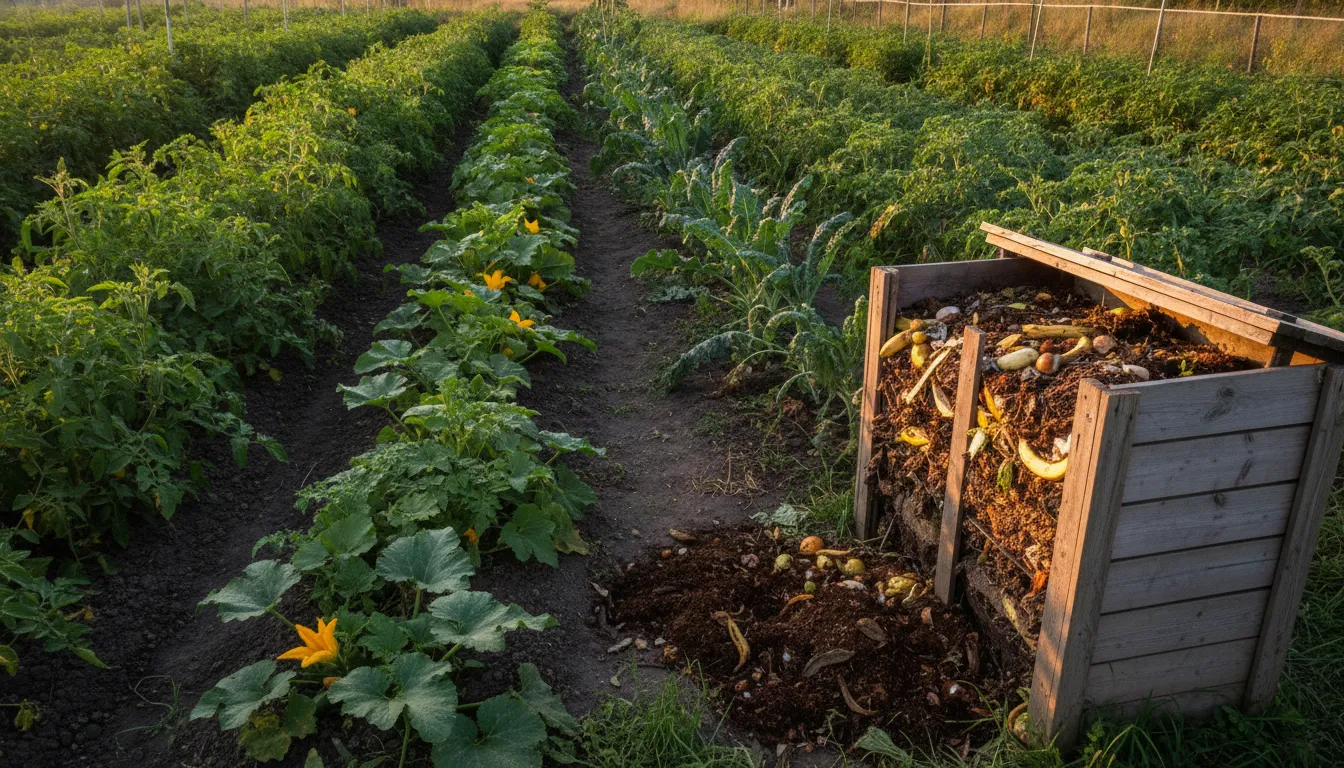
Composting is one of the most concrete gestures a person can make for planet health — and for their garden or vegetable patch. You reduce the amount of trash going to the landfill, decrease methane emissions, improve the soil of your plants, and close a cycle that nature has known how to do for millions of years.
Start small: a plastic bin, a handful of worms, and the scraps you would have thrown away are enough to take the first step. In just a few weeks, you’ll notice that what was trash transforms into something that nourishes life.
If you want to continue exploring ways to make your life more sustainable, also check out how solar energy can be an option even in apartments — another change that starts at home and generates real impact.
The transformation of waste into nutrition is, ultimately, a perfect metaphor for what we need to do on a larger scale: rethink what we call disposal and see, instead, possibilities.
