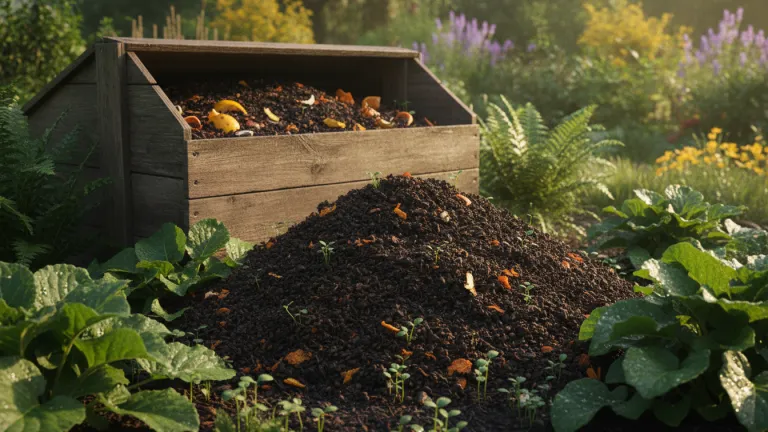
Imagine that every time you throw a banana peel in the regular trash, you’re contributing to a global climate problem. Sounds exaggerated? It’s not. Organic waste disposed of in landfills releases methane — a gas with a global warming potential dozens of times greater than CO₂ — when it could be transforming into something valuable: natural fertilizer, living soil, life. The good news is that there’s a simple, affordable solution within anyone’s reach: composting.
In Brazil, urban solid waste generation is among the highest in Latin America. According to the Overview of Solid Waste in Brazil, published by the Brazilian Association of Public Cleaning and Special Waste Companies (ABRELPE), organic matter represents more than half of everything we discard daily. Most of it goes straight to landfills, where it decomposes without oxygen and generates greenhouse gases on a large scale. Turning this waste into compost is one of the most powerful actions an ordinary citizen can take for the planet.
This article will show you what composting is, why it matters so much for the climate and soil, and — most importantly — how you can start today, whether in a small apartment, a house with a backyard, or in partnership with your community.
What is composting and how does this natural process work
Composting is the controlled decomposition of organic materials by microorganisms such as bacteria and fungi, with the participation of earthworms and other invertebrates. The final result is organic compost (or humus), a dark substance rich in nutrients with the smell of fresh earth — practically the opposite of the smelly garbage we imagine.
The process mimics what happens naturally in forests, where leaves fall, animals die, and everything decomposes on the ground, feeding the trees again. The difference is that in home or community composting, we control conditions to accelerate this cycle and ensure the result is safe and useful.
The two pillars of composting: green and brown materials
To work well, composting needs a balance between two types of material:
- Green materials (nitrogen-rich): fruit and vegetable scraps, coffee grounds, eggshells, freshly cut grass, green leaves.
- Brown materials (carbon-rich): unprinted cardboard, dry leaves, sawdust, non-laminated paper, straw.
The ideal ratio is around two to three parts brown material for each part green material. This balance prevents bad odors (too much green) and slow decomposition (too much brown). Proper aeration and moisture complete the recipe: the pile should always be moist like a well-wrung sponge and receive oxygen through periodic turning.
Why composting is a climate ally
The climate impact of organic waste in landfills is often underestimated. When organic matter decomposes without oxygen (a condition called anaerobic, typical of compacted landfills), it releases methane (CH₄). The Intergovernmental Panel on Climate Change (IPCC) points out that methane has a global warming potential more than 80 times greater than CO₂ over a 20-year horizon — and landfills are one of the main anthropogenic sources of this gas.
Composting, on the other hand, is an aerobic process: it occurs in the presence of oxygen and therefore releases mainly CO₂ and water vapor in much smaller quantities than those generated in landfills. But the benefit goes beyond emissions reduction:
- Carbon sequestration in soil: organic compost incorporated into the earth increases the soil’s organic matter content, which then retains more carbon.
- Reduced use of synthetic fertilizers: chemical fertilizer production is fossil fuel intensive. Using compost reduces this demand.
- Improved soil health: soils richer in organic matter retain more water, resist erosion better, and support greater microbial biodiversity.
On a global scale, the Food and Agriculture Organization of the United Nations (FAO) recognizes composting as one of the waste management practices with the greatest potential contribution to sustainable food systems and climate resilience.
Home composting: step-by-step guide to start today
You don’t need a large backyard or expensive equipment to get started. Here’s how to set up your composter at home:
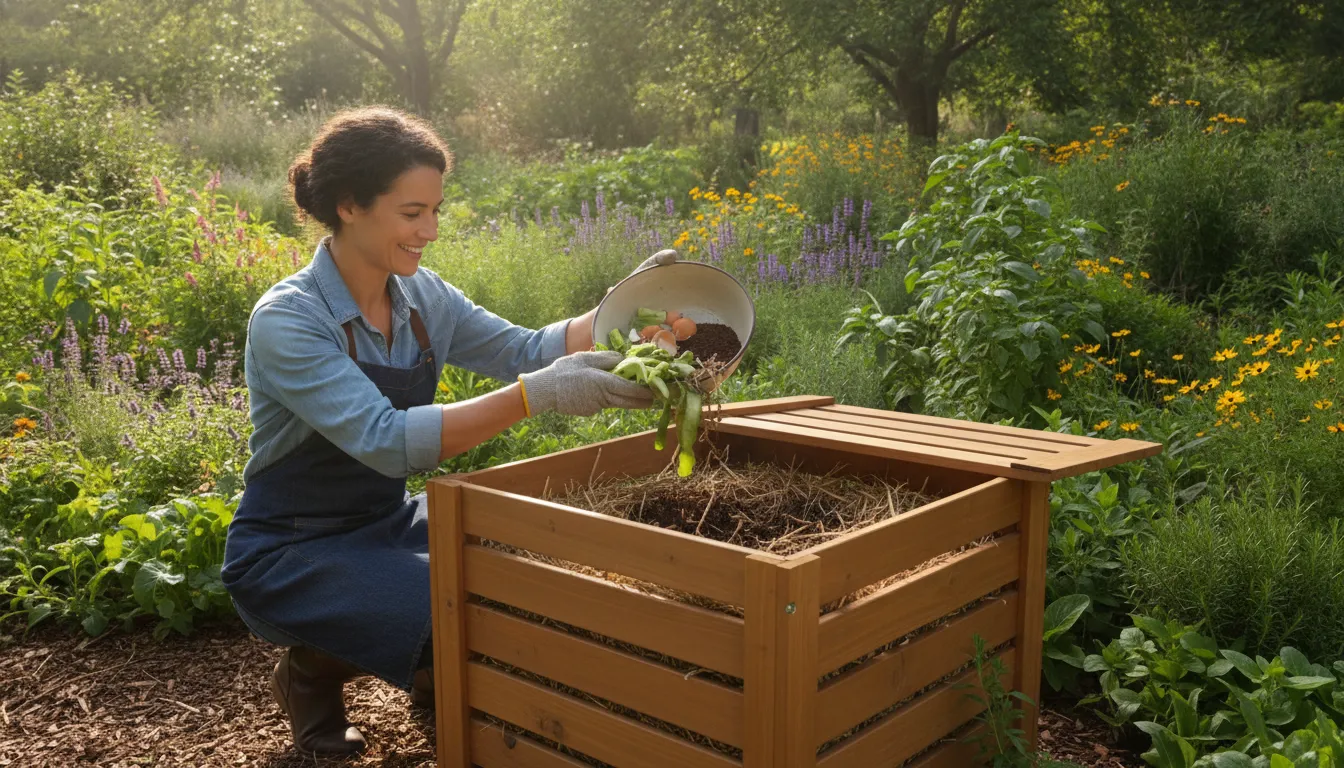
- Choose the container: it can be a ready-made composter, a plastic bucket with a lid (drill holes for aeration), or a slatted wooden box. For apartments, worm composters (vermicomposting) are ideal as they’re compact and nearly odorless.
- Choose the location: a shaded corner of the backyard, balcony, or utility area. Avoid intense direct sunlight, which dries out the mixture too much.
- Build the base: start with a layer of brown material (dry leaves, torn cardboard) about 10 cm thick. This ensures drainage and aeration.
- Add organic scraps: add kitchen waste (peels, coffee grounds, eggshells) and always cover with a layer of brown material. This cover prevents odors and keeps unwanted insects away.
- Maintain moisture: the pile should always be moist but not waterlogged. If it’s dry, spray with water. If it’s too wet, add more brown material.
- Turn periodically: in backyard composters, turning the pile every one to two weeks speeds up decomposition and ensures oxygenation.
- Wait for the compost to be ready: under good conditions, compost is ready in two to four months. It will be ready when it has a dark color, uniform texture, and smells like forest soil.
What can and CANNOT go in the composter
| Can compost | Cannot compost |
|---|---|
| Fruit and vegetable peels | Meat, fish, and dairy |
| Coffee grounds and paper filters | Oils and fats |
| Eggshells | Feces from carnivorous animals |
| Dry leaves and grass | Diseased or pesticide-treated plants |
| Cardboard and unprinted paper | Plastic, glass, metal |
| Bread scraps (in small amounts) | Diapers and synthetic materials |
Vermicomposting: the perfect option for apartments
For those living in small spaces, vermicomposting — composting with worms — is the ideal solution. Worms of the species Eisenia fetida (red wiggler) are the most commonly used: they digest organic waste with impressive efficiency and produce worm castings, considered one of the most complete organic fertilizers available.
A worm composter can fit under the kitchen sink, has practically no smell when properly managed, and processes waste quickly. In addition to solid humus, it produces leachate (dark liquid released during the process), which when diluted in water works as an excellent liquid fertilizer for plants.
If you want to take a step further in sustainable gardening, start your home garden and use the compost you produce to nourish your own plants — a virtuous cycle that connects composting, food, and sustainability.
Community and urban composting: collective and transformative
Not everyone has the space or inclination to compost individually — and that’s okay. Community composting is a powerful alternative growing in Brazilian cities and around the world.
Some models that work:
- Voluntary drop-off points: neighborhoods or condominiums organize a collection point for organic waste, which is managed collectively or delivered to cooperatives.
- Condominium composters: buildings install collective composters in gardens or common areas, often with support from city governments.
- Partnerships with fairs and markets: farmers’ markets generate large volumes of organic waste that can be composted locally.
- Urban community gardens: the compost produced feeds shared gardens, which in turn produce fresh food for the community.
In many Brazilian cities, municipal environmental departments already offer free courses, subsidized composting kits, and technical support for community initiatives. It’s worth researching what’s available in your municipality.
How to use finished compost: closing the cycle
Compost is a gift to the soil. Here’s how to use it:
- In pots and home gardens: mix compost with soil at a ratio of approximately 20 to 30% of the total substrate volume.
- In gardens and flower beds: spread a 3 to 5 cm layer over the soil and lightly incorporate with a rake.
- As mulch: applied on the soil surface, compost retains moisture, controls weeds, and protects roots.
- Donation: if you produce more than you need, many community gardens, schools, and environmental projects gladly accept compost.
Caring for the soil is also caring for the climate. Healthy soils rich in organic matter are fundamental allies in fighting climate change — just like reducing deforestation, a topic we explore in depth in our article about what Amazon deforestation is destroying.
Myths and truths about composting
Many people delay starting due to misconceptions. Let’s debunk them:
- “Composters smell bad.” Only true when poorly managed. With the right ratio of brown and green materials, the process has almost no odor.
- “It attracts rats and insects.” Only happens when meat, fat is added, or when the composter isn’t covered. Following basic rules, there’s no problem.
- “It’s too complicated.” Composting can be as simple as throwing peels in a bucket and covering with leaves. You learn by doing.
- “It only works with large spaces.” Vermicomposting proves otherwise: it fits in apartments of any size.
- “It takes too long to see results.” With worms, compost can be ready in less than two months. Results appear quickly.
Start now: your next practical step
Transformation begins with concrete actions. Here’s a list of things you can do this week:
- Set aside a bucket with a lid to collect organic waste in the kitchen.
- Search Google for “free composting [your city name]” to see if there are municipal programs available.
- Gather dry leaves or set aside cardboard boxes to use as brown material.
- Talk to neighbors about setting up a collective composter in your building.
- If you have plants at home, try vermicomposting — starter kits can be found at fairs, garden stores, and even online marketplaces.
Composting isn’t a magic solution, but it’s one of the individual actions with the greatest real and measurable impact on the climate, soil, and city health. Every fruit peel that goes to the composter instead of the landfill is a small act of resistance and care for the planet we share. And the best part: the soil returns the favor, producing more life, more food, and more beauty. Why not start today?
