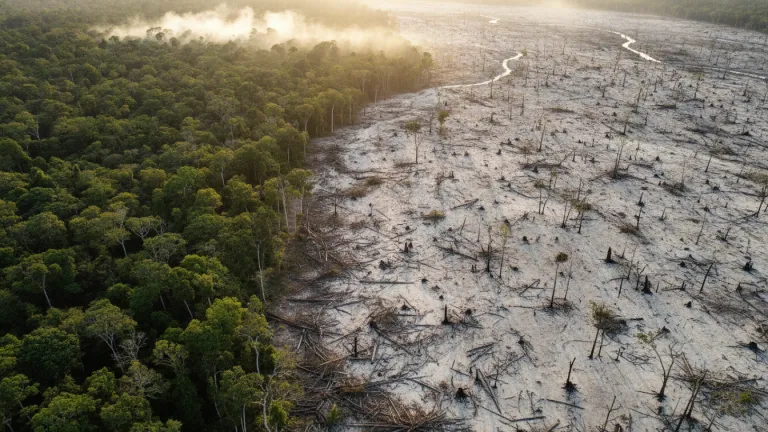
Amazon Deforestation: Real Consequences You Need to Know
The Amazon is not just a forest. It is the largest tropical biome on the planet, a living system that regulates the climate of entire continents, harbors about 10% of all known terrestrial biodiversity, and is home to hundreds of indigenous peoples. When we hear that hectares of forest have been destroyed, the numbers can seem abstract — distant, almost unreal. But the consequences of Amazon deforestation are already felt in the electricity bills of those living in São Paulo, in the soybean fields of Mato Grosso, in the floods of Rio Grande do Sul, and in the droughts that compromise the water supply of entire cities.
In recent years, Brazil has experienced significant fluctuations in this scenario. After a period of significant reduction in deforestation rates in the early 2000s, the indices rose again over the past decade. Data from INPE (National Institute for Space Research) pointed to a significant drop in deforestation rates between 2023 and 2024, a result of more active public policies, but experts warn that pressure on the forest remains intense — and that the accumulated damage is already taking a heavy toll.
This article is not about catastrophism. It’s about understanding, clearly and honestly, what’s at stake — and what each of us can do to turn this around.
What Amazon Deforestation Really Means on a Global Scale
When a tree is cut down in the Amazon, it doesn’t just disappear from the map. It takes with it decades of stored carbon, which is released into the atmosphere in the form of CO₂ and other greenhouse gases. The Amazon stores a colossal amount of carbon in its biomass — scientific estimates published in journals such as Nature and Science point to billions of tons of carbon accumulated over millennia. Degradation and deforestation turn this stockpile into a net emitter of greenhouse gases.
The IPCC (Intergovernmental Panel on Climate Change) recognizes that tropical deforestation is one of the main sources of carbon emissions in the world, accounting for a significant share of annual global emissions. Brazil, being the country with the largest extent of tropical forest, carries a disproportionate responsibility — and power — in this equation.
Beyond carbon, the Amazon rainforest is fundamental to the hydrological cycle. It produces the so-called “flying rivers”: currents of water vapor that move across the continent and feed rainfall in regions very far from the forest, including the Central-West, Southeast, and even parts of South America. When the forest shrinks, this system weakens — and the consequences appear in the form of droughts, heat waves, and climate irregularities that directly affect food production and water supply.
Climate Consequences That Have Already Reached Your City
You don’t need to live in Pará or Amazonas to feel the effects of deforestation. Researchers from USP, Unicamp, and international institutions have documented the relationship between the loss of forest cover in the Amazon and the reduction of rainfall volumes in regions such as southeastern Brazil.
The water crisis that hit the Cantareira System in São Paulo between 2014 and 2015 was studied by climatologists who pointed out, among other factors, the influence of the reduction of flying rivers. Extreme weather events — such as the historic droughts in the Amazon in 2023 and the devastating floods in Rio Grande do Sul in 2024 — are also analyzed in light of changes in the regional climate system, partly influenced by forest degradation.
For Brazil’s electricity sector, this has a direct impact: the country relies heavily on hydroelectric plants. When rivers have less water, energy generation is compromised, tariff flags rise, and electricity bills become more expensive for everyone. It’s a cycle that begins in the forest and ends in the consumer’s pocket.
Biodiversity at Risk: What We Lose Without Knowing
The Amazon is considered by the IUCN (International Union for Conservation of Nature) as one of the most biodiverse regions on the planet. It is estimated that the forest harbors thousands of species of plants, birds, mammals, reptiles, amphibians, and insects — many of them not yet catalogued by science.
Deforestation not only eliminates species: it fragments habitats, isolates animal populations, and destabilizes entire food chains. Species that depend on large expanses of continuous forest — such as jaguars, giant otters, and various migratory birds — are the first to suffer from fragmentation.
There is also a less visible but equally urgent dimension: the loss of knowledge. Many Amazonian plants have medicinal properties studied by pharmaceutical laboratories around the world. When a species goes extinct before being catalogued, we lose forever what it could offer us — in terms of medicines, scientific research, and biotechnological potential.
Social Impacts: Indigenous Peoples and Traditional Communities on the Front Lines
Deforestation is not just an environmental issue — it is also a human rights issue. More than 300 indigenous peoples live in the Brazilian Amazon, according to data from FUNAI and the Socio-Environmental Institute (ISA). Their lands, when demarcated and protected, are proven to have the lowest deforestation rates — demonstrating that guaranteeing indigenous territorial rights is also an effective environmental policy.
When the forest is destroyed, entire communities lose their sources of food, water, medicine, and culture. Deforestation is frequently associated with violent land conflicts, slave-like labor in illegal mining areas, and mercury contamination of rivers, directly affecting the health of riverside populations.
Protecting the Amazon, therefore, cannot be discussed without talking about social justice. They are two sides of the same coin.
The Role of Livestock and Agriculture in Deforestation
Understanding the causes of deforestation is essential for acting intelligently. According to historical data from INPE and reports from organizations such as MapBiomas, the expansion of extensive livestock farming is responsible for most of the deforestation in the Amazon, followed by the clearing of areas for agriculture, especially soybeans.
This does not mean that agriculture and forest are incompatible — quite the contrary. Brazil has technologies and production systems that allow increasing agricultural productivity without cutting down a single additional tree. Embrapa has developed for decades systems such as crop-livestock-forest integration (ILPF), which combines different productive activities in the same space, increasing land use efficiency and reducing pressure on native areas.
The challenge is political and economic: making these more sustainable practices financially attractive to rural producers — and ensuring that the consumer market, including international markets, demands and pays better for products with proven sustainable origins.
What You Can Do: Practical and Concrete Actions
It may seem like the problem is too big for an ordinary person to make a difference. But individual choices — when added to millions of others — carry real weight. Here’s what you can start doing today:
- Reduce beef consumption, especially beef without sustainable origin certification. Extensive livestock farming is the main cause of deforestation; reducing demand is a direct way to pressure the market.
- Research the origin of the products you consume. Apps and certification labels, such as Rainforest Alliance and FSC, help identify products with lower environmental impact.
- Support organizations working to protect the Amazon, such as ISA (Socio-Environmental Institute), Imazon, IPAM (Amazon Environmental Research Institute), and Conectas, either financially or by amplifying their work on social media.
- Hold your political representatives accountable. Participate in public consultations, sign petitions, and vote for candidates committed to serious environmental policies.
- Reduce your food waste. Much of deforestation is linked to the production of food that will never be consumed. Less waste means less pressure on the land.
- Plant something. If you live in a city, considering urban agriculture is a concrete way to reconnect with nature and reduce your food footprint.
- Share quality information. Misinformation about deforestation is a real problem. Share reliable sources and help build a better-informed public opinion.
Signs of Hope: What Is Working
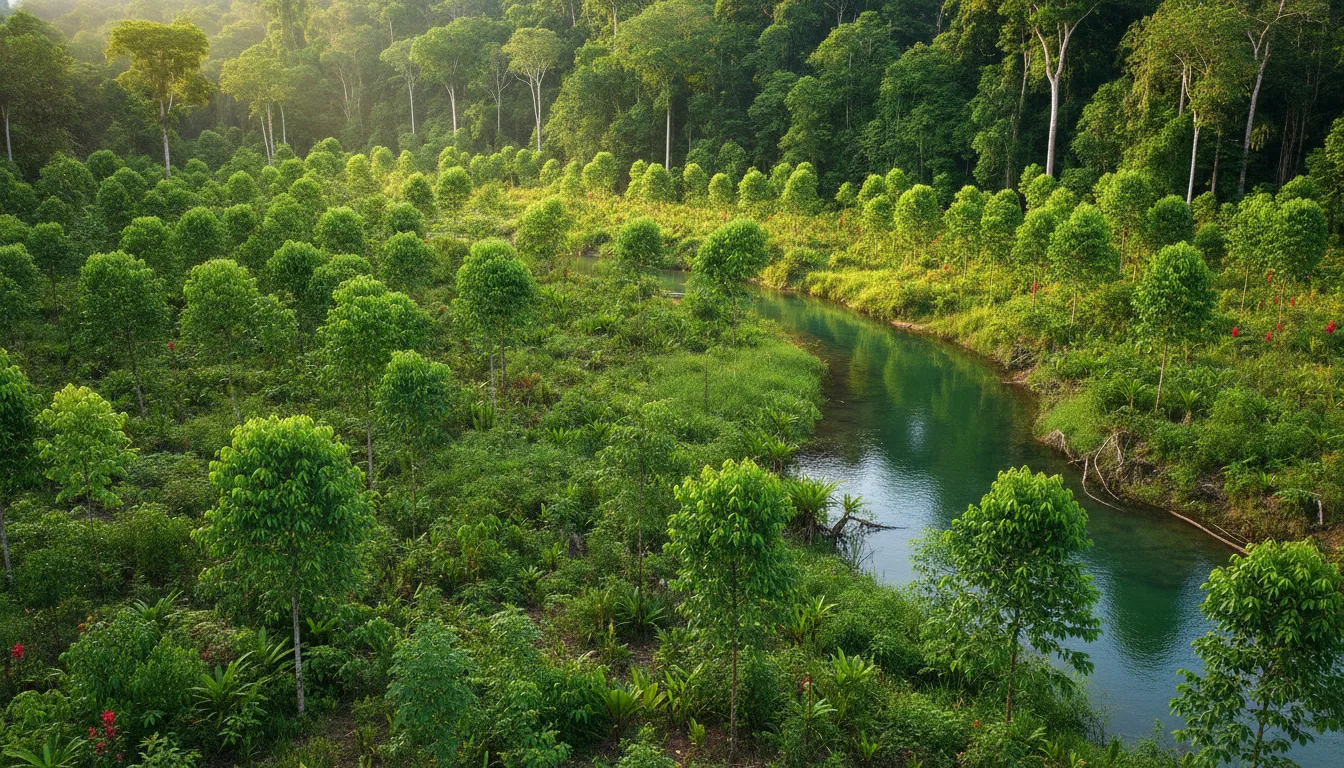
It would be dishonest to end this article without acknowledging real advances. Brazil has already demonstrated in the past that it is possible to drastically reduce deforestation when there is political will and effective instruments. Between 2004 and 2012, deforestation rates in the Amazon dropped by about 80%, according to INPE — a feat internationally recognized as one of the greatest environmental conservation achievements in recent history.
The resumption of enforcement and monitoring policies from 2023 has already begun to show results. The Amazon Fund, funded mainly by Norway and Germany, has resumed operations and has been supporting bioeconomy projects, enforcement, and support for local communities. The bioeconomy — which includes sustainable management of forest products such as açaí, Brazil nuts, rubber, and vegetable oils — emerges as a real economic alternative to keep the forest standing while generating income for those who live in it.
There is also a growing movement of Brazilian and multinational companies committing to eliminating deforestation from their supply chains — pressured both by international regulations, such as the European Union’s deforestation law, and by increasingly aware consumers.
The Amazon is at a critical moment — but not at a point of no return. Science shows that forests have the capacity to regenerate when given the right conditions. History shows that public policies work when there is real commitment. And everyday experience shows that engaged people can change behaviors, markets, and governments.
Protecting the Amazon is not a distant cause of idealistic environmentalists. It is a matter of climate, water, energy, health, economy, and justice. It is, ultimately, a matter of the future. And the future is built with the choices we make now — including the choice to stay informed, share, and act. You have already taken the first step.
