
Have you ever stopped to think about how much of planet Earth is needed to sustain your lifestyle? That’s exactly the question the concept of ecological footprint tries to answer. Developed in the 1990s by researchers Mathis Wackernagel and William Rees at the University of British Columbia, this index measures the amount of biologically productive area — land and sea — needed to generate the resources a person consumes and to absorb the waste they produce.
The problem is that, collectively, humanity already consumes far more than the Earth can regenerate in a year. The Global Footprint Network organization estimates that, in recent years, humanity has been using the equivalent of more than one and a half planets worth of resources annually. This means we’re “borrowing” from Earth’s future regenerative capacity — an ecological deficit that grows each decade.
The good news is that the ecological footprint isn’t a fixed destiny. It’s actually a map. And maps exist to guide us. By understanding where your biggest impacts are, you can make more conscious decisions — without having to give up quality of life. This article will show you how to do that in a practical and accessible way.
What Is the Ecological Footprint and How Is It Calculated
The ecological footprint is measured in global hectares (gha) — a unit representing one hectare of land with average global productivity. It takes into account different consumption categories:
- Carbon: the forest area needed to absorb the CO₂ emitted by your energy consumption and transportation
- Food: land and water used to produce what you eat
- Housing: energy consumed at home (electricity, gas, heating)
- Goods and services: everything you buy and discard
- Built-up land: space occupied by urban infrastructure
The higher the number in gha, the greater the impact. The biocapacity available per person on the planet is approximately 1.6 gha. The average footprint of a Brazilian, according to historical data from the Global Footprint Network, is around 2.9 gha — above the sustainable average, but well below countries like the United States (over 8 gha) and Australia.
How to Calculate Your Personal Ecological Footprint
You don’t need to be a scientist to find out the size of your footprint. There are free and accessible online calculators:
- Visit the footprintcalculator.org website (from the Global Footprint Network) or calculadora.footprintnetwork.org
- Answer questions about your eating habits, transportation, housing, and consumption of goods
- The result will show your footprint in gha and in “number of planets” needed if everyone lived like you
- Note the categories where you scored highest — they will be your starting point
The process takes about 10 minutes and often surprises people. Many discover that food and transportation account for most of the impact, not necessarily the visible daily waste.
Food: The Factor That Weighs Most on Your Footprint
If there’s one aspect of daily life with enormous potential for change, it’s what we put on our plates. Food production accounts for a significant portion of global greenhouse gas emissions, deforestation, and freshwater use.
Beef, in particular, has a significantly larger footprint than other foods. This occurs for three main reasons: methane emissions from cattle (a very potent greenhouse gas), intensive land use for grazing and feed cultivation, and deforestation associated with livestock expansion — especially in Brazil, where the Amazon biome and the Cerrado face constant pressure, according to data from the National Institute for Space Research (INPE).
Practical High-Impact Changes in Diet
You don’t need to become vegan overnight. Small adjustments already make a real difference:
- Reduce red meat consumption: replacing beef with chicken, fish, or legumes in two or three meals per week already represents a considerable reduction in emissions
- Prefer local and seasonal foods: foods transported from far away or grown out of season consume more energy
- Reduce food waste: according to the Food and Agriculture Organization of the United Nations (FAO), approximately one-third of all food produced in the world is lost or wasted — a problem with enormous environmental impact
- Buy only what you need: plan meals before going to the market
- Value family farming and organic products: agroecological systems tend to be more sustainable and contribute to biodiversity conservation, as highlighted by Embrapa in its studies on agroecological transition
Transportation: How You Get Around Matters a Lot
The transportation sector is one of the largest CO₂ emitters in Brazil and worldwide. The use of vehicles powered by fossil fuels represents a significant portion of individual carbon footprint.
The good news is that Brazil has some unique advantages: the national electricity matrix is predominantly renewable — composed mainly of hydroelectric, wind, and solar power, according to data from the National Electric Energy Agency (ANEEL) — and the country already has a tradition with ethanol, a fuel derived from sugarcane that emits less carbon than gasoline in the complete production cycle.
Transportation Choices from Least to Most Impactful
| Mode of transportation | Relative carbon footprint |
|---|---|
| Walking / Bicycle | Virtually zero |
| Public transportation (bus, subway, train) | Low to moderate |
| Electric car (with renewable energy) | Low |
| Ethanol-powered car | Moderate |
| Gasoline-powered car | High |
| Airplane (domestic and international flights) | Very high |
Prioritize walking, cycling, and using public transportation whenever possible. For necessary car trips, consider vehicle sharing. And if the topic is how to choose the best mode for your routine, it’s worth reading a specialized guide on sustainable transportation.
Energy at Home: Small Changes, Big Results
The household footprint involves electricity and gas consumption. Even with a relatively clean electricity matrix in Brazil, saving energy still matters — both for the direct impact and for the indirect impact on reservoirs, infrastructure, and costs.
Simple Habits to Reduce Energy Consumption
- Replace incandescent or fluorescent bulbs with LED: LEDs consume much less energy and have a much longer lifespan
- Turn off devices on standby: phantom consumption can represent a significant portion of the electricity bill
- Use the washing machine with a full load and, preferably, cold water
- Prefer fans over air conditioning when the temperature allows
- Check the energy efficiency label when buying appliances — it indicates the product’s energy efficiency
- Consider solar photovoltaic energy: the cost of panels has dropped significantly in recent years and Brazil has one of the best solar irradiation indices in the world, according to data from the Brazilian Solar Energy Atlas (Inpe/CCST)
Consumption of Goods and Services: The Culture of Disposal
We live in a consumer society that encourages frequent replacement of products — clothes, electronics, furniture. Every item produced consumes natural resources, energy, and generates waste. The ecological footprint of “goods and services” is often underestimated because it’s not visible in daily life.
The concept of circular economy proposes an alternative: instead of “produce, use, and discard,” the circular model encourages repairing, reusing, recycling, and redesigning products so they last longer and generate less waste.
Some practices you can adopt today:
- Consume less and better: before buying, ask yourself if you really need the item
- Repair before replacing: cobblers, seamstresses, and repair shops help extend the life of products
- Buy second-hand: thrift stores, fairs, and used goods platforms are great options
- Avoid fast fashion: the textile sector is one of the most polluting in the world, with enormous water consumption and generation of chemical effluents
- Make cleaning products at home: besides saving money, you reduce plastic packaging and chemicals in the environment — see how at Make Eco-Friendly Cleaning Products at Home
To go deeper into this transformation of consumption habits, the guide on conscious shopping offers practical strategies to spend less and pollute less at the same time.
Water: The Invisible Resource in Your Footprint
The concept of water footprint complements the ecological footprint by showing the total volume of freshwater used — directly and indirectly — in your lifestyle. Food, clothing, electronics: everything has a “cost” in water that rarely appears on the label.
Brazil is privileged in water resources, but that doesn’t mean the problem doesn’t affect us. Regions like the Northeast and parts of the Central-West face growing water stress, and climate change is expected to intensify this situation, according to IPCC projections.
Practical actions to reduce water consumption:
- Install flow reducers on faucets and showerheads
- Fix household leaks immediately (one drip per second can waste thousands of liters per month)
- Prefer short showers over baths
- Reuse washing machine water to clean floors
- Plant native species in the garden, which need less irrigation
Conclusion: Your Footprint Is Dynamic — And You Have the Power to Change It
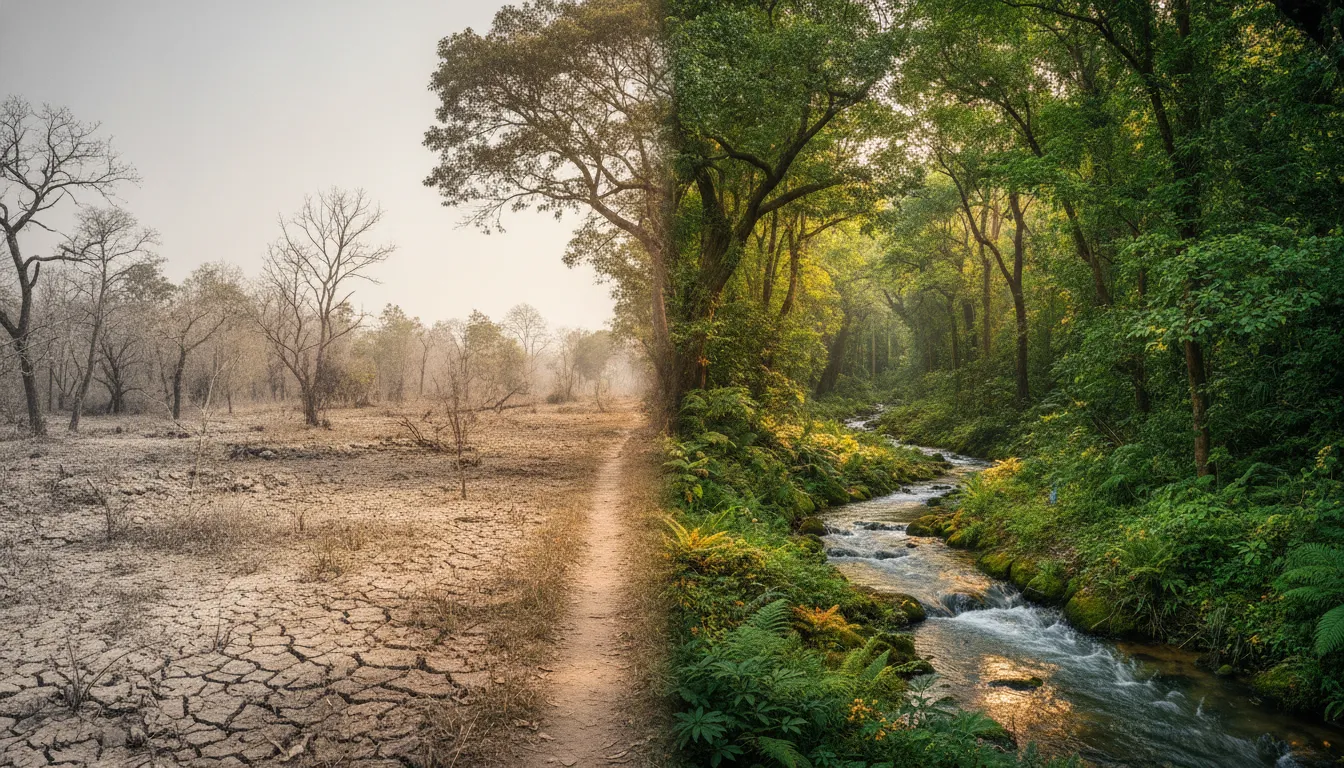
The ecological footprint is not a sentence. It’s a diagnosis. And, like any good diagnosis, it exists to guide action, not to generate guilt or paralysis.
Every choice we make — what we eat, how we move around, what we buy, how we use energy and water — has real consequences on the ecosystems that sustain life on the planet. But these choices also have the power to reverse negative trends when made consciously and collectively.
You don’t need to change everything at once. Start by calculating your ecological footprint today. Choose one or two areas where your impact is greatest and implement gradual changes. Share what you learn with people close to you. Small individual actions, added together, create cultural and market pressure for more sustainable products, services, and policies.
In 2026, the tools, knowledge, and sustainable alternatives are already available like never before. What makes the difference now is the willingness to use them. The planet thanks you — and you’ll thank yourself too.
