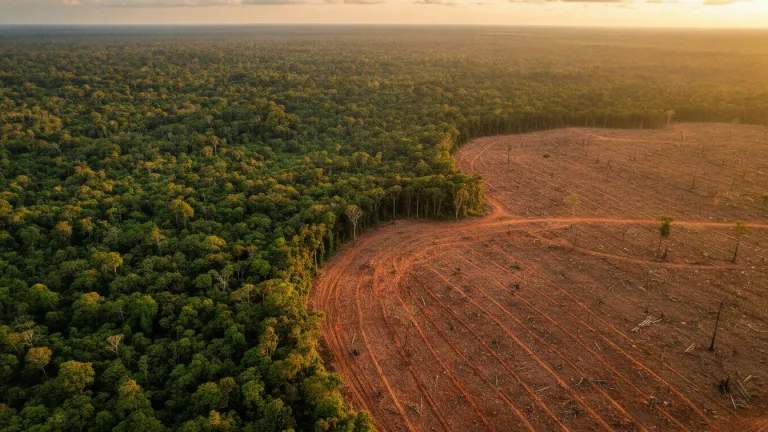
The Amazon is burning. Not metaphorically, but literally — with fire hotspots multiplying each dry season, fueled by decades of progressive deforestation. For those watching from afar, it may seem like a distant problem, limited to the borders of a single country. But what happens in the world’s largest tropical rainforest reverberates in every corner of the globe, from rainfall cycles in Southeast Asia to ocean temperatures in the South Atlantic.
The Brazilian Amazon covers more than 5 million square kilometers and harbors approximately 10% of all living species on Earth. It regulates regional and global climate, stores immense volumes of carbon, and produces about 20% of the oxygen circulating in Earth’s atmosphere. When this forest disappears, we don’t just lose trees — we lose a life support system that took millions of years to form.
In this article, we’ll understand why Amazon deforestation is one of the most urgent environmental crises of the 21st century, what its concrete consequences are for the planet, and most importantly, what each of us can do to be part of the solution.
The Current State of Amazon Deforestation
Deforestation in the Brazilian Amazon has been systematically monitored by INPE (National Institute for Space Research) through the PRODES system since the 1980s. Historical data shows alarming peaks in the early 2000s, followed by a significant decline until the mid-2010s, and a new escalation starting in 2019.
According to INPE, the Amazon biome has lost more than 700,000 km² of original forest cover since systematic monitoring began — an area larger than all of France. Although the most recent data from 2024 and 2025 point to a slowdown in annual deforestation rates, experts warn that the Amazon may be approaching a tipping point: the moment when the forest stops generating enough rain to sustain itself and begins to irreversibly transform into savanna.
Main causes of Amazon deforestation
Deforestation doesn’t happen by accident. It’s driven by a combination of economic, political, and social factors:
- Agricultural expansion: extensive cattle ranching and soybean cultivation for export are historically the biggest drivers of Amazon deforestation, according to reports from MapBiomas and the Amazon Institute of People and the Environment (Imazon).
- Illegal logging: entire communities of illegal loggers operate in protected areas and indigenous lands.
- Illegal mining (garimpo): especially devastating for rivers and indigenous communities, such as the Yanomami, whose health crisis gained international attention in 2023.
- Public land grabbing: fraudulent appropriation of federal lands for subsequent resale and conversion to pasture or crops.
- Unplanned infrastructure: roads opened without proper environmental licensing function as “fishbone” patterns, facilitating access to the forest interior.
Climate Consequences: Far Beyond Brazilian Borders
The most widely documented impact of Amazon deforestation is its contribution to global warming. Amazon trees store carbon throughout their lives. When they’re cut down and burned, all that carbon is rapidly released into the atmosphere as CO₂ and other greenhouse gases.
The IPCC (Intergovernmental Panel on Climate Change) recognizes tropical deforestation as one of the main sources of global greenhouse gas emissions. Studies published in leading scientific journals such as Nature and Science indicate that parts of the Amazon now emit more carbon than they absorb during certain periods, especially in the most deforested regions of the deforestation arc in the south and east of the biome.
The “flying rivers” and Brazil’s water crisis
One of the less visible — but extremely serious — effects of deforestation is the disruption of the so-called flying rivers: streams of water vapor that the Amazon rainforest releases into the atmosphere through tree transpiration. Research by climatologist Antonio Donato Nobre and the INPA team (National Institute for Amazon Research) shows that these aerial rivers transport moisture to Brazil’s Central-West, Southeast, and even Southern regions, feeding the rains that supply reservoirs, irrigate crops, and sustain cities like São Paulo and Buenos Aires.
When the Amazon shrinks, these flying rivers weaken — and the consequences arrive in the form of prolonged droughts, crop failures, and water and electricity supply crises. In a country where hydroelectric generation still accounts for a significant portion of the energy matrix, according to ANEEL data, this relationship between forest and energy is not a metaphor: it’s infrastructure.
Biodiversity in Collapse: What We Lose with Each Hectare
The Amazon is the planet’s most biodiverse ecosystem. It’s estimated to harbor more than 40,000 plant species, 1,300 bird species, 3,000 freshwater fish species, and a diversity of insects not yet fully catalogued by science.
The IUCN (International Union for Conservation of Nature) classifies dozens of Amazonian species as threatened with extinction, a number that grows with each new deforestation cycle. But biodiversity loss goes beyond the disappearance of charismatic species like the jaguar or the pink river dolphin. It means:
- Collapse of ecosystem services such as pollination, pest control, and water purification
- Loss of genetic material potentially valuable for medicine and agriculture
- Disruption of food chains that sustain riverine human populations
- Increased risk of emergence of new zoonotic diseases, as noted by researchers from EcoHealth Alliance and Fiocruz
Indigenous peoples and traditional communities on the front lines
No environmental tragedy is purely environmental. Amazon deforestation directly threatens the physical and cultural survival of more than 300 indigenous peoples living in the forest. Research from the Socio-Environmental Institute (ISA) consistently demonstrates that demarcated indigenous lands have the lowest deforestation rates in the Amazon — which means protecting these communities’ rights is also one of the most effective environmental conservation strategies.
The Role of Global Consumption in Forest Destruction
It’s tempting to view deforestation as an exclusively Brazilian problem. But global demand for commodities like soy, beef, timber, and minerals is a fundamental driver of this process. Countries in Europe, Asia, and North America consume products whose production chains frequently pass through Amazon deforestation.
Initiatives like the Glasgow Agreement on Deforestation (2021) and new European Union regulations on imported deforestation — in effect since 2023 with progressive requirements in subsequent years — seek to create market pressure for traceable, deforestation-free products. But implementation still faces significant monitoring and traceability challenges.
What You Can Do: Practical Actions Starting Today
The feeling of powerlessness in the face of a crisis of this magnitude is understandable. But the sum of conscious individual choices, especially when combined with collective pressure on companies and governments, has real transformative power. Here’s what’s within anyone’s reach:
In your daily consumption:
- Reduce beef consumption, especially from sources without origin certification. Cattle ranching is the main driver of Amazon deforestation.
- Prefer products with recognized socio-environmental certification seals, such as Rainforest Alliance or FSC (for wood and paper).
- Avoid uncertified wood in renovations and furniture.
- Question companies about their supply chain traceability policies.
In your civic engagement:
- Learn about candidates’ environmental policies before voting.
- Support organizations working directly in the Amazon, such as ISA, Imazon, Funbio, or Greenpeace Brazil.
- Share quality information on this topic — combating environmental misinformation is also a form of action.
In your digital and financial footprint:
- Check if your bank or investment fund finances companies involved in deforestation. Organizations like the Rainforest Action Network publish periodic reports on the topic.
- Consider better understanding your ecological footprint to identify the highest-impact points in your lifestyle.
Solutions That Work: Inspiring Examples
The crisis is real, but we’re not empty-handed. There are solutions that have already proven to work:
| Solution | Evidence of effectiveness |
|---|---|
| Indigenous land demarcation | Lowest deforestation rates documented by INPE in demarcated indigenous territories |
| Payment for Environmental Services (PES) | Programs like REDD+ showed deforestation reduction in verified projects |
| Satellite technology monitoring | DETER/INPE system enables near real-time response to deforestation alerts |
| Soy Moratorium (2006) | Associated with significant reduction of deforestation for soy cultivation in the biome |
| Conditional rural credit | Initiatives like the Rural Environmental Registry (CAR) create incentives for environmental compliance |
These examples show that when there’s political will, resources, and enforcement, it’s possible to significantly reduce deforestation — as Brazil already demonstrated between 2004 and 2012, when rates dropped more than 80% from the historical peak, according to INPE.
Conclusion: The Forest Can Still Be Saved — and You’re Part of It
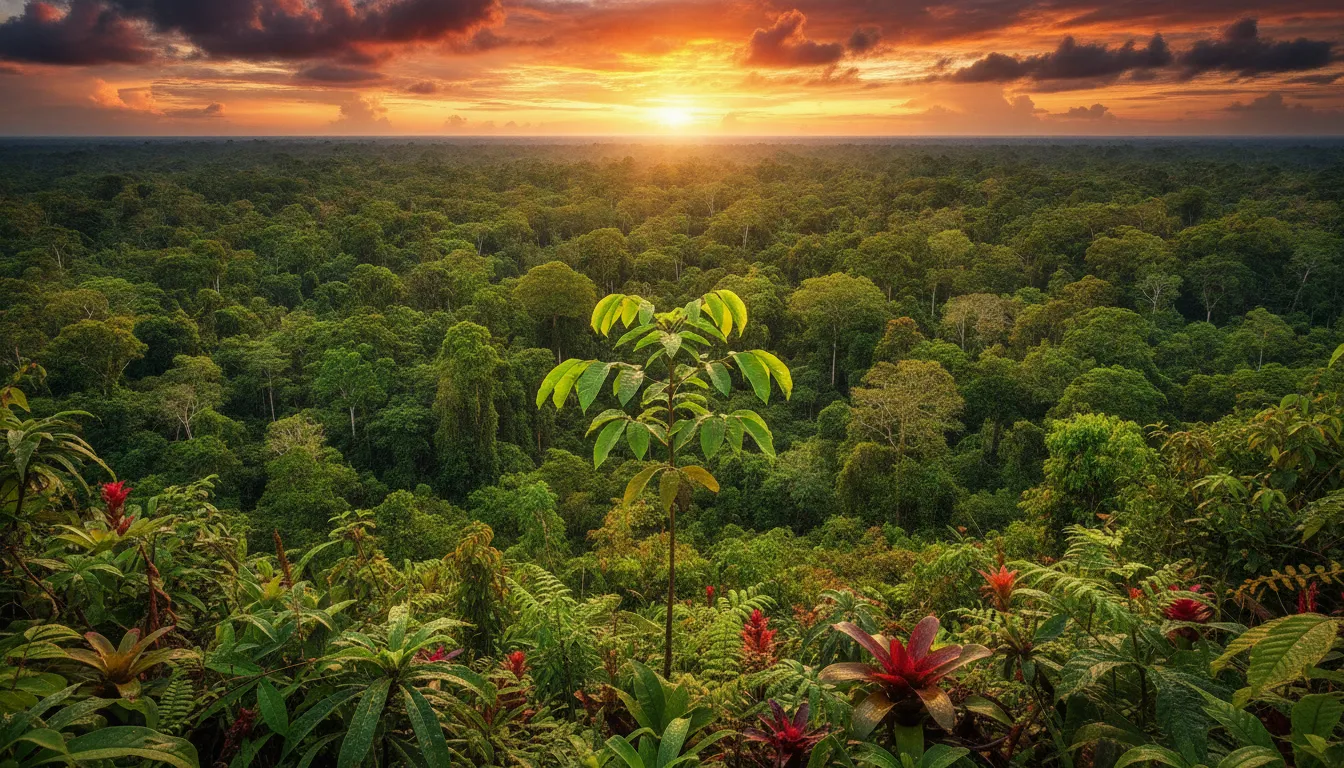
The Amazon is not just Brazil’s lung. It’s an irreplaceable piece of the planet’s climate system, an unparalleled repository of life, and home to millions of people whose cultures and knowledge depend directly on the standing forest.
Deforestation is not inevitable. It’s the result of choices — public policies, business models, consumption patterns. And choices can be remade.
In 2026, we live at a decisive moment: monitoring tools have never been so precise, international pressure has never been so organized, and public awareness of climate urgency has never been so widespread. What’s often missing is transforming this awareness into daily action and sustained collective pressure.
Start today: question the origin of what you consume, support those working on the front lines of conservation, and talk about it with the people around you. The Amazon rainforest has survived millions of years of natural history. With the right choices, it can survive us too.
