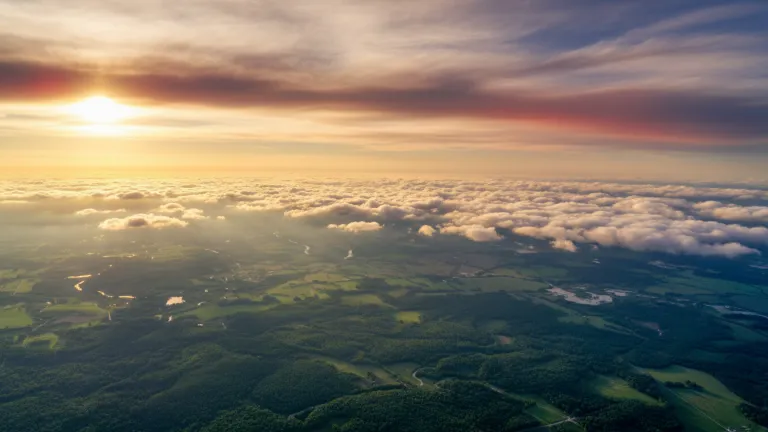
Imagine waking up on a summer morning and feeling a different kind of heat — more intense, more persistent, as if the planet has forgotten how to breathe. This sensation, increasingly common in various regions of Brazil and the world, has a well-established scientific explanation: the greenhouse effect. But contrary to popular belief, this phenomenon is not inherently a villain. It is, in fact, the reason life exists on Earth as we know it.
The problem lies in the imbalance. The natural greenhouse effect has kept the planet’s average temperature around 15°C for millennia — without it, this average would drop to approximately -18°C, making Earth uninhabitable for most species. What has changed in recent decades is the intensification of this process by human activities, which have amplified the phenomenon to the point of destabilizing the global climate.
Understanding how the greenhouse effect truly works is the first step to acting intelligently and responsibly. In this article, you will discover the science behind the phenomenon, the gases involved, Brazil’s role in this context, and, most importantly, what you can do now to be part of the solution.
What is the Greenhouse Effect: The Physics Behind the Phenomenon
The greenhouse effect is a natural process of heat retention in the Earth’s atmosphere. To understand it, imagine the planet wrapped in an invisible blanket formed by specific gases. This “blanket” regulates the surface temperature, preventing heat from completely dissipating into space.
The process works as follows: solar radiation (mainly in the form of visible light) passes through the atmosphere and warms the Earth’s surface. Subsequently, this surface emits infrared radiation (heat) back upwards. This is where greenhouse gases (GHGs) come into play: instead of allowing this heat to escape freely into space, they absorb part of this energy and re-emit it in all directions — including back to the surface.
The result is a protective layer that keeps the Earth relatively warm. The term “greenhouse effect” is an analogy to the functioning of a glass greenhouse, where light enters easily, but heat finds it difficult to escape.
Main Greenhouse Gases and Their Origins
Not all atmospheric gases contribute to the greenhouse effect. Nitrogen (N₂) and oxygen (O₂), which together make up about 99% of the air we breathe, are practically transparent to infrared radiation. It is other compounds, present in much smaller concentrations, that do the work of retaining heat.
The main greenhouse gases are:
- Carbon dioxide (CO₂): the most well-known and abundant human-origin GHG. Emitted mainly by burning fossil fuels (coal, oil, and natural gas) and deforestation. Atmospheric CO₂ concentrations have surpassed 420 parts per million (ppm) in recent years, the highest level in at least 800,000 years, according to NOAA and IPCC monitoring data.
- Methane (CH₄): has a much higher global warming potential than CO₂ over short periods. It is emitted by livestock (cattle enteric fermentation), landfills, rice cultivation, and natural gas extraction.
- Nitrous oxide (N₂O): mainly related to the use of nitrogen fertilizers in agriculture and certain industrial processes.
- Water vapor (H₂O): the most abundant natural greenhouse gas, but it acts more as an amplifier than a primary cause of warming.
- Fluorinated gases (HFCs, PFCs, SF₆): used in refrigeration systems and industrial processes; although present in small quantities, they have an extremely high global warming potential.
The Role of Deforestation in the Greenhouse Effect
Forests act as carbon reservoirs: while standing, they absorb CO₂ from the atmosphere and store this carbon in their biomass. When they are cut down or burned, this carbon is released back into the air. Deforestation, therefore, acts in two negative ways: it eliminates carbon sinks and becomes a source of emissions. In Brazil, deforestation in the Amazon and Cerrado has historically represented a significant portion of national GHG emissions, according to reports from SEEG (Greenhouse Gas Emissions Estimation System) and the IPCC.
How Intensified Greenhouse Effect Affects Global Climate
The IPCC (Intergovernmental Panel on Climate Change) is the world’s leading scientific reference on the subject. In its Sixth Assessment Report (AR6), published between 2021 and 2022, the panel concluded that it is unequivocal that human influence has warmed the atmosphere, ocean, and land, and widespread and rapid changes have already occurred in the climate system.
The consequences of the intensified greenhouse effect include:
- Increase in global average temperature: the average surface temperature has already increased by approximately 1.1°C compared to the pre-industrial era, according to the IPCC.
- Melting glaciers and rising sea levels, posing risks to coastal communities worldwide.
- More frequent and intense extreme weather events: heatwaves, prolonged droughts, torrential rains, and more powerful hurricanes.
- Changes in rainfall patterns, affecting agriculture, water supply, and ecosystems.
- Ocean acidification, caused by CO₂ absorption by waters, impacting corals and marine life.
In Brazil, the impacts are already being felt: historic droughts in the Pantanal and Northeast regions, extreme rains in the South and Southeast, and changes in the hydrological cycle directly affecting electricity generation and food production.
Natural vs. Anthropogenic Greenhouse Effect
It is essential to distinguish the two:
Characteristic Natural Greenhouse Effect Anthropogenic Greenhouse Effect Origin Natural Earth processes Human activities Duration Stable for millennia Accelerated in the last ~150 years Resulting temperature ~15°C (balanced global average) Progressive increase above balance Main gases Water vapor, natural CO₂, natural CH₄ Fossil CO₂, agricultural CH₄, N₂O, fluorinated gases Impact on life Essential for life existence Threat to ecosystem stability The natural greenhouse effect is our ally. The problem is the imbalance caused by the increasing emission of GHGs since the Industrial Revolution, which has artificially intensified this mechanism.
Brazil in the Context of Greenhouse Gas Emissions
Brazil holds a unique position in global climate discussions. On one hand, it has the largest tropical forest on the planet and an electricity matrix with a significant share of renewable sources, such as hydropower. On the other hand, it has historically ranked among the world’s largest GHG emitters when considering emissions from deforestation and agriculture.
According to SEEG data, Brazilian emissions have fluctuated directly with deforestation rates — especially in the Amazon. Reducing deforestation is, therefore, the most impactful measure for reducing national emissions. In the energy sector, transitioning to renewable sources — such as wind energy, which has seen significant expansion in the last decade — represents an important strategic path.
Brazil has made formal climate commitments under the Paris Agreement, with emission reduction targets established in its Nationally Determined Contributions (NDC). Meeting these targets depends on both robust public policies and the participation of society and the private sector.
What You Can Do to Reduce Your Contribution to the Greenhouse Effect
Understanding the problem is important, but taking action is what truly makes a difference. The good news is that there are many practical choices anyone can adopt in their daily lives to reduce their carbon footprint. Here are some of the most impactful:
- Reduce red meat consumption: cattle farming is one of the main sources of methane in Brazil. Reducing consumption frequency already makes a difference.
- Opt for public transportation, cycling, or walking whenever possible. If using a car, consider electric or hybrid models in your next purchase.
- Avoid food waste: food that ends up in the trash represents wasted emissions throughout the production chain.
- Reduce electricity consumption at home: switch to LED bulbs, turn off devices on standby, and use energy-efficient appliances.
- Support and advocate for forest preservation policies: as a conscious consumer, informed voter, or supporter of environmental organizations.
- Consider renewable energy sources: installing solar panels, for example, can drastically reduce emissions associated with your home energy consumption.
- Buy less and better: excessive consumerism fuels carbon-intensive production chains. Prioritize quality, durability, and sustainably sourced products.
- Offset what you can’t avoid: there are reliable carbon offset programs linked to reforestation and preservation projects in Brazil.
To deepen your sustainable choices in everyday life, check out our complete guide: Sustainability in Everyday Life: A Guide to Getting Started.
Conclusion: Knowledge is the First Step to Change

The greenhouse effect is not an abstract monster acting in the shadows — it is a physical process that we can understand, measure, and, to a large extent, influence with our choices. Science is clear about the causes and risks, but it also points to concrete paths for solutions.
Every decision counts. Every individual action, combined with millions of others around the world, forms a real force for transformation. And the time to act is not tomorrow — it is today, with what we have available.
If this article helped you better understand how the planet works and how you can protect it, share it with someone else who also wants to be part of the solution. The planet thanks you — and future generations even more.
Back To Top - Opt for public transportation, cycling, or walking whenever possible. If using a car, consider electric or hybrid models in your next purchase.
- Melting glaciers and rising sea levels, posing risks to coastal communities worldwide.
- Methane (CH₄): has a much higher global warming potential than CO₂ over short periods. It is emitted by livestock (cattle enteric fermentation), landfills, rice cultivation, and natural gas extraction.
