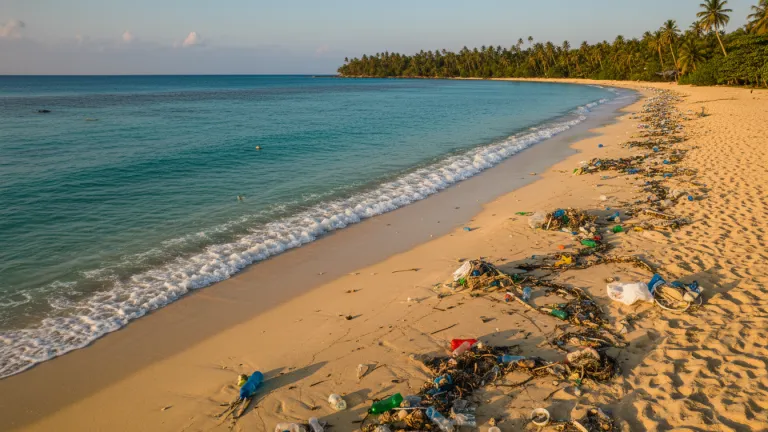
Imagine opening a can of tuna and finding, alongside the fish, invisible plastic fragments. It seems distant, but scientific studies have already detected microplastics in seafood consumed by humans worldwide. The ocean, which covers more than 70% of the planet’s surface and regulates the global climate, is being transformed into a repository of plastic waste — and the consequences extend far beyond what the eye can see.
Marine plastic pollution is now recognized as one of the most urgent environmental crises of the 21st century. Unlike an oil spill, which is localized and visible, plastic contamination is diffuse, persistent, and silent. Plastics do not biodegrade — they fragment into increasingly smaller particles, infiltrating entire ecosystems, food chains, and eventually, our own bodies.
This article exists to go beyond the shock and offer clarity: what do we really know about the impact of plastic in the oceans, what are the most solid scientific evidences, and most importantly, what can each person do today to be part of the solution. Because information without action changes nothing.
The Scale of the Problem: How Much Plastic Reaches the Sea?
Accurately estimating the amount of plastic in the oceans is a real scientific challenge. Numbers circulate widely in the media, but it’s important to distinguish estimates from certainties.
Studies consistently indicate that millions of tons of plastic waste enter the oceans each year, originating from rivers, winds, fishing activities, and coastal disposals. An analysis published in the journal Science in 2015, conducted by Jambeck et al., estimated that between 4.8 and 12.7 million tons of plastic entered the sea annually at that time — and the growth trend has persisted in subsequent years.
The United Nations Environment Programme (UNEP) points out that global plastic production continues to grow, with more than 400 million tons produced annually. A significant fraction of this volume is inadequately managed and ends up in the natural environment.
The main entry points of plastic into the oceans include:
- Rivers carrying solid waste from urban areas without adequate sanitation
- Direct disposal on beaches and coastal zones
- Abandoned fishing gear (the so-called “ghost nets”)
- Microplastics from washing synthetic clothes, which pass through sewage treatment systems
- Industrial plastic pellets (nurdles) escaping during transport
Brazil, with its extensive coastline and volume of solid waste generated, ranks among the countries with significant potential contribution to this contamination — especially in regions with still incipient selective collection.
Microplastics: The Invisible Enemy
If larger plastics are visible and disturbing, microplastics are even more concerning due to their omnipresence and difficulty of removal. Microplastics are defined as any plastic fragment less than 5 millimeters in size.
They originate in two ways:
- Primary: already manufactured at this size, such as microbeads present in cosmetic products (although many countries have already banned this use) and industrial pellets
- Secondary: resulting from the fragmentation of larger plastics by the action of the sun, waves, and time
Researchers have already found microplastics in seemingly unreachable places: in Antarctic ice, in the depths of ocean trenches, in the air we breathe in cities, in tap water, and even in human blood. A study published in the journal Environment International in 2022 detected microplastics in blood samples from adult volunteers, marking a milestone in research on human exposure.
In the marine environment, microplastics are ingested by zooplankton, small fish, mollusks, and crustaceans. From there, they enter the food chain. Fish we consume, such as sardines and anchovies, have been found with plastic fragments in their digestive tracts in studies conducted in the Atlantic and Mediterranean.
Science is still mapping the long-term effects of this exposure on humans. What is already known is that plastics carry chemical additives — such as phthalates and bisphenol A — that have documented hormonal interference potential.
Impact on Marine Biodiversity
The most visible and immediate impact of plastic pollution is on marine fauna. Sea turtles mistake plastic bags for jellyfish — their natural prey — and die from intestinal obstruction or starvation. Albatrosses feed their chicks pieces of plastic collected on the ocean surface, believing them to be food.
The IUCN Red List (International Union for Conservation of Nature) includes several threatened species whose situation is worsened by marine pollution, including species of turtles, marine mammals, and coastal birds.
The main documented impacts on marine life are:
- Entanglement: abandoned fishing nets continuously capture and kill whales, dolphins, turtles, and sharks, even without any fisherman operating
- Ingestion: fish, birds, and mammals consume plastic fragments, reducing the intake of real food and causing internal damage
- Chemical contamination: plastics absorb persistent organic pollutants from seawater; when ingested, these pollutants concentrate in the animals’ tissues
- Habitat alteration: plastic islands and waste accumulation on the seabed modify benthic (bottom) ecosystems
Coral reefs, already pressured by ocean warming — a phenomenon directly linked to the greenhouse effect and climate change — face additional pressure with the presence of plastics, which increase the incidence of coral diseases and block the sunlight needed for zooxanthellae photosynthesis.
The Economic and Social Impact Few Calculate
Plastic pollution is not just an environmental problem: it has real and measurable economic costs, especially for communities that depend on the ocean.
UNEP estimated, in a report published before the last decade, that the economic damages caused by plastic pollution to marine ecosystems reached tens of billions of dollars per year globally — affecting tourism, fishing, and cleanup costs.
Those most directly affected:
- Artisanal fishermen: nets damaged by plastic, reduced fish stocks, and contaminated fish reduce income and food security
- Coastal communities and islanders: dependent on tourism, suffer from polluted beaches and deteriorating local image
- Developing countries: bear proportionally higher cleanup costs relative to their GDP and have less waste management infrastructure
In Brazil, coastal municipalities in the Northeast and Amazon regions record increasing volumes of plastic waste, much of foreign origin carried by ocean currents — highlighting that marine pollution does not respect borders and requires international cooperation.
What Science and Policies Are Doing
In 2022, the United Nations Environment Assembly (UNEA) approved a historic resolution for the development of a Global Treaty on Plastic Pollution, with ongoing negotiations involving more than 170 countries. The negotiation rounds extended until 2025, with completion expected in 2026. It is considered one of the most ambitious environmental agreements since the Paris Agreement.
In the scientific field, researchers are working on several fronts:
- Development of truly biodegradable bioplastics in the marine environment
- Microplastic filtration technologies in water treatment plants
- Collection systems in rivers before plastic reaches the sea (such as the model developed by The Ocean Cleanup organization)
- Satellite mapping and artificial intelligence of ocean “garbage patches”
In Brazil, the National Solid Waste Policy (PNRS), in effect since 2010, created the legal framework for reverse logistics and shared responsibility — but implementation still faces significant structural challenges, especially in smaller municipalities.
What You Can Do: Practical and Real Actions
The good news is that individual changes, when added together, have real weight — especially when combined with collective pressure for systemic changes. Here are concrete actions, organized by impact:
Reduce Single-Use Plastic in Daily Life
- Replace disposable packaging with reusable options: water bottle, cloth bag, personal cup, and cutlery
- Refuse plastic straws — opt for metal, bamboo, or simply drink without a straw
- Prefer bulk products in markets that offer this option
- Choose cosmetics without microbeads (check the label: polyethylene, nylon-12, and polypropylene are indicators)
- Wash synthetic clothes less frequently and, when possible, use special washing bags that retain microplastic fibers (like the Guppyfriend)
Dispose Properly and Participate in Recycling
- Separate recyclable waste and deliver it to local recycling cooperatives
- Dispose of electronics and batteries at specific collection points
- Never litter beaches, rivers, or vacant lots
Expand Your Impact Beyond the Individual
- Participate in or organize beach and river cleanup efforts — initiatives like the “1 Minute for the Amazon” movement and local groups regularly organize actions
- Support public policies: contact elected representatives to express support for legislation restricting disposable plastics
- Choose companies with real sustainability commitments — your purchasing power is a form of voting
To deepen your journey towards more sustainable choices in everyday life, check out the guide Everyday Sustainability: A Beginner’s Guide to Making a Difference.
Conclusion: The Ocean Awaits Us
Plastic in the oceans is a real, scientifically documented problem with serious consequences for ecosystems, biodiversity, and human health. But it is not a problem without a solution.
The scale of the challenge may seem paralyzing, but environmental history shows that change is possible when science, public policy, and society work together. The ozone layer recovered because the world acted in unison. Severely degraded rivers were restored. Species have returned from the brink of extinction.
The ocean does not need perfection — it needs consistency. Every bottle refused, every cleanup action, every informed vote, and every conversation about the issue adds up. Start today with what is within your reach. The planet — and the oceans — respond to this care.
- Support public policies: contact elected representatives to express support for legislation restricting disposable plastics
- Participate in or organize beach and river cleanup efforts — initiatives like the “1 Minute for the Amazon” movement and local groups regularly organize actions
- Refuse plastic straws — opt for metal, bamboo, or simply drink without a straw
- Replace disposable packaging with reusable options: water bottle, cloth bag, personal cup, and cutlery
- Coastal communities and islanders: dependent on tourism, suffer from polluted beaches and deteriorating local image
- Ingestion: fish, birds, and mammals consume plastic fragments, reducing the intake of real food and causing internal damage
- Secondary: resulting from the fragmentation of larger plastics by the action of the sun, waves, and time
- Primary: already manufactured at this size, such as microbeads present in cosmetic products (although many countries have already banned this use) and industrial pellets
