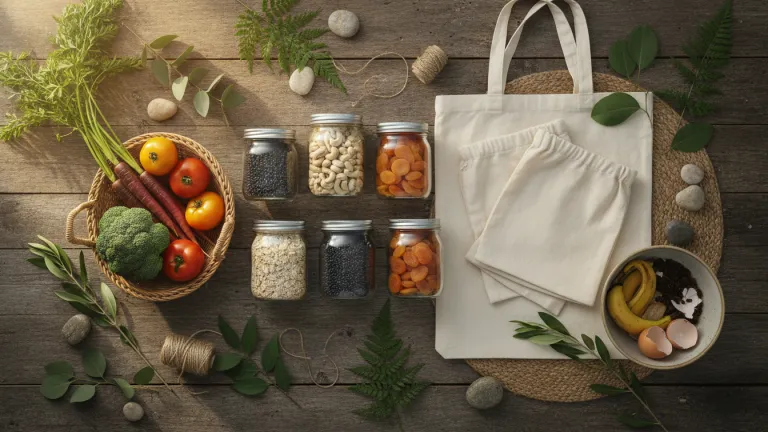
Imagine opening your trash bin at the end of a week and finding almost nothing inside. Not as a result of restriction or sacrifice, but because you started consuming more intentionally, reusing what you used to throw away, and redirecting the rest to composting or recycling. This is the daily life of those who have adopted the Zero Waste philosophy — and what seems like utopia at first glance becomes, in practice, a series of small chained decisions.
Brazil generates impressive volumes of solid waste. According to data from the Panorama of Solid Waste in Brazil, published by the Brazilian Association of Public Cleaning and Special Waste Companies (Abrelpe), the country produced more than 80 million tons of urban waste per year in the latest available surveys — and a significant portion of this material still ends up in dumps or landfills without any recovery. Given this scenario, movements like Zero Waste gain strength not as a passing trend, but as a concrete response to a structural problem.
The good news is that you don’t need to zero out your trash overnight. The Zero Waste philosophy is, above all, a journey — and every step in that direction already makes a real difference for the planet.
What Is the Zero Waste Philosophy
The term Zero Waste was popularized worldwide by the Zero Waste International Alliance (ZWIA), which defines the concept as the conservation of all resources through responsible production, consumption, reuse, and recovery of products, packaging, and materials, without burning and without discharge to land, water, or air that threatens the environment or human health.
In domestic practice, the philosophy is often represented by the so-called 5 Rs, systematized by activist Bea Johnson, author of the book Zero Waste Home:
- Refuse what you don’t need (freebies, plastic bags, extra packaging)
- Reduce what you consume overall
- Reuse what already exists, replacing disposables with durables
- Recycle only what couldn’t be refused, reduced, or reused
- Rot (compost) the organic remainder
The order matters. Recycling appears almost at the end of the list because, although essential, it remains a process that consumes energy and resources. The ideal is to reach this stage as little as possible.
Why Zero Waste Matters for the Environment
The environmental impact of waste goes far beyond the volume it occupies in landfills. The decomposition of organic waste under anaerobic conditions (without oxygen, as in conventional landfills) produces methane, a gas with a global warming potential much higher than carbon dioxide over a 20-year horizon, as indicated by IPCC (Intergovernmental Panel on Climate Change) reports. Industrial production to replace discarded products also generates emissions, consumes water, and puts pressure on ecosystems.
Additionally, single-use plastic represents one of the greatest environmental challenges of our time. Plastic fragments have already been found in deep marine environments, in polar organisms, and even in human blood samples, according to studies published in peer-reviewed scientific journals. The problem is not just aesthetic — it involves contamination of food chains and risks to biodiversity.
Adopting Zero Waste practices at home directly contributes to reducing demand for disposable products, decreasing pressure on waste collection and treatment systems, and sending a market signal for companies to rethink their packaging.
How to Start: Step-by-Step Guide for Beginners
There is no universal mandatory order, but the roadmap below was designed for those starting from scratch who want visible results quickly:
- Conduct a waste audit. Before changing anything, observe what you discard most during a week. Separate by categories: plastic, organic, paper, glass, metal, reject. This shows where the biggest opportunity for change lies.
- Eliminate the easiest disposables to replace. Plastic bags (with reusable bags), straws (with stainless steel or bamboo versions), disposable cups (with a reusable bottle), paper napkins (with cloth napkins). These are simple swaps with high cumulative impact.
- Restructure your grocery shopping trips. Bring reusable bags, prefer buying in bulk when possible, and choose glass or paper packaging over plastic. Make a list to avoid impulse purchases — unnecessary consumption is one of the biggest waste generators.
- Start composting. Organic waste typically represents between 40% and 60% of the weight of Brazilian household waste, according to Abrelpe estimates. Composting at home or delivering organic waste to community collection points is one of the highest-impact individual actions.
- Find the right recycling points. Many materials accepted by conventional selective collection also have specialized drop-off points: cooking oil, electronics, batteries, light bulbs, and expired medications. Check your city hall’s website or platforms like Cataki to locate eco-points.
- Gradually replace hygiene and cleaning products. Solid shampoo, bar soap, powder or tablet toothpaste, cleaning product refills — the market for alternatives with less packaging has grown considerably in recent years in Brazil.
- Involve the people in your household. Individual changes are more likely to stick when there’s collective buy-in. Talk about the reasons, propose changes one at a time, and celebrate progress.
Home Composting: The Key to Reducing Organic Waste
Composting transforms food scraps and organic materials into nutrient-rich fertilizer — and can be done even in small apartments. There are three main formats accessible to urban residents:
Vermicomposting (with worms)
Uses red wiggler worms to decompose organic waste in a compact space, odor-free when properly managed. Ideal for apartments.
Bucket composter
Simple system with two or three stacked buckets that can be placed on a balcony or laundry area. Produces liquid leachate (diluted fertilizer) and solid humus.
Collective or community composting
Condominiums, urban gardens, and some city governments offer organic waste drop-off points. It’s worth checking what exists in your city.
To learn more about how to reuse food scraps even before composting, check out Reusing Food Scraps Is Easier Than You Think — whole food utilization is the first step to reducing the organic waste that goes to the composter.
Practical List: Simple Swaps with Big Impact
The table below shows direct swaps that anyone can make progressively, without needing large investments:
| Disposable product | Durable alternative |
|---|---|
| Plastic bag | Fabric tote bag |
| PET water bottle | Stainless steel or glass bottle |
| Plastic cups and cutlery | Stainless steel, bamboo, or melamine versions |
| Paper towels | Dish cloths or rags |
| Synthetic dish sponge | Natural loofah sponge |
| Liquid soap packaging | Bar soap or refill |
| Plastic produce bags | Mesh fabric bags |
| Plastic straw | Stainless steel, glass, or bamboo straw |
| Disposable sanitary pad | Cloth pad or menstrual cup |
The secret is not to swap everything at once — that generates cost and frustration. The logic is: when a disposable product runs out, replace it with the reusable version at the time of repurchase.
Zero Waste Beyond Home: Conscious Consumption and Systemic Pressure
Adopting Zero Waste habits in the home environment is essential, but the impact amplifies when the change goes beyond your four walls.
At work: bring your own mug and cutlery, refuse unnecessary printed materials, propose proper selective collection points to the company.
When shopping: give preference to companies with verifiable commitments to packaging reduction, reverse logistics programs, and responsible production. Your purchasing power is a form of voting.
In the community: participate in swap groups, thrift stores, tool libraries, and repair initiatives (repair cafés). The circular economy starts at the local scale.
In politics: support and demand from elected representatives public policies on waste management, single-use plastic reduction targets, and investment in recycling infrastructure. Brazil’s National Solid Waste Policy (PNRS), a federal law from 2010, already establishes important guidelines — but its implementation still faces significant gaps in many municipalities.
To deepen habit changes in daily home life, the article Less Waste at Home Starts with Small Habits brings practical tips organized by room in the house.
Common Mistakes Made by Zero Waste Beginners
Knowing the most frequent pitfalls helps you avoid them:
- Wishcycling: throwing everything you think is recyclable into selective collection. Contaminated or non-accepted materials by the local system harm the entire batch. Always check what is collected in your city.
- Buying many “sustainable” products at once: replacing what still works with eco-friendly versions generates unnecessary waste and expense. Wait for the current product to run out.
- Ignoring organic waste: focusing only on plastic and forgetting that food waste represents a huge portion of household disposal.
- Seeking perfection: Zero Waste doesn’t mean no waste. It means reducing as much as possible within the real possibilities of each person and context.
- Giving up for not seeing immediate results: system change is gradual. Results appear in weeks and months, not days.
Conclusion: Your Next Step Starts Now

The Zero Waste philosophy doesn’t require perfection — it requires intention. Every package refused, every food scrap utilized, every disposable product replaced with a durable one represents a choice that accumulates with those of other people and creates real pressure on production and disposal systems.
In 2026, we have access to more information, more market alternatives, and more support communities than at any other time in history. The tools are available. The knowledge is accessible. What’s often missing is simply taking the first step.
Choose one swap from the table above. Do your waste audit this week. Research the nearest composting point to you. Share what you learned with someone. Small actions, multiplied by millions of people, create changes that no individual action could ever achieve alone.
The planet doesn’t need a handful of people living Zero Waste perfectly. It needs many people doing what they can, consistently and increasingly. You’re already on the right path.
