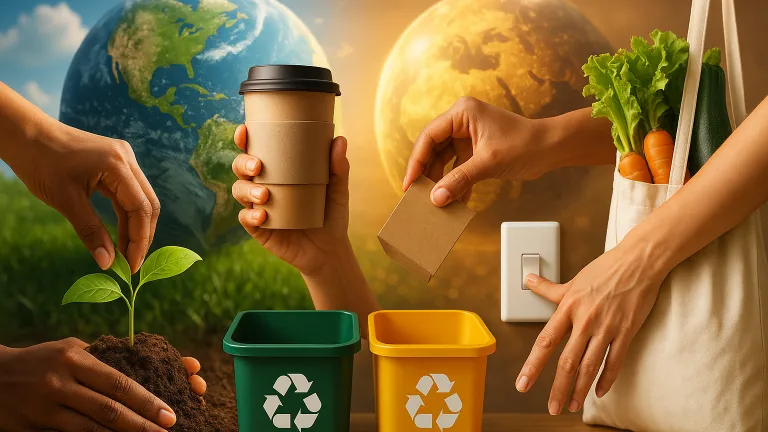
# Small Actions, Big Impacts: Transforming Your Daily Routine into a Planet-Loving Act
We are living at a crucial moment in human history, where every decision we make has the power to influence the future of our planet. Have you ever stopped to think that the disposable plastic cup you used for just a few minutes can remain in nature for hundreds of years? Or that your choice of transportation to work directly impacts the air quality we all breathe?
The truth is, we don’t need to be environmental heroes or make radical changes in our lives to contribute to environmental preservation. In reality, it’s the small daily actions, when multiplied by millions of people, that create the most significant positive impacts. This article will show you how you can transform your daily routine into a true act of love for the planet, proving that every gesture counts and that we all have a fundamental role in this journey.
Our Earth is extraordinary and deserves our care and attention. Let’s discover together how small changes can lead to significant transformations.
The Power of Small Changes: Understanding the Ripple Effect
When we talk about environmental preservation, many people feel overwhelmed, thinking that their individual actions are insignificant in the face of major global problems. However, this thought couldn’t be more wrong. The concept of the “butterfly effect” applied to sustainability demonstrates that small behavioral changes can trigger extraordinary chain reactions.
Imagine you decide to reduce the use of disposable plastic in your home. This decision can inspire your family, friends, and colleagues to do the same. If each influenced person also inspires others, we create a wave of positive change that expands exponentially. Studies by the UN Environment show that when entire communities adopt sustainable practices, the results can be measured on regional and even global scales.
Moreover, our daily choices have an important psychological effect: they reinforce our identity as change agents. Each time we choose the more sustainable alternative, we strengthen our commitment to the planet and develop a deeper environmental consciousness. This personal transformation is the first step to creating a society genuinely committed to environmental preservation.
Rethinking Consumption: The Art of Conscious Buying
One of the fundamental pillars of a sustainable routine is rethinking our consumption habits. We live in a society that constantly encourages us to buy more, even when we don’t need it. The culture of rampant consumerism is directly linked to the main environmental problems we face today: pollution, depletion of natural resources, and excessive waste production.
Before any purchase, ask yourself: “Do I really need this?” This simple question can prevent impulsive and unnecessary acquisitions. When the answer is yes, look for sustainable alternatives. Prefer durable products over disposable ones, choose items with recyclable or biodegradable packaging, and support companies that demonstrate genuine environmental commitment.
The concept of “conscious consumption” also involves valuing local and seasonal products. By buying from producers in your region, you reduce the carbon footprint associated with transporting goods and strengthen the local economy. Seasonal foods, besides being tastier and more nutritious, require fewer resources to produce, such as pesticides and artificial cultivation systems.
Another powerful practice is adopting the principle of the “5 Rs”: Rethink, Refuse, Reduce, Reuse, and Recycle – in that order of priority. Before recycling, for example, think if you can reuse that item. Before reducing, question if you can refuse unnecessary products. This hierarchy helps us focus on the most impactful actions.
Sustainable Eating: Every Meal is a Choice
Did you know that our food choices are among the individual actions with the greatest environmental impact? Food production is responsible for approximately 26% of global greenhouse gas emissions, according to data from the Food and Agriculture Organization of the United Nations (FAO).
Reducing meat consumption, especially red meat, is one of the most effective actions we can adopt. You don’t need to become vegetarian or vegan overnight – starting with one or two meatless days a week already makes a significant difference. Beef production, for example, requires vast amounts of water, land, and food for cattle, and is responsible for much of the deforestation in various regions of the world.
Prioritizing organic foods also contributes to a more sustainable food system. Although they may be more expensive, these products are grown without toxic pesticides that contaminate soil, water, and harm biodiversity. If the budget is limited, focus on buying organic versions of the foods you consume most or those known to have more pesticide residues.
Wasting less food is equally crucial. About one-third of all food produced globally is wasted, according to the FAO. Planning meals, storing food properly, creatively using leftovers, and composting organic waste are habits that drastically reduce our environmental impact and also save money.
Green Mobility: Rethinking How We Move
Transportation is responsible for a significant portion of carbon emissions in urban areas. Fortunately, there are several alternatives to make our commutes more sustainable without compromising our quality of life.
Whenever possible, opt to walk or bike. Besides not generating emissions, these options bring benefits to physical and mental health. For medium distances, consider public transportation, which has a much smaller per capita carbon footprint than individual vehicles. If public transport in your city is not ideal, how about organizing carpooling with co-workers or neighbors?
For those who need a car, driving more efficiently can significantly reduce fuel consumption: keep tires inflated, avoid abrupt accelerations and braking, do not carry unnecessary weight in the vehicle, and turn off the engine during long stops. When changing vehicles, consider hybrid or electric options, which are becoming increasingly accessible.
Air travel has a high environmental impact, so reserve it for when it is truly necessary. For closer destinations, consider alternatives like train or bus. When flying is unavoidable, some airlines offer carbon offset programs that, while not a perfect solution, help mitigate the impact.
Energy Efficiency at Home: Small Adjustments, Big Savings
Our home is a space full of opportunities to reduce energy consumption and, consequently, decrease our carbon footprint. Many of these changes are simple and save money on the electricity bill.
Start by replacing incandescent bulbs with LEDs, which consume up to 80% less energy and last much longer. Make the most of natural light during the day by keeping curtains open and positioning work areas near windows. Turn off lights when leaving rooms and unplug devices when not in use, as many continue to consume energy in standby mode.
In the kitchen, prefer electric ovens or microwaves to gas ovens when possible – they are more energy-efficient. When cooking, use lids on pots to speed up the process and save energy. When buying new appliances, prioritize models with an A-class energy efficiency label.
Heating and cooling environments are responsible for a large part of residential energy consumption. Improving the home’s thermal insulation, using ceiling fans, adjusting the thermostat to moderate temperatures, and dressing appropriately according to the season can significantly reduce this consumption.
Consider also investing in solar energy. The costs of installing photovoltaic panels have consistently decreased, and in many cases, the investment pays off in a few years through savings on the electricity bill, besides adding value to the property.
Reducing Waste: Towards Zero Waste
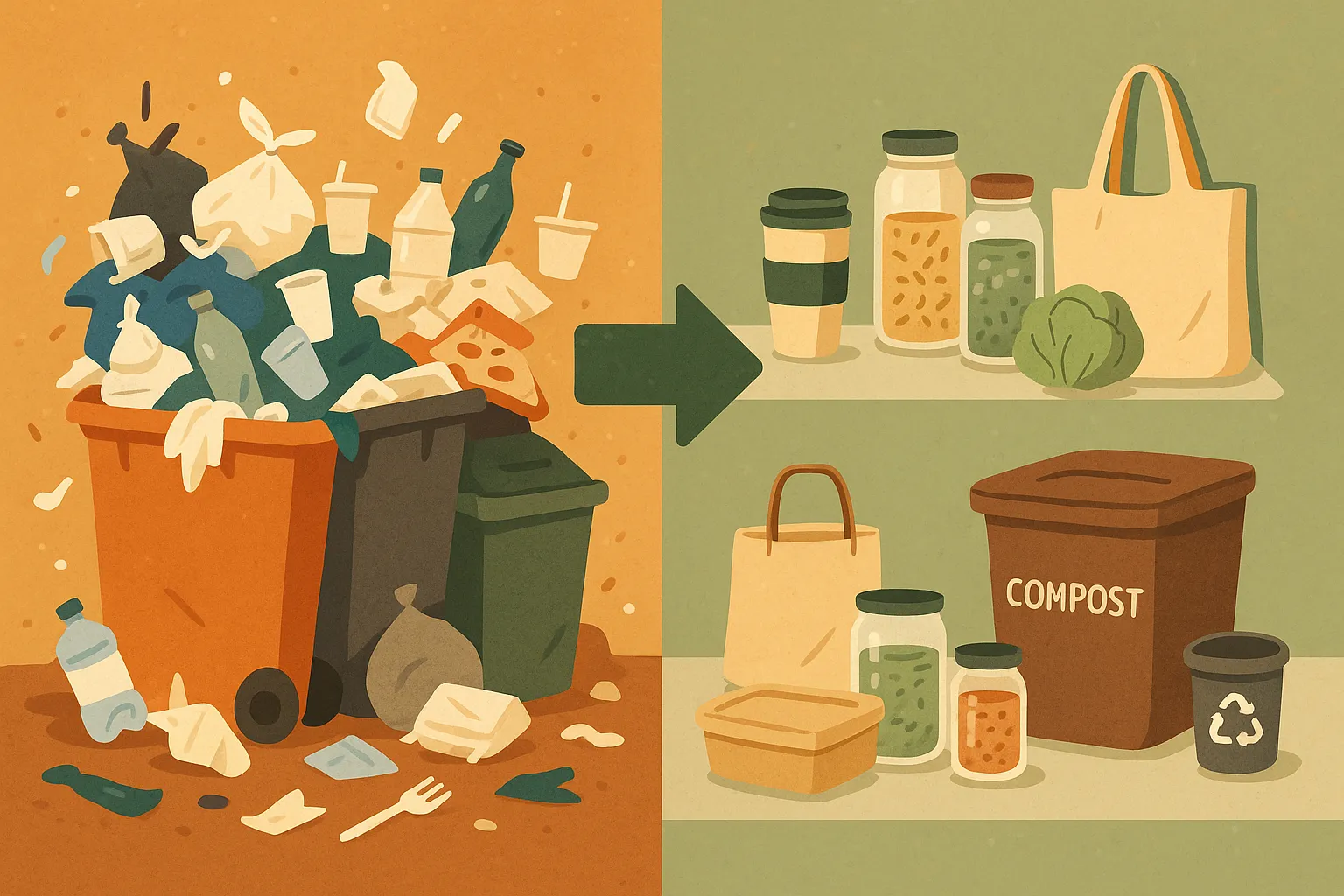
The “zero waste” movement may seem extreme, but it serves as inspiration to drastically reduce the amount of waste we generate. Perfection is not necessary – every reduction counts.
In the kitchen, eliminate the use of disposables: replace paper napkins with cloth ones, swap plastic wrap for reusable containers, use permanent bottles and cups instead of disposable plastic. When shopping, bring your own reusable bags and, if possible, containers for bulk products.
In the bathroom, there are sustainable alternatives for practically all products: solid soaps and shampoos eliminate plastic packaging, bamboo toothbrushes are biodegradable, menstrual cups or reusable pads replace disposable products. Look for brands that offer refills or recyclable packaging.
Create an efficient waste separation system in your home. Besides basic recycling (paper, plastic, glass, and metal), consider composting organic waste. Even in small apartments, it is possible to compost with compact and odorless systems, turning peels and food scraps into nutrient-rich fertilizer for plants.
Before discarding any item, ask yourself if it can be donated, sold, or transformed. Old furniture can gain new life with refurbishment, clothes can be customized, containers can become organizers.
