You open the fridge, grab an empty cream cheese jar, and toss it in the trash without a second thought. You repeat the gesture with the oil can, the glass sauce bottle, and the cereal box. It seems routine, but this silent cycle of disposal has a real impact: Brazil generates over 80 million tons of solid waste annually, according to the Brazilian Association of Public Cleaning and Special Waste Companies (Abrelpe). A significant portion of this volume comes from packaging that could have a second—or third—life at home.
The good news is that reusing packaging doesn’t require significant investments or a kitchen overhaul. It primarily requires a change in perspective: seeing that glass jar, colorful can, or paper roll not as trash, but as a solution waiting to be discovered. This practice fits perfectly into the logic of the circular economy, a concept gaining increasing strength in global environmental policies, which proposes keeping materials in use for as long as possible before discarding them.
In this article, you’ll find practical guidelines, tips organized by packaging type, and an honest look at the collective impact of individual choices. Because when thousands of families adopt small reuse habits, the ripple effect on household waste volume—and on the natural resources that are no longer extracted—is genuinely significant.
Why Reusing Packaging Makes an Environmental Difference
The disposal of packaging is one of the biggest challenges in urban waste management worldwide. According to the United Nations Environment Programme (UNEP), global plastic production exceeds 400 million tons per year, and a large part of this volume is intended for single-use packaging. In Brazil, the National Solid Waste Policy (PNRS), in effect since 2010, prioritizes non-generation and reuse of waste—exactly in that order—before even considering recycling.
This is important because recycling, while valuable, is not perfect. It still consumes energy, water, and inputs. Reusing packaging without any industrial processing is, from an energy standpoint, always the most efficient option. Each glass jar that becomes a spice holder prevents a new one from being manufactured; each decorated can as a vase avoids ore extraction and gas emissions in the smelting process.
Besides the direct environmental benefit, reusing packaging reduces the amount of waste reaching landfills—many of which operate above capacity in Brazilian cities—and eases the pressure on recyclable material collectors, whose work is essential but already overloaded.
Before You Start: How to Safely Clean Packaging
Reusing doesn’t mean keeping dirty packaging. Proper cleaning is the first step and ensures that reuse is healthy, especially when the purpose is to store food.
Essential Care for Cleaning Packaging
Wash immediately after use, before residues dry and become difficult to remove.
Use hot water and mild soap for most materials—glass, rigid plastic, metal, and laminated cardboard.
Let dry completely before reusing, especially if storing dry foods like grains, flours, or spices. Any moisture promotes mold growth.
To eliminate strong odors (such as tomato sauce in plastic jars), leave the container exposed to the sun for a few hours or soak in a solution of water and baking soda for 20 minutes.
Avoid scraping glass or metals with abrasive sponges that can create micro-scratches where bacteria settle.
Dispose of plastic packaging with cracks, deep scratches, or deformations, as these damages compromise the safety of stored food.
An important caveat: packaging that has been in contact with chemicals (detergents, paints, solvents) should never be reused for food, even after washing. They can be used for decorative or organizational purposes, but away from any food use.
Reusing Glass Packaging: The Most Versatile Material
Glass is probably the easiest and safest material to reuse at home. It doesn’t absorb odors, doesn’t stain, withstands high temperatures, and is completely inert—meaning it doesn’t release substances into food.
Practical Uses for Glass Jars and Bottles
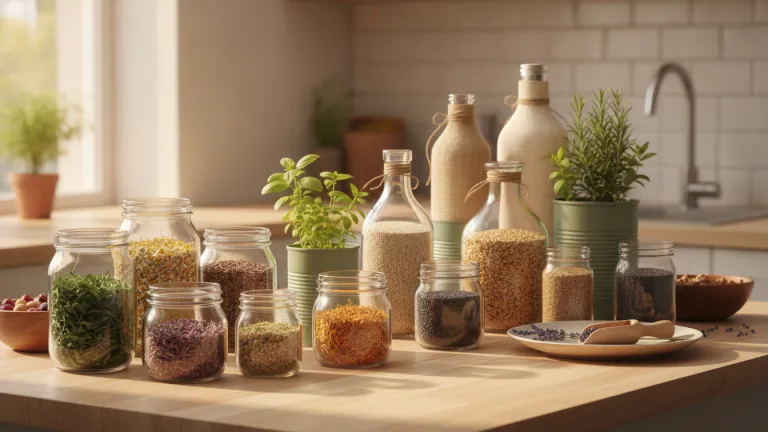
Store dry foods: grains, beans, lentils, rice, oats, seeds, and nuts are perfectly preserved in glass jars with lids, protected from moisture and insects.
Organize spices: smaller jars of jam, cream cheese, or mustard are ideal for storing dried herbs, salt, pepper, and spices—with the advantage of seeing the contents without opening.
Homemade fermentation: wide-mouth jars (like those for palm hearts or pickles) are excellent for making kefir, kombucha, pickles, and vegetable ferments.
Take food outside: glass bottles with screw caps are a durable and safe alternative to disposable plastic bottles.
Organize office and bathroom: pencil holders, cotton swab holders, clip holders—glass has an aesthetic appeal that matches any environment.
Plant pots: with some gravel at the bottom for drainage, glass jars accommodate succulents, small cacti, and herbs like basil and chives.
What to Do with Rigid Plastic Packaging
Not all plastic is the same. Prefer to reuse those with recycling symbols numbered 2 (HDPE), 4 (LDPE), and 5 (PP), considered more stable and safe for prolonged contact with food. Avoid number 7 (others) for storing food.
Ice cream and margarine tubs: excellent for freezing soups, broths, sauce portions, and homemade meals.
Large PET bottles: can become improvised watering cans (pierce the cap with a heated needle), bird feeders, or even mini-greenhouses for seedlings (cut in half and use the top as a cover).
Cleaning product containers: great for storing other homemade cleaning products, like scented vinegar or soapy water for general cleaning.
Plastic caps: collect and donate to social projects—several Brazilian NGOs collect them for exchange for wheelchairs or for educational projects with children.
Cans and Metal Packaging: Durability in Favor of Reuse
Preserve cans, powdered milk cans, oil cans, and chocolate powder packaging are robust, resistant, and have a long life when well cared for.
Pots and planters: with holes made at the base (use a nail and hammer), cans of any size become charming pots. Painted with metal paint, they look even more beautiful.
Kitchen utensil holders: larger cans easily store spatulas, wooden spoons, whisks, and other long utensils.
Tool and screw organizers: in the garage or office, small cans are perfect for separating nails, clips, erasers, and batteries.
Food storage: well-sealed cans protect cookies, ground coffee, and cocoa powder from moisture.
Cardboard, Boxes, and Paper Packaging: Creativity with What Would Be Trash
Cardboard is often discarded without ceremony, but it has surprising strength and immediate practical uses.
How to Reuse Boxes and Cardboard at Home
Drawer organization: cut cereal or pasta boxes into smaller pieces and use them as dividers to separate socks, underwear, bras, or office items.
Surface protection: during moves or manual work, cardboard protects floors and tables from scratches and dirt.
Improvised urban garden: market boxes lined internally with plastic bags and filled with substrate become temporary beds for herbs and vegetables.
Gift wrapping: kraft paper from packaging, decorated with stamps or watercolor, makes beautiful and personalized wrappings.
Toys and children’s projects: large appliance boxes become houses, cars, and castles that stimulate children’s creativity.
Creating a Reuse System at Home
Adopting packaging reuse consistently requires a small domestic system to avoid the chaos of keeping everything and using nothing.
Setting Up a Simple and Efficient System
Type of Packaging
Storage Location
Planned Destination
Small glass jars
Kitchen shelf
Spices, seeds
Large glass jars
Pantry
Grains, ferments
Medium and large cans
Countertop or garden
Pots, utensil holders
Cardboard boxes
Closet or office
Drawer organization
PET bottles
Balcony or yard
Watering cans, seedlings
Golden rule: only keep what you will actually use in the next 30 days. If you accumulate without a plan, the stock of packaging becomes more trash inside the house. Set a limited space—a shelf, a box—and stick to that limit.
Reusing packaging is one of the most accessible gestures within a more sustainable life. It doesn’t require extra money, doesn’t demand technology, and can start now, with the next jar you open. The impact of one family is small; the impact of thousands of families acting the same way is transformative.
Start with the simplest: choose a package you usually discard this week and give it a new use. It could be a glass jar for storing spices, a can for organizing brushes, a cereal box for separating drawers. One step at a time builds new habits—and new habits gradually change the amount of waste your home produces.
The planet doesn’t need perfection. It needs people willing to act with what they have, where they are. And you already have everything you need to start today.
Para fornecer as melhores experiências, usamos tecnologias como cookies para armazenar e/ou acessar informações do dispositivo. O consentimento para essas tecnologias nos permitirá processar dados como comportamento de navegação ou IDs exclusivos neste site. Não consentir ou retirar o consentimento pode afetar negativamente certos recursos e funções.
Funcional
Always active
O armazenamento ou acesso técnico é estritamente necessário para a finalidade legítima de permitir a utilização de um serviço específico explicitamente solicitado pelo assinante ou utilizador, ou com a finalidade exclusiva de efetuar a transmissão de uma comunicação através de uma rede de comunicações eletrónicas.
Preferências
O armazenamento ou acesso técnico é necessário para o propósito legítimo de armazenar preferências que não são solicitadas pelo assinante ou usuário.
Estatísticas
O armazenamento ou acesso técnico que é usado exclusivamente para fins estatísticos.O armazenamento técnico ou acesso que é usado exclusivamente para fins estatísticos anônimos. Sem uma intimação, conformidade voluntária por parte de seu provedor de serviços de Internet ou registros adicionais de terceiros, as informações armazenadas ou recuperadas apenas para esse fim geralmente não podem ser usadas para identificá-lo.
Marketing
O armazenamento ou acesso técnico é necessário para criar perfis de usuário para enviar publicidade ou para rastrear o usuário em um site ou em vários sites para fins de marketing semelhantes.

 Back To Top