
Imagine waking up every day in a city where the air you breathe irritates your eyes, worsens your children’s asthma, and shortens the lives of thousands of people. This isn’t science fiction or some distant future scenario: it’s the reality for millions of people living in major urban centers today. City pollution is one of the most urgent environmental challenges and, at the same time, one that responds most to concrete changes in the behavior of individuals and governments.
According to data from the World Health Organization (WHO), air pollution is responsible for millions of premature deaths per year worldwide, with disproportionate impact on populations in low and middle-income countries. In Brazil, cities like São Paulo, Manaus, and Cubatão have historically ranked among the most polluted in Latin America, with high levels of particulate matter, nitrogen dioxide, and tropospheric ozone. The good news — and yes, it exists — is that there are real, practical, and accessible actions that each person can take to make a difference.
This article isn’t about guilt. It’s about power. About understanding that urban pollution has identifiable causes, tested solutions, and that you, wherever you are, can be part of the turning point. Let’s get to what matters.
What Really Pollutes Cities
Before acting, you need to understand the enemy. Urban pollution doesn’t come from a single source — it’s the result of a set of practices that have accumulated over decades of unplanned growth.
The main sources of pollution in cities include:
- Individual motorized transport: gasoline and diesel vehicles are responsible for a large share of fine particulate matter (PM2.5), carbon monoxide, and nitrogen oxide emissions in urban areas.
- Industries and thermal power plants: especially in metropolitan regions with active industrial parks.
- Burning of solid waste: a practice still common in outskirts and rural areas near urban centers, releasing toxic compounds directly into the atmosphere.
- Construction: generates dust and debris that contribute to particulate matter in the air.
- Water and noise pollution: untreated sewage, irregular garbage disposal in rivers, and constant traffic noise complete the full picture of urban pollution.
Understanding these sources is the first step in choosing where to focus your energy and action.
Sustainable Mobility: The Change with the Greatest Impact
If there’s one area where ordinary citizens have real power to make an impact, it’s in how they get around. Transportation has historically been one of the largest sources of urban emissions.
How to Reduce Emissions in Daily Commuting
- Prefer public transportation whenever possible. A full bus removes dozens of cars from the road. Even conventional diesel buses at full capacity emit less per passenger than individual cars.
- Use a bicycle for short trips. Many cities have expanded their bike lanes between 2020 and 2025. Check your city’s bike lane map — the route to work may already have adequate infrastructure.
- Organize carpools. Ride-sharing apps and neighborhood WhatsApp groups can reduce the number of vehicles circulating with only one occupant.
- Choose electric or hybrid vehicles when renewing your fleet. With the expansion of the charging network and the arrival of more affordable models on the market, this option is increasingly viable for the middle class.
- Avoid unnecessary car trips. Planning shopping, remote work when possible, and video conference meetings reduce emissions without sacrificing quality of life.
The gradual replacement of mobility habits has an enormous cumulative effect when practiced by many people at the same time.
Conscious Consumption and Waste: Less Trash, Less Pollution
There’s a direct connection between what we buy, how we dispose of it, and the level of pollution in cities. Many countries still face serious challenges with solid waste management, with a significant portion of collected waste still having inadequate disposal.
Consumption Practices That Reduce Urban Pollution
- Reduce before recycling. The correct hierarchy is: refuse, reduce, reuse, recycle. Buying less is always more efficient than recycling more.
- Properly separate recyclable waste. Contaminated material (like greasy cardboard) goes straight to the landfill. Correct separation increases the actual recycling rate.
- Dispose of batteries, electronics, and medications at specific collection points. These materials contain toxic substances that, in regular landfills, contaminate soil and groundwater.
- Avoid burning trash. This practice is illegal in many places and releases compounds extremely harmful to respiratory health.
- Buy local and with less packaging. Farmers’ markets, cooperatives, and bulk stores reduce the volume of discarded plastic and emissions associated with goods transportation.
If you want to go further, you can learn to preserve the environment with simple choices in everyday life — small decisions that, combined, make a real difference.
Urban Green Spaces: Trees and Gardens as Anti-Pollution Allies
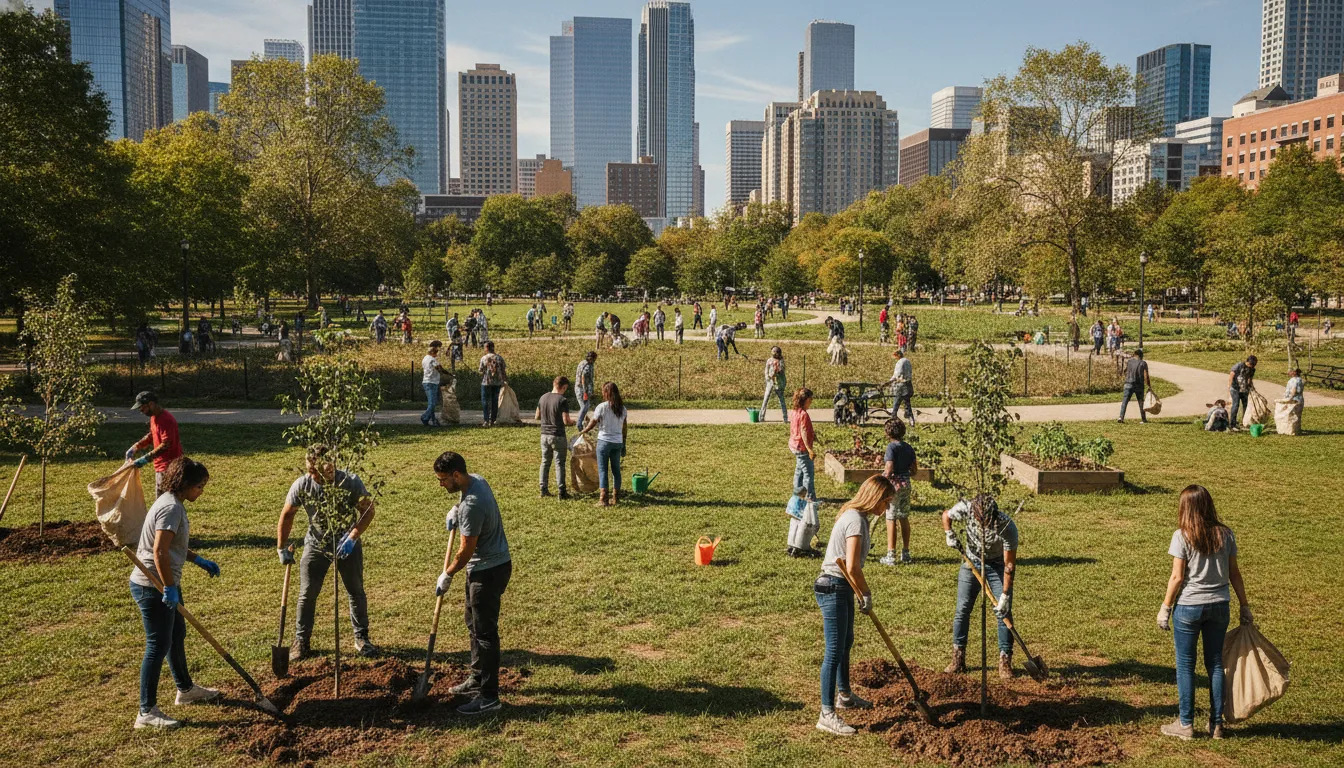
Planting trees in cities isn’t romanticism — it’s environmental engineering. Urban vegetation filters air particles, reduces the heat island effect, absorbs carbon dioxide, and improves the population’s psychological well-being.
How Citizens Can Increase Urban Green Spaces
- Participate in tree planting events in your city. Many municipalities and NGOs organize urban forestation actions that need volunteers.
- Adopt green sidewalks. In many cities, it’s permitted and encouraged to plant native species in the strip between the wall and the curb.
- Start a community garden. Idle spaces in condominiums, squares, and vacant lots can be transformed into gardens that produce food, create community, and reduce local heat.
- Grow plants on balconies and windowsills. Even in apartments, greenery contributes to indoor air quality and creates urban ecological corridors.
- Produce your own organic fertilizer. With home composting, you divert organic waste from trash and feed your plants without needing chemical inputs. Learn how to start at home by visiting our guide to make organic fertilizer at home and enrich the soil.
Cities with more trees have lower temperatures, better air quality, and healthier residents. It’s that simple.
Clean Energy in the Urban Environment
Energy generation and consumption are critical factors in air pollution. The more the city depends on fossil sources, the greater the emission of pollutants. The good news is that there’s still plenty of room to advance in efficient consumption and distributed generation.
Practical Actions to Reduce Energy Pollution
- Reduce electricity consumption at home. Devices in standby mode, high-powered electric showers, and air conditioning used without criteria increase demand that, during dry periods, may be supplied by polluting thermal power plants.
- Switch to LED bulbs. Consumption is significantly lower than incandescent or fluorescent bulbs.
- Consider solar generation. Even living in an apartment, there are shared generation and solar energy subscription models that allow you to participate in the energy transition without needing to install panels on your own roof.
- Prefer appliances with high energy efficiency. Energy efficiency labels indicate the most efficient models available on the market.
- Support and demand public investment in electric transportation. Electric buses and metropolitan trains powered by clean energy have a much greater collective impact than any individual change.
Collective Pressure and Citizen Participation: The Impact Multiplier
No significant environmental change happens only with isolated individual actions. Collective pressure — organized, well-founded, and persistent — is what historically moves public policies.
How to Actively Participate in the Fight Against Pollution
- Report environmental violations. Environmental agencies receive complaints about illegal burning, irregular disposal, and industrial pollution. Many platforms accept online complaints.
- Participate in public hearings. Urban mobility plans, industrial licensing, and municipal budgets go through public consultations that rarely have significant citizen participation.
- Support local environmental organizations. With time, money, or publicity, you amplify the voice of those already on the front lines.
- Talk about the topic. Normalizing discussion about urban pollution among friends, family, and coworkers is a real way to change culture and collective behavior.
- Vote with environmental criteria. Candidates with track records and concrete proposals for clean mobility, sanitation, and urban forestation exist in all parties — research before voting.
Systemic change needs people who not only adjust their consumption but also demand that structures change.
Small Actions, Big Results: A Practical Summary
To facilitate your journey, here’s an overview of the most impactful actions organized by effort and return:
| Action | Effort | Impact |
|---|---|---|
| Use public transport or bike | Medium | High |
| Separate waste correctly | Low | Medium |
| Do home composting | Medium | High |
| Reduce energy consumption | Low | Medium |
| Plant trees or gardens | Medium | High |
| Report violations | Low | High (collective) |
| Participate in public hearings | High | Very high |
| Switch to electric vehicle | High | High (long term) |
The table makes clear that not every action requires great effort — and that even simple changes have real impact when practiced consistently.
Conclusion: Your City Is Also Your Responsibility
Urban pollution is a problem built over decades by decisions — from governments, industries, and people. And that’s exactly why it can be deconstructed by the same forces when directed the right way.
You don’t need to solve everything at once. Choose one action from this list, practice it for 30 days, and then add another. Invite someone to do it with you. Share what you’ve learned. Demand more from your mayor, your condominium, your company.
The city you want to breathe in starts with the choices you make today. And every person who takes on this commitment makes the next collective step a little closer. The planet thanks you — and so does your health.
