Have you ever stopped to think about how many kitchen sponges you throw away each month? Those yellow-and-green synthetic sponges that live by the sink accumulate bacteria quickly, last only a few weeks, and end their days in landfills, where they can take decades to decompose. In Brazil, where the volume of urban solid waste remains a structural challenge, every small choice at home has a real impact. The loofah sponge emerges in this context as a concrete, accessible alternative that has been gaining more and more space in the kitchens of those looking to reduce everyday waste.
But is it really worth it? The question is legitimate. Before switching any product, it’s fair to understand what you’re buying, how to use it properly, what the limitations are, and whether the cost-benefit makes sense for your wallet and the planet. The good news is that the answer, in most cases, is yes — with some important nuances that we’ll explore throughout this article.
In the following sections, you’ll find everything you need to know about the loofah sponge: what it is, where it comes from, how to use it, how to maintain it, where to buy it, and how it fits into a more sustainable routine without complicating your life.
What Is a Loofah Sponge and Where Does It Come From
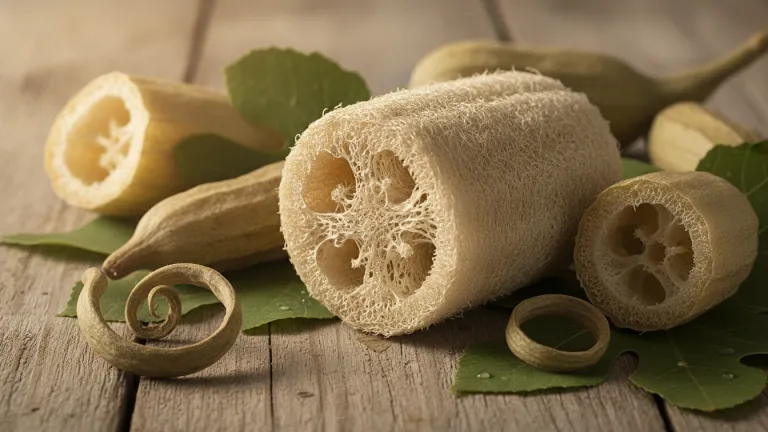
The loofah sponge is obtained from the mature, dried fruit of a plant called Luffa cylindrica, known in Brazil by popular names such as vegetable sponge or simply loofah. Luffa belongs to the cucurbit family — the same family as cucumber, zucchini, and melon — and is cultivated in various regions of the country, especially in the Northeast and Southeast.
When the fruit fully ripens and is left to dry, its inner pulp forms a natural fibrous network, which is exactly what we use as a sponge. This process is completely natural: no chemical synthesis, no petrochemicals, no plastic. After use, the sponge decomposes organically, unlike conventional synthetic sponges.
Brazil has very favorable climatic conditions for growing luffa, and the plant is already produced both artisanally and commercially in several states. This means that by choosing a loofah of national origin, you also support local farmers — often families who practice small-scale agriculture.
Loofah Sponge vs. Synthetic Sponge: What Really Changes
Before moving on to the usage tutorial, it’s worth understanding the practical differences between the two products. The table below summarizes the main points:
| Criteria | Synthetic Sponge | Loofah Sponge (Luffa) |
|---|---|---|
| Material | Polyurethane (petroleum-derived) | Natural vegetable fiber |
| Decomposition time | Decades to centuries | Weeks to a few months |
| Bacteria accumulation | High (porous surface retains moisture) | Also accumulates, but dries faster |
| Average durability | 2 to 4 weeks | 4 to 8 weeks with proper care |
| Average cost (2026) | Low (mass product) | Slightly higher, but growing supply reduces the gap |
| Origin | Industrial / petrochemical | Agricultural / natural |
| Disposal | Regular trash (not recyclable) | Compostable |
One point that deserves attention: no sponge, whether vegetable or synthetic, is completely free of bacteria. What sets the loofah apart is that it dries more quickly between uses, which reduces the moist environment where microorganisms thrive. Still, it needs regular sanitization — and we’ll talk about that later.
Is a Loofah Sponge Worth It? See the Concrete Benefits
The short answer is: yes, it’s worth it — especially if you adopt some simple care habits. Here are the main benefits:
- Truly biodegradable: unlike plastic sponges, the loofah can go into the compost bin or simply be disposed of in organic waste, where it decomposes naturally.
- Less waste over time: because it lasts longer than synthetic sponges when properly cared for, you discard fewer pieces per month.
- Versatile: it works for dishes, countertops, shower enclosures, cleaning fruits and vegetables, body exfoliation (there are specific versions for this), and even crafts.
- National and accessible cultivation: because it’s grown on Brazilian soil, it has a lower carbon footprint in transportation when purchased from regional producers.
- Aesthetically pleasing: for those who like a more visually harmonious kitchen, the natural texture of luffa has a distinctive aesthetic appeal.
Limitations also exist and deserve honesty:
- It can be less efficient on non-stick surfaces, as its rougher texture may scratch some delicate coatings.
- It requires more attention to drying than those accustomed to synthetic sponges might imagine.
- The unit price is still higher than conventional sponges in many regions, although the difference has decreased with increased supply in recent years.
How to Use a Loofah Sponge the Right Way
Many people try the loofah sponge and give up because they don’t know how to use it properly. The secret lies in a few simple steps:
- Hydrate before first use: soak the sponge in warm water for 5 to 10 minutes before using it for the first time. This softens the fibers and makes the texture more comfortable.
- Use dish soap normally: the loofah absorbs the product well. Apply dish soap directly onto it or onto the dishes and scrub as you would with any sponge.
- Apply moderate pressure: for pots with heavy grime, let them soak before scrubbing. The loofah doesn’t have the abrasive layer of synthetic sponges, so for heavily encrusted grease, it’s best to combine soaking with scrubbing.
- Rinse thoroughly after each use: remove all dish soap and food residue from the fibers.
- Squeeze and dry in a ventilated area: this is the most important step for durability. Never leave the loofah sitting in a pool of water. Hang it or rest it on a surface that allows air circulation.
- Sanitize weekly: place the sponge in boiling water for 5 minutes or soak it for 30 minutes in a solution of water with white vinegar (ratio of 1 part vinegar to 2 parts water). This reduces bacteria buildup and extends its lifespan.
- Dispose of when necessary: when the fibers start shedding excessively or the odor persists even after sanitization, it’s time to replace it. Take it to the compost or dispose of it in organic waste.
How to Make Your Loofah Sponge Last Longer
The durability of the loofah is directly linked to the care you give it. Some simple practices make a big difference:
- Avoid leaving it in permanent contact with standing water. A sponge holder with drainage or a simple hook solves this problem.
- Don’t use it on surfaces with strong abrasive products without first checking compatibility, as some concentrated chemicals can degrade the fibers more quickly.
- Wash the sponge immediately after using it on greasy foods, such as meat or fried items, to prevent grease from soaking into the fibers.
- Have more than one sponge in rotation. While one is being used, the other can dry completely — this increases the lifespan of both.
- Cut it into smaller pieces if you want to adapt the size for different uses. A whole loofah can be divided for the kitchen and bathroom, for example.
If you’re already thinking about reducing household waste and saving more at home, the loofah sponge is one of the easiest and cheapest starting points to begin.
Where to Find and How to Choose a Quality Loofah Sponge
Today, in 2026, the loofah sponge is available through a much wider variety of channels than a few years ago:
- Farmers’ markets and organic markets: they usually have local producers, which ensures freshness and a lower carbon footprint in transportation.
- Natural product and zero waste stores: found in capitals and medium-sized cities, with a curated selection of sustainable products.
- National e-commerce: platforms like Mercado Livre, Elo7, and stores specializing in sustainability offer options from different regions of Brazil.
- Supermarkets and pharmacies: some chains already include loofah sponges on their cleaning product shelves.
When choosing, pay attention to:
- Origin: prefer products with indication of national provenance and, if possible, from family farming.
- Preservatives and bleaching agents: some loofahs undergo bleaching processes with chlorine. If possible, opt for natural versions without whiteners.
- Size and firmness: loofahs that are too soft may be too young and deteriorate quickly; those that are too hard may be old and brittle. The ideal texture is firm but with some flexibility.
- Packaging: there’s no point in buying a sustainable sponge wrapped in unnecessary plastic. Prioritize sellers who use paper or minimal packaging.
The Loofah Sponge in the Context of a More Sustainable Life
The loofah sponge is a product, and like any product, it has a life cycle. The act of switching from a synthetic sponge to a vegetable one is significant, but the real impact increases when it’s part of a set of conscious choices at home.
Small changes in the kitchen — like using a loofah sponge, opting for biodegradable detergents, properly separating recyclable waste, and reducing food waste — create a real cumulative effect over time. It’s not about perfection, but about direction.
The transition to more sustainable habits rarely happens all at once. It’s built with small repeated decisions that gradually become natural. The loofah sponge is exactly that kind of choice: simple, concrete, and something you can make today, the next time you go to the store.
Conclusion: Small Change, Real Impact
Is a loofah sponge worth it? Based on everything we’ve seen, the answer is yes — as long as you use and care for it the right way. It’s biodegradable, versatile, produced in Brazil, and becoming increasingly accessible. Its limitations exist but can be worked around with simple maintenance habits.
If you haven’t tried it yet, why not start the next time you need to replace your kitchen sponge? Look for a loofah at a local market, hydrate it, use it, and notice the difference. And if you already use one, share it with someone who doesn’t yet know about this alternative — because sustainability is also built in community, one tip at a time.
The planet thanks you. And so does your kitchen.
