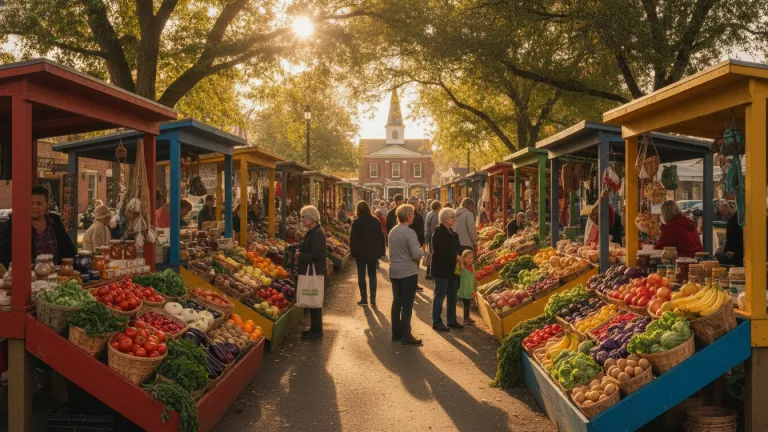
You arrive at the supermarket, grab that plastic-wrapped tomato with a label saying “controlled origin product” and toss it in your cart without a second thought. But what if I told you that tomato may have traveled over 600 miles before reaching your hands — passing through cold storage facilities, trucks, distribution centers, and more packaging than you can count? Meanwhile, three blocks from your house, a small farmer harvests fresh tomatoes every morning and sells them at the neighborhood farmers market. The question more and more consumers are asking themselves is: is buying from local producers really worth it?
The short answer is yes — but the topic deserves a more honest and complete exploration than the easy enthusiasm of social media. Buying local has quite concrete environmental, economic, and even nutritional advantages. But it also has limitations, costs, and complexities we need to understand to make informed choices. In this article, we’ll examine both sides with real data and help you make decisions that make sense for your reality.
If you’ve ever felt confused among so many appeals for “conscious” consumption and didn’t know where to start, take a deep breath. The idea isn’t to turn every trip to the market into a philosophical dilemma, but to understand why small changes in your shopping habits can generate positive impacts — for the environment, for the local economy, and for your plate.
The Environmental Impact of the Conventional Food Chain
To understand the value of local consumption, you first need to comprehend what happens behind the shelves of large supermarkets. The global food system is responsible for a significant portion of greenhouse gas emissions. According to IPCC reports, the food sector — including production, transportation, processing, and waste — represents a significant contribution to global CO₂ equivalent emissions.
In many countries, food logistics is especially intense. Large nations have continental dimensions, and much of the food consumed in major cities travels hundreds or thousands of miles from origin to point of sale. This transportation, done mostly by highways with diesel-powered trucks, generates emissions that could be avoided or reduced with shorter supply chains.
Beyond transportation, there’s another silent problem: food waste. Significant volumes of food are lost along the production chain, partly because products need to withstand long journeys and storage periods. Fruits and vegetables harvested before their ideal ripeness to survive transport have lower nutritional value and are more likely to be discarded before reaching the final consumer.
What “Local” Really Means — and Why It Matters
Before romanticizing the concept, it’s important to be clear: “local production” doesn’t have a universal definition. In some contexts, it means produced in the same municipality; in others, in the same state or region. For practical purposes, we can think of local production as that which involves short distribution chains — meaning fewer intermediaries between producer and consumer.
The main ways to access local production include:
- Farmers markets and open-air markets — present in practically every municipality
- CSAs (Community Supported Agriculture) — a model where consumers pay in advance and receive weekly baskets directly from the producer
- Organic markets and fairs — focused on agroecological production without pesticides
- Collective buying groups — consumers organize to buy directly from producers in larger quantities
- Direct delivery from producers — increasingly common through apps and social media
Each format has different advantages and limitations. The important thing is that all reduce, to a greater or lesser degree, the number of steps between farm and table.
Concrete Benefits of Buying from Local Producers
Positive environmental impact with short supply chains
The reduction of distances traveled by food — known as “food miles” — is one of the most cited arguments in favor of local consumption. When a producer 30 miles from the city directly supplies a local market, the environmental cost of transportation is significantly lower than bringing the same product from another state or country.
Additionally, family farmers and local producers tend to adopt more diversified practices and, often, more sustainable ones than intensive large-scale monoculture. Crop diversity contributes to soil health, local biodiversity, and reduced use of chemical inputs — although this isn’t an absolute rule.
Freshness, nutritional quality, and flavor
Foods harvested at the right point of maturity and consumed within a few days generally have higher nutrient concentration than those harvested green to withstand long journeys. Studies in nutrition sciences indicate that vitamins like C and folate progressively degrade after harvest — the longer the food takes to reach the table, the greater the loss.
This is both an environmental and public health argument: a tomato that reached your hands two days after being picked has very different nutritional and sensory characteristics from one that was harvested two weeks ago.
Support for the local economy and family farming
Family farming is responsible for a significant portion of the food that reaches consumers’ tables. According to agricultural data, family farming accounts for a substantial share of national production of basic foods like beans, root vegetables, greens, and fruits.
When you buy directly from a local producer, a larger share of the price paid goes to the person who produces. In the conventional chain, the producer often receives only a small fraction of the final price paid by the consumer — the rest goes to intermediaries, distributors, and retailers.
Real Limitations: What Local Consumption Doesn’t Solve
Being honest about limitations is just as important as highlighting benefits. Some caveats that deserve attention:
- It’s not always cheaper. In many cases, organic products and those from local producers have higher prices, making them inaccessible to low-income families. Public policies for access and food acquisition programs are fundamental to democratizing this access.
- Seasonality limits variety. Buying local often means adapting your diet to what’s available in season — which can be challenging for those accustomed to the unrestricted availability of supermarkets.
- “Local” is not synonymous with “sustainable.” A local producer may use excessive pesticides, practice burning, or degrade water sources. Geographic origin alone doesn’t guarantee good environmental practices.
- Transportation isn’t everything. Researchers like Hannah Ritchie from Our World in Data remind us that, for most foods, the transportation impact is smaller than that of the production method itself. In other words, a local product produced intensively may have a larger carbon footprint than an imported one produced efficiently.
How to Start Buying from Local Producers: Step by Step
If you want to incorporate more local consumption into your daily life, you don’t need to turn your routine upside down. Start gradually:
- Identify farmers markets near you. Most municipalities have market schedules available on official websites or by phone. Note the day and time of the nearest ones.
- Start with 2 or 3 items. Don’t try to replace everything at once. Fruits, vegetables, and eggs are great entry points — they’re easy to find at markets and have a noticeable difference in freshness.
- Talk to the vendors. Ask where the product comes from, if they use pesticides, how they cultivate. This conversation helps make more informed choices and strengthens the relationship with producers.
- Explore CSAs and buying groups in your city. A quick search on social media with terms like “CSA [your city]” or “organic market [neighborhood]” can reveal options you didn’t know about.
- Plan meals based on seasonality. Find out what’s in season — agricultural organizations often publish harvest calendars. Cooking with what’s locally available is cheaper, more nutritious, and tastier.
- Consider reducing meat consumption as part of the same movement. Animal protein production has a high environmental impact; combining local vegetable consumption with reduced meat consumption multiplies the benefits.
- Be kind to yourself. There’s no perfect consumer. One market trip per week already makes a difference — you don’t need to completely abandon the supermarket.
A Practical List: What to Prioritize When Buying Local
Some foods especially benefit from direct purchase from local producers, whether for freshness, seasonality, or environmental impact:
- Leafy greens (lettuce, arugula, spinach, kale) — lose nutrients and texture quickly; the fresher, the better
- Tomatoes, peppers, and cucumbers — noticeably superior flavor when harvested at the right point
- Eggs — freshness is noticeable and local producers usually have chickens with more space and varied diet
- Seasonal fruits — every region has its seasonal treasures
- Honey and bee products — local artisanal production tends to be more traceable and free of adulterations
- Fresh herbs — basil, cilantro, parsley: freshness is everything
- Local beans and grains — when possible, value traditional varieties from your region
Conclusion: Every Purchase Is a Vote
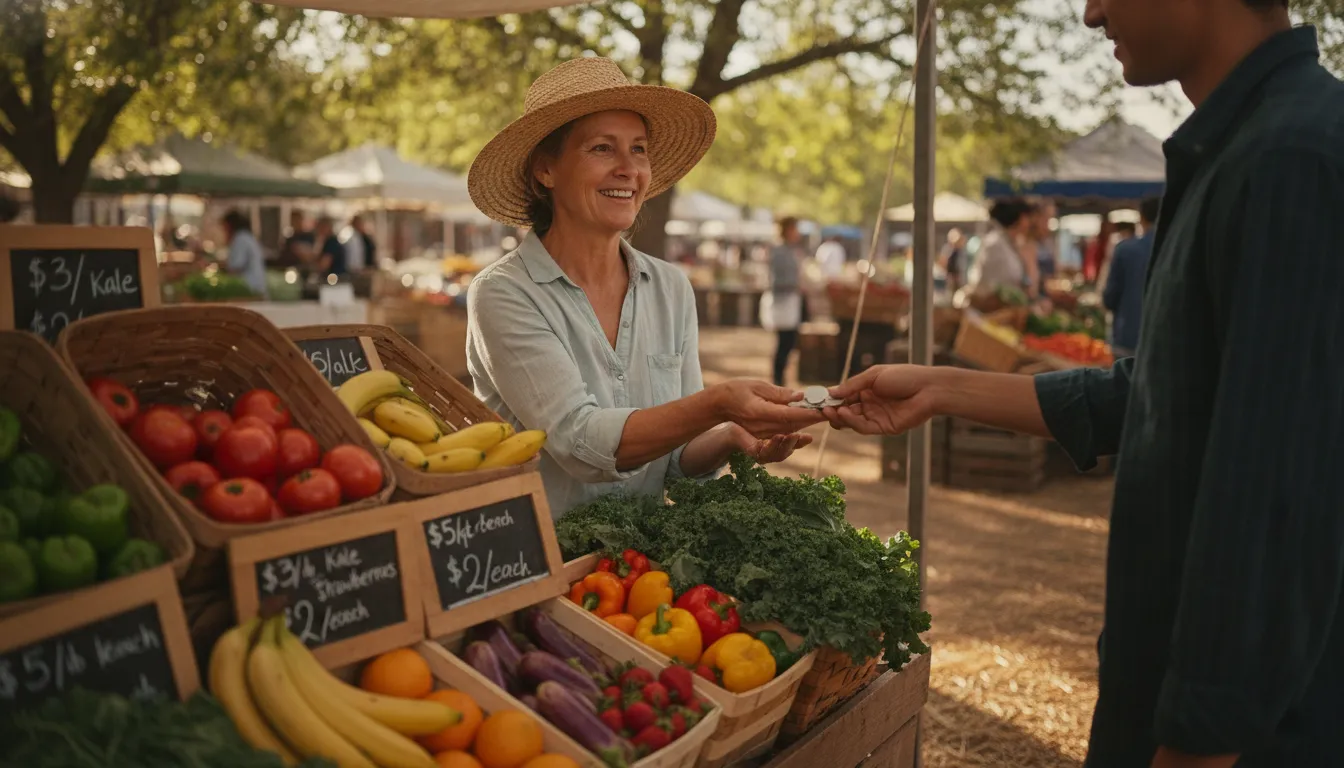
In the end, buying from local producers isn’t a magic solution for all environmental problems — but it’s one of the most accessible, practical choices with real positive effects that a consumer can make. You strengthen your region’s economy, reduce waste, support more diversified agricultural practices, and often eat better.
The key is not to treat this as an absolute commitment or rigid identity, but as a preference you cultivate over time. Every tomato bought at the market, every conversation with a vendor, every CSA basket subscription is a small act of reconnection with the origin of what you eat — and a concrete incentive for a fairer and more sustainable food system.
How about starting this weekend? Look for the nearest farmers market, bring a reusable bag, and discover what’s in season in your region. The planet thanks you — and so will your lunch.
