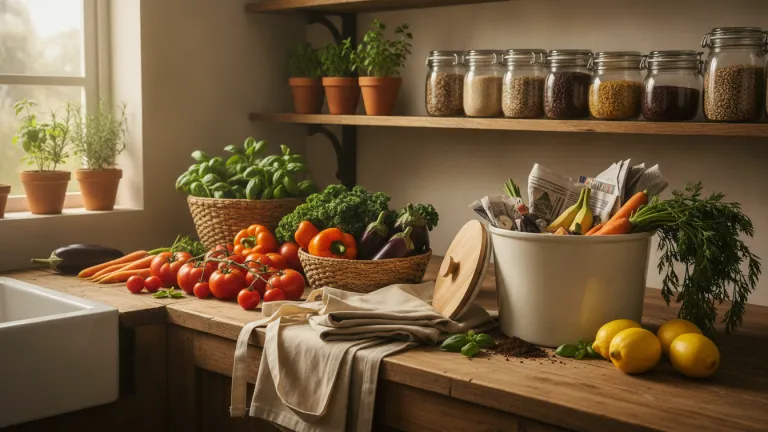
Every year, tons of perfectly good food end up in the trash while millions of people go hungry. This contradiction isn’t new, but it remains one of the most urgent issues of our time. Food waste is a systemic problem — but it starts, and can be fought, right in your own kitchen.
According to the Food and Agriculture Organization of the United Nations (FAO), approximately one-third of all food produced worldwide for human consumption is lost or wasted along the production chain. This represents an enormous environmental impact: beyond the unnecessary use of water, land, and energy in production, food that rots in landfills releases methane, a greenhouse gas with warming potential far greater than CO₂ in the short term. The Intergovernmental Panel on Climate Change (IPCC) has already identified food waste as one of the factors that significantly contributes to global greenhouse gas emissions.
The good news is that you don’t need to wait for public policies or large corporations to take action. Small habit changes in your home kitchen have real impact — on your wallet, your health, and the planet. This article brings together practical, accessible, and effective strategies for you to waste less starting today.
The food waste problem in Brazil and worldwide
Brazil ranks among the countries with the highest rates of food waste. According to data from Embrapa, the country wastes tens of millions of tons of food per year throughout the entire chain — from production to final consumption. A significant portion of this waste occurs precisely in Brazilian homes, during improper storage, preparation, and disposal of leftovers.
In the global context, the United Nations Environment Programme (UNEP) published the Food Waste Index Report pointing out that household waste represents the largest share of total waste in retail and consumption. In other words, the weakest link — and the most powerful for change — is the final consumer.
Beyond the climate impact, there is an undeniable social dimension: while nutritious foods are discarded, a significant portion of the Brazilian population still faces food insecurity. Reducing waste at home is, therefore, a gesture that connects environmental sustainability and social responsibility.
Shopping planning: the foundation for wasting less
The biggest cause of household waste begins even before reaching the kitchen: at the time of purchase. Impulse buying, without a list and without planning, results in items forgotten in the refrigerator until they spoil.
How to plan your shopping sustainably
- Create a weekly menu before going to the store. Define what you will eat at each meal throughout the week, considering lunch, dinner, and snacks.
- Take inventory of your refrigerator and pantry before leaving. Write down what you already have at home to avoid duplicate purchases.
- Make a detailed shopping list based on the menu and what’s missing. Follow the list strictly — it’s your best ally against waste.
- Buy only what you will consume during the week. For perishable items like leafy greens, herbs, and ripe fruits, prefer smaller quantities and shop more frequently if possible.
- Give priority to products with shorter expiration dates in your refrigerator, consuming them first (FIFO principle: first in, first out).
This simple approach already drastically reduces the volume of food that ends up in the trash without being consumed.
Smart storage: preserve more, waste less
Even when we shop with planning, poorly stored food spoils quickly. Knowing the best ways to store each type of food makes a huge difference in the durability and quality of what you have at home.
Practical storage tips by category
- Leafy greens: wash, dry well, and wrap in paper towels inside a sealed container in the refrigerator. They last up to twice as long.
- Fresh herbs (parsley, cilantro, chives): place in a glass with a little water, like a bouquet, and loosely cover with a plastic bag. Storing them this way in the refrigerator keeps them fresh for up to a week.
- Fruits and vegetables: separate those that produce ethylene (like bananas, apples, and avocados) from those sensitive to it (like carrots, broccoli, and leafy greens). Ethylene accelerates ripening and can spoil nearby items.
- Bread: if you won’t consume it within 2 to 3 days, freeze it. Frozen sliced bread can go directly into the toaster.
- Meal leftovers: store in airtight containers, labeled with the date, and consume within 3 days. What won’t be consumed should be frozen before spoiling.
- Grains and flours: keep in sealed, dry containers to avoid moisture and pests.
Clear organization in the refrigerator — with items that expire sooner at the front and visible — helps remind you what needs to be consumed with priority.
Whole food utilization: from stem to peel
One of the most powerful strategies against waste is expanding what we consider “edible.” Much of the peels, stems, seeds, and leaves we throw away are rich in nutrients and have excellent flavor when properly prepared.
What you can use that you normally discard
- Fruit and vegetable peels (such as beet, carrot, and zucchini): can go in the oven to make crispy chips or be used in broths.
- Kale, broccoli, and spinach stems: sautéed with garlic and olive oil are delicious and nutritious.
- Pumpkin seeds: washed, seasoned, and roasted become a healthy snack.
- Carrot and beet leaves: have a slightly bitter taste and work well in sautés, omelets, and broths.
- Onion and garlic peels: can be used to enrich homemade broths (remove before serving).
- Watermelon rind and white part: the white part can be pickled or sautéed like a vegetable.
- Day-old bread: becomes breadcrumbs, croutons, French toast, or a base for bread soup.
Whole food cooking has deep roots in traditional Brazilian cuisine — and is coming back strongly as a sustainable and flavorful practice.
How to use leftovers creatively and safely
Leftovers aren’t a problem — they’re ingredients waiting for a second chance. With a little creativity, dinner leftovers become the next day’s lunch in a tasty way without waste.
Ideas for repurposing leftovers safely
- Rice and beans from the day before can become fried croquettes, rice couscous, or a soup base.
- Leftover roast beef or cooked chicken works shredded in taco fillings, sandwiches, pasta, or baked rice.
- Cooked or roasted vegetables can be blended into creamy soups or serve as a base for a quick sauté.
- Overripe fruits are perfect for smoothies, homemade jams, cakes, and compotes.
- Milk about to expire can become homemade yogurt, curd, or be used in pancake and cake recipes.
Important: always respect safe storage times. Leftovers should be refrigerated within two hours after preparation and consumed or frozen within three days.
Home composting: the right destination for what can’t be used
Even with all care, there will always be organic waste that cannot be consumed — very hard peels, coffee grounds, eggshells, trimming scraps. For these materials, composting is the best solution.
Composting transforms organic waste into high-quality natural fertilizer, diverting material from landfills (where it would generate methane) and returning nutrients to the soil. It’s possible to compost even in small apartments, using worm composters (vermicomposting) or bokashi, a Japanese method that ferments waste without odor and in compact spaces.
Starting to compost at home is simpler than it seems: there are ready-made kits, online communities, and even municipal support programs in various Brazilian cities. The fertilizer produced works for plants, balcony gardens, and can be donated to neighbors or community gardens.
Technology and apps for better food utilization
In 2026, there are more tools than ever to help reduce food waste. Some apps allow you to log items in your refrigerator and receive alerts before they expire. Others suggest recipes based on ingredients you already have at home — a practical way to avoid that paralysis in front of a semi-empty fridge.
Food sharing platforms have also grown in Brazil, connecting people who have surpluses (from gardens, markets, and fairs) with those who can use them. It’s worth researching local initiatives in your city.
Another expanding practice is imperfect food markets, which sell fruits and vegetables that don’t meet market aesthetic standards — but are equally nutritious — at lower prices. Buying from these spaces is a way to combat waste still in the production chain.
Just as you can reduce plastic consumption at home with simple habits, reducing food waste is a behavior change that starts small and grows over time.
Conclusion: every meal is a choice

Reducing food waste doesn’t require perfection. It doesn’t need to be a radical turnaround or a sacrifice. It’s a set of simple habits — planning, storing well, using more, composting the rest — that, combined, make a real difference.
Every time you use that overripe fruit to make a smoothie, or transform leftovers into a creative dish, you’re saving money, relieving pressure on natural resources, and contributing to a fairer food system. These are everyday choices with collective impact.
Start today with a small step: before throwing something away, ask — can I use this another way? Often, the answer will surprise you.
