Why your budget doesn’t decrease even when you try to save
Have you ever stopped to add up how much you spend per month just on cleaning products? Degreasers, multipurpose cleaners, bleach, bathroom cleaners, stain removers, laundry detergent… The list grows, and with it the pile of plastic containers that end up in the trash. For many Brazilian families, this set of expenses represents a significant portion of the monthly household budget, not to mention the impact of all those bottles that rarely make it to neighborhood recycling collection.
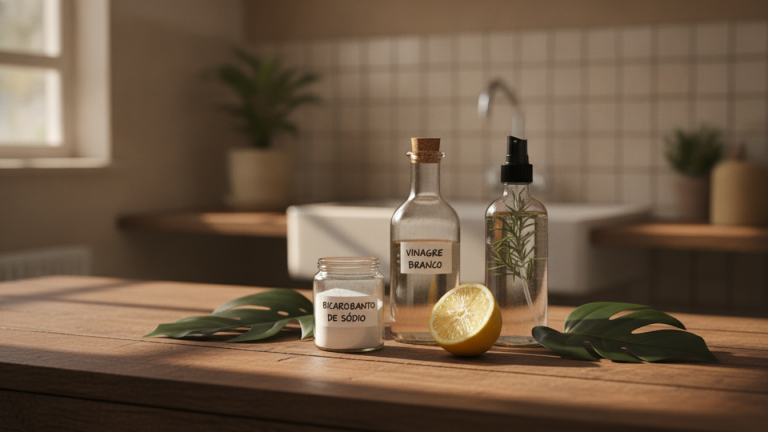
The good news is that there are simple alternatives, made with ingredients you probably already have at home, that actually work for most everyday tasks. Baking soda, white vinegar, lemon, coconut soap, and alcohol are the five core ingredients in this story. With them, you can prepare an efficient cleaning arsenal, safer for your family’s health, and much cheaper than what’s on the supermarket shelf.
By the end of reading this article, you’ll know exactly how to prepare the main homemade cleaning products, which situations each one works best for, which combinations to avoid, and how to store everything safely.
What makes industrial products a problem for the planet
Most cleaning products sold in Brazilian supermarkets contain synthetic surfactants, artificial fragrances, preservatives, and other compounds that take a long time to degrade in the environment. The United Nations Environment Programme (UNEP) points out that personal care and household products are among the relevant sources of micropollutants in urban water bodies worldwide.
In Brazil, the scenario is worsened by improper disposal of packaging. According to Abrelpe data, most solid waste generated in the country still ends up in landfills, and much of the single-use plastic never actually reaches recycling. Each bottle of cleaner you don’t buy is one less bottle in that chain.
There’s also the question of health inside your home. Closed environments, such as apartments, accumulate vapors from products containing chlorine, ammonia, and solvents. Limited ventilation means the concentration of these compounds in indoor air is often higher than in outdoor air. Switching these products for homemade recipes reduces your family’s exposure to these agents, especially for children and people with asthma or rhinitis.
The five ingredients that do almost everything
Before the recipes, it’s worth understanding what each ingredient does. This helps you adapt them for situations not on the list.
- Baking soda: mild abrasive, neutralizes odors, and has slight bactericidal action. Great for scrubbing surfaces without scratching.
- White vinegar: acetic acid that dissolves light grease, limescale, and soap residue. Also inhibits fungal growth on surfaces.
- Lemon (juice or peel): natural citric acid with degreasing and bleaching action. Leaves a pleasant smell and helps remove light stains.
- Coconut soap or neutral bar soap: natural surfactant that removes grease and dirt without harming delicate surfaces.
- Ethyl alcohol 70%: proven disinfectant for surfaces, effective against most bacteria and viruses under domestic conditions.
These ingredients are found in any market, pharmacy, or street fair. The initial investment is low, and the amount you use in each recipe is small, so supplies last quite a while.
Practical recipes: step by step with cost and prep time
Multipurpose cleaner for kitchen and bathroom
Materials:
- 500 ml of filtered or boiled and cooled water
- 2 tablespoons of baking soda
- 2 tablespoons of white vinegar
- 10 drops of lavender or mint essential oil (optional, for fragrance)
- 1 reused spray bottle
Prep time: 5 minutes Approximate cost: less than R$ 2.00 per 500 ml bottle
- Put the baking soda in the bottle first.
- Add the vinegar slowly, as the mixture will bubble.
- Wait for the reaction to subside and fill with water.
- Add the essential oil if desired.
- Cap and shake gently before each use.
Use on countertops, sinks, stoves, and tiles. Spray, let sit for two minutes, and scrub with a damp cloth.
Strong degreaser for stove and oven
Materials:
- 1 cup of baking soda
- Juice of half a lemon
- Water as needed to form a paste
Prep time: 3 minutes Approximate cost: less than R$ 1.50 per application
- Mix the baking soda with the lemon juice until it forms a paste.
- Apply directly to accumulated grease on the stove or grates.
- Let sit for 15 to 20 minutes.
- Scrub with a sponge or brush and rinse.
For the oven, you can apply the paste to the interior walls, close it, and let it sit for an hour before scrubbing.
Bathroom cleaner (toilets, sinks, and drains)
Materials:
- 1/2 cup of baking soda
- 1/2 cup of white vinegar
- 10 drops of tea tree oil, if available
Prep time: 2 minutes
- Sprinkle the baking soda inside the toilet or over the surface to clean.
- Pour the vinegar over it.
- Let the effervescence work for 10 minutes.
- Scrub with a brush and flush or rinse.
Tea tree oil has documented antifungal properties and helps especially in drains and grout lines with a tendency to accumulate mold.
Disinfectant for frequently touched surfaces
Materials:
- 70% ethyl alcohol (purchased ready-made)
- Spray bottle
Prep time: zero, just transfer to the spray bottle.
70% alcohol is already at the right concentration for home use. Higher concentrations evaporate too quickly and are less effective. Spray on doorknobs, light switches, remote controls, and cell phones, let sit for 30 seconds, and don’t rinse.
Homemade fabric softener
Materials:
- 500 ml of white vinegar
- 20 drops of essential oil of your choice
Prep time: 2 minutes Approximate cost: R$ 3.00 to R$ 4.00 per liter
- Mix the vinegar with the essential oil in a capped bottle.
- Use half a cup in the fabric softener compartment of the washing machine.
Vinegar removes soap residue from fibers, leaving clothes soft, and the vinegar smell disappears completely after drying. It works well in both conventional washing machines and hand washing.
Common mistakes that can ruin cleaning (or be dangerous)
Homemade recipes are safe, but certain precautions make the difference between a product that works and one that doesn’t—or worse, one that can be dangerous.
- Never mix vinegar with bleach (sodium hypochlorite). This combination releases toxic chlorine gas. If you use bleach for any specific task, use it separately from acidic ingredients.
- Don’t mix baking soda with vinegar and store in a closed bottle. The reaction generates carbon dioxide; in a closed container without a valve, pressure can force the cap off. Prepare it fresh or let the mixture settle before capping.
- Vinegar is not suitable for marble, granite, and natural stone. The acidity corrodes the polish over time. For these surfaces, use neutral soap diluted in water.
- Alcohol doesn’t replace cleaning with soap. Alcohol disinfects but doesn’t remove physical dirt. Clean first with water and soap, then apply alcohol if you want to disinfect.
- Keep ingredients away from children. Vinegar and baking soda are safe, but alcohol and concentrated essential oils require caution.
How much you can save in practice
The comparison below uses average prices found in Brazilian supermarkets in early 2025 and 2026. Values may vary by region, but the proportion remains the same.
| Product | Industrial version (approx.) | Homemade version (approx.) | Estimated savings |
|---|---|---|---|
| Multipurpose cleaner 500 ml | R$ 8.00 to R$ 12.00 | R$ 1.50 to R$ 2.00 | Over 80% |
| Degreaser 500 ml | R$ 10.00 to R$ 15.00 | R$ 1.50 | Over 85% |
| Fabric softener 2 L | R$ 18.00 to R$ 25.00 | R$ 6.00 to R$ 8.00 | Over 60% |
| Bathroom cleaner 500 ml | R$ 6.00 to R$ 10.00 | R$ 1.00 to R$ 1.50 | Over 80% |
A family that substitutes just three of these products for homemade versions can save dozens of reais per month, which over the course of a year represents significant savings without sacrificing efficient cleaning.
If you’re already doing other sustainable practices at home, like using a cheap solar heater, the combination of savings starts to show up noticeably on your bill at the end of the month.
What to do with leftover packaging
Switching to homemade products doesn’t happen overnight. You’ll still have industrial bottles around during the transition. The tip is simple: when a product runs out, reuse the bottle for the homemade version. This solves two problems at once: you reuse the packaging and don’t generate more plastic waste.
For bottles that can’t be reused, check if your neighborhood’s recycling collection accepts rigid plastic. Cleaning product containers are usually PET or HDPE type, both recyclable. According to Law 12.305/2010 (National Solid Waste Policy), municipalities are obligated to provide recycling collection points, but coverage is still uneven across the country.
Another growing option in Brazilian cities is buying supplies in bulk, like baking soda, soap, and vinegar in larger packages. Natural product fairs and some compounding pharmacies sell these items with less packaging per product, which reduces trash even further.
Frequently asked questions about homemade cleaning products
Are homemade products as effective as industrial ones?
For most everyday tasks, yes. Light stains, daily grease, limescale, and general cleaning respond very well to recipes with baking soda, vinegar, and soap. For specific situations, like disinfection in case of illness or severe mold cleaning, 70% alcohol and tea tree oil are effective allies.
Can I use these recipes in an apartment with delicate surfaces?
Yes, but pay attention to surfaces. Avoid vinegar on polished natural stone like marble and granite. For wood, use diluted neutral soap and a well-wrung cloth. For glass, the multipurpose cleaner with vinegar works very well and leaves no streaks.
How long do these products last after preparation?
The multipurpose cleaner lasts about two weeks at room temperature. Vinegar fabric softener lasts months because of vinegar’s natural acidity. The degreasing paste should be prepared fresh. In general, since they don’t contain preservatives, it’s best to prepare in small quantities and use right away.
Are these ingredients safe to go down the drain and not pollute water?
Baking soda, vinegar, coconut soap, and lemon are biodegradable and don’t represent significant risk to the sewage system or water bodies when used in normal domestic quantities. Alcohol degrades quickly. Avoid large amounts of essential oils down the drain. If you’re curious about what happens to water that goes down your home’s drain, the article about grey water and black water reuse provides more context on the domestic water cycle.
Start with one recipe this week
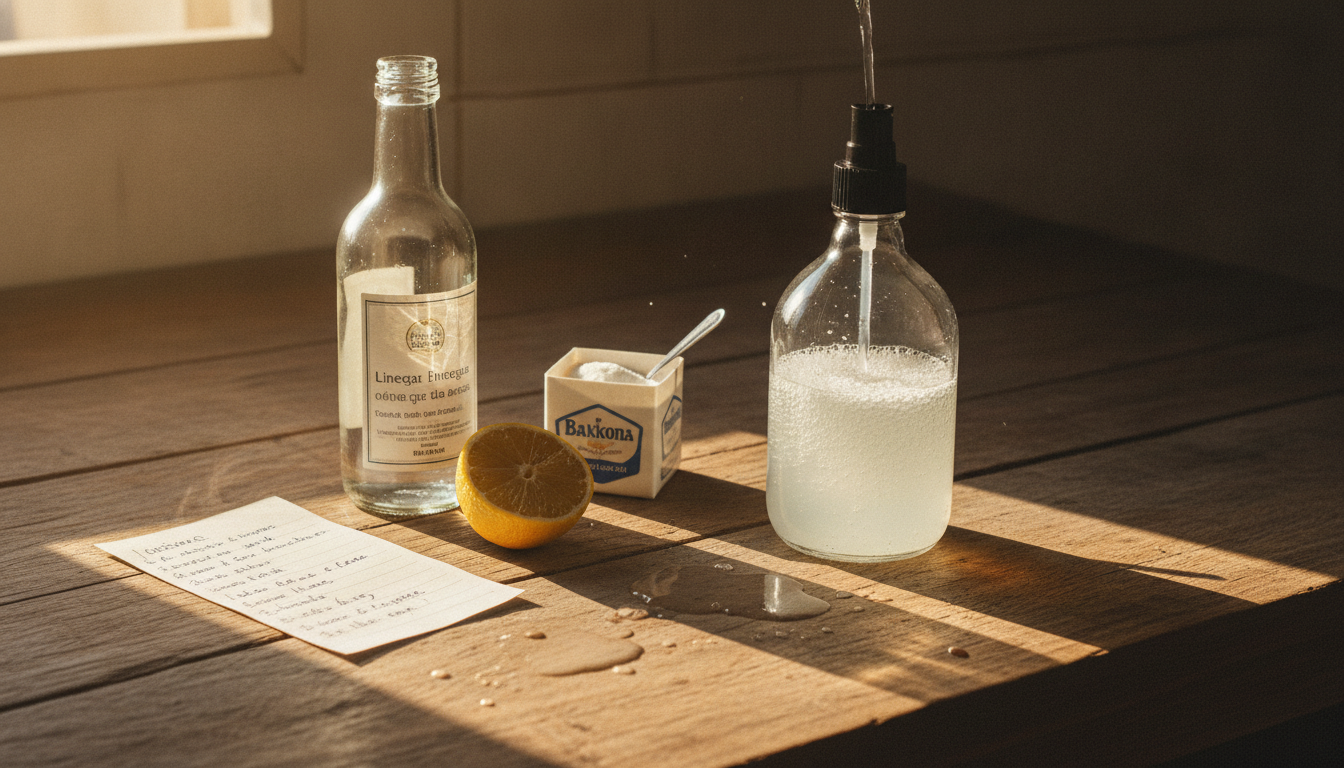
You don’t need to replace everything at once. Pick a product that’s running out—the multipurpose cleaner or fabric softener are easiest to start with—and prepare the homemade version before buying the next industrial bottle.
Baking soda and white vinegar are probably already in your kitchen. If not, they cost little and last long. A week of testing is enough to notice that cleaning works, your house smells fresh, and your weekly trash is visibly smaller.
Small changes made by many people have a real impact. And this one starts with what you choose to put in your cart the next time you go to the supermarket.
