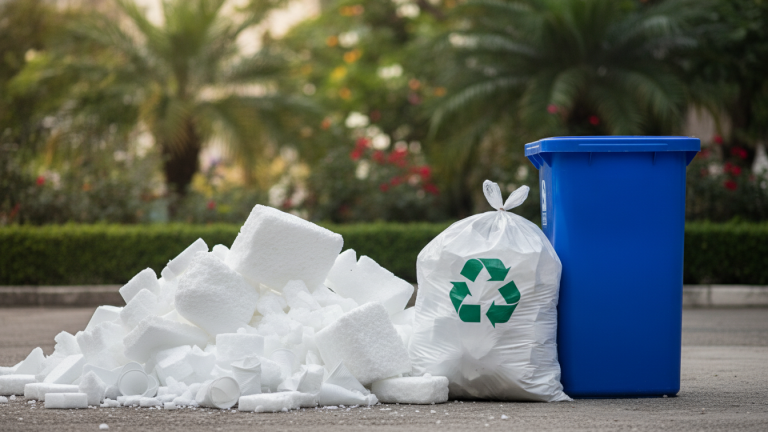
That white block of styrofoam left over from your appliance box has been sitting in the corner of your house for weeks. You know you can’t throw it in regular trash, but you also don’t know exactly what to do with it. If that sounds familiar, you’re not alone: styrofoam is one of the materials that generates the most doubt when it comes to recycling in Brazil.
The problem is real and large-scale. Styrofoam, whose technical name is expanded polystyrene (EPS), takes hundreds of years to decompose in nature. Because it’s very bulky and has low density, it takes up enormous space in sanitary landfills. According to Abrelpe data, Brazil still sends most of its solid waste directly to landfills, and materials like styrofoam contribute to this problem precisely because many people are unaware of alternatives.
The good news is that there is a way out. In this text you will discover where to properly dispose of styrofoam, how to reuse it at home, what mistakes to avoid, and what Brazilian legislation already provides for this type of waste. With practical information and real paths, you can resolve this issue this week.
What is styrofoam and why is it an environmental problem
Styrofoam is made from polystyrene, a type of plastic derived from petroleum. During the manufacturing process, it is expanded with air, resulting in that light white material that every Brazilian knows well: pizza boxes, appliance packaging, market trays, and refrigerated food transport boxes.
The major environmental challenge of styrofoam lies in its physical structure. It breaks into increasingly smaller pieces, generating microplastics that contaminate soil, rivers, and oceans. Studies by the United Nations Environment Programme (UNEP) identify microplastics as one of the most concerning forms of growing pollution in the world. When a block of styrofoam breaks into small balls scattered on the ground, each of those balls can last for centuries.
In Brazil, Law 12.305/2010, known as the National Policy on Solid Waste (PNRS), establishes shared responsibilities among manufacturers, distributors, retailers, and consumers for the lifecycle of products. This means that, in theory, those who sell styrofoam packaging are obligated to create return channels. In practice, these channels are still insufficient, and the consumer is left not knowing where to go.
Why styrofoam can’t go in regular selective collection
You’ve probably already separated styrofoam for the yellow trash in selective collection, thinking you were doing the right thing. The problem is that most recycling cooperatives in Brazil don’t accept styrofoam in the conventional flow, and for a simple reason: the material is 98% air and only 2% polystyrene. This makes transportation extremely expensive relative to the useful weight recovered.
When styrofoam arrives at cooperatives uncompacted, it takes up space that could be used for materials with higher financial returns, such as aluminum, paper, and PET. In many cases, styrofoam separated with good intentions ends up being discarded with regular trash anyway. That’s why taking styrofoam to your neighborhood’s selective collection point without first verifying whether that specific cooperative accepts the material can be a wasted effort.
The solution is to use specific channels, which exist and work throughout Brazil, but require an extra step on your part.
How to properly dispose of styrofoam: real paths
Ecopoints and voluntary drop-off centers
Ecopoints are physical structures maintained by city governments to receive waste that shouldn’t go to regular trash, such as rubble, old furniture, electronics, and in many cases, styrofoam. They’re different from conventional selective collection points. To find out if your city has ecopoints that accept styrofoam, visit your city hall’s website or call the local environmental agency.
Cities like São Paulo, Curitiba, Belo Horizonte, and Porto Alegre have relatively structured ecopoint networks. But even in smaller municipalities, it’s worth asking: many have targeted solutions that don’t appear easily in a quick search.
Companies specialized in EPS recycling
There are companies in Brazil that work specifically with expanded polystyrene recycling. They receive the styrofoam, compact the material with machines called densifiers, and send it to industries that transform it into new products, such as picture frames, baseboards, and even building materials.
Some of these companies accept material donations. A quick search for “EPS recycling” or “styrofoam recycling” plus your city’s name tends to return useful results. If you live in an apartment and accumulate styrofoam frequently, it’s worth contacting one of these companies directly and arranging periodic collection.
Return to manufacturer or point of sale
The PNRS provides for mandatory reverse logistics for certain product categories. For appliance packaging, for example, the manufacturer should provide return channels. In practice, this doesn’t always happen visibly. But it’s worth asking directly at the store where you bought the product whether they accept the packaging back. Some major retail chains have already joined this type of program.
How to reuse styrofoam at home before discarding
Before thinking about disposal, think about reuse. Styrofoam has characteristics that make it useful in various everyday situations, and reusing it means delaying the environmental problem even further.
See practical uses:
- Thermal insulation in plant pots: styrofoam at the bottom of the pot improves drainage and protects roots from excessive heat, something important in the Brazilian climate.
- Packaging for transporting fragile products: save pieces of styrofoam to protect objects when you need to send something by mail or transport delicate items.
- Crafts and school projects: larger blocks can become scale models, sets, and manual projects for children.
- Support in renovations: pieces of styrofoam work as spacers when installing panels and wall coverings.
- Growing seedlings: styrofoam boxes with holes in the base work as improvised raised beds, widely used in urban and community gardens.
These uses don’t eliminate the problem, but they reduce the amount of styrofoam that needs to be discarded at once. And when the time comes for disposal, the material has already served more than one function.
Common mistakes that seem right but aren’t
Some well-intentioned practices end up creating more problems than they solve. Be aware of these situations:
- Burning styrofoam: burning releases toxic gases, including carbon monoxide and styrene compounds. In addition to harming the health of those nearby, it’s illegal according to Brazilian environmental legislation.
- Throwing it in organic trash or compost bins: styrofoam doesn’t decompose biologically. It has no place in the compost bin. If you have doubts about what can or can’t go into composting, the article What can’t go in the compost bin and why explains this in detail.
- Throwing it in regular trash without compacting: if there’s no other option, at least reduce the volume. Step on the styrofoam to break it into smaller pieces before disposing, which facilitates handling in landfills.
- Mixing styrofoam with other plastics in recycling: expanded polystyrene is a separate category of plastic and should not be mixed with PET, PP, or HDPE.
Step-by-step to dispose of your styrofoam this week
If you want to resolve the styrofoam sitting at home quickly, follow this sequence:
- Assess the condition of the material: is it clean and whole, or dirty with food residue? Styrofoam from meat trays, for example, needs to be washed before any disposal.
- Research the nearest ecopoint: visit your city hall’s website or call the municipal environmental agency.
- Check local cooperatives: call the recycling cooperative in your neighborhood and ask directly if they accept EPS.
- Look for specialized companies: search for “styrofoam recycling EPS” plus your city. Specialized companies usually have contact forms on their website.
- Evaluate reuse: before disposing, see if any of the uses listed above makes sense for your situation.
- If there’s no local alternative: compact the styrofoam as much as possible and discard it in regular trash, without burning.
Estimated time to find the correct disposal point: about 15 minutes of research. Cost: zero.
Frequently asked questions about styrofoam disposal
Can I wash styrofoam from market trays and recycle it?
Yes, washing is necessary before any recycling attempt. Remove food residue with water and soap, dry well, and only then send for proper disposal. Dirty styrofoam complicates the process at cooperatives and recycling companies.
Is there any federal government program for styrofoam?
The 2010 PNRS created the legal framework for reverse logistics of packaging, but specific implementation for styrofoam is still fragmented and depends on state and municipal initiatives. There is no single uniform federal program for all of Brazil in 2026.
Can styrofoam be composted in any way?
No. Expanded polystyrene is not biodegradable and has no useful role in the composting process. It simply remains in the middle of the compost without transforming.
Can I paint or glue styrofoam before disposing it for crafts?
You can use it in crafts, but know that painted or white glue-adhered styrofoam can still be recycled. Styrofoam with contact cement, oil paint, or materials that penetrate deep into the structure complicates recycling and should be discarded as waste.
Start today: a small action that makes a difference
You don’t need to solve the styrofoam problem in the entire world. You need to solve what’s in your hallway right now. Separate the pieces that are stored, wash the ones with food residue, and set aside 15 minutes to research the ecopoint or cooperative closest to your house.
This is a habit that, when repeated, changes the way you deal with waste in general. And if you want to go further in caring for what comes in and out of your house, it’s also worth rethinking the cleaning products you use: see how in homemade cleaning products that cost almost nothing, a simple change that reduces plastic packaging and still saves money.
Styrofoam has a proper destination. Now you know what it is.
