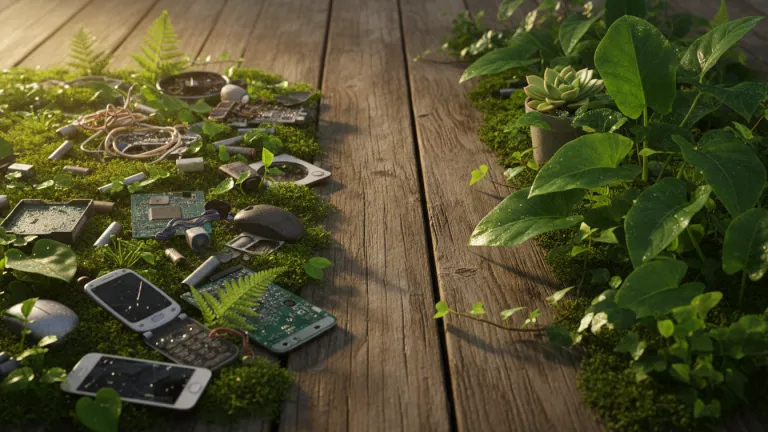
Have you ever stopped to think about what happens to that AA battery that ended up in a drawer, or the old cell phone that has been forgotten in a drawer for two years? In Brazil, tons of electronic waste and batteries are disposed of incorrectly every year — mixed with regular household waste, thrown in vacant lots, or simply ignored. This carelessness has serious consequences: heavy metals such as lead, mercury, and cadmium present in these products can contaminate soil and groundwater, affecting entire ecosystems and human health.
The good news is that in 2026, Brazil has a more developed electronic waste collection infrastructure than ever before, driven by the National Solid Waste Policy (PNRS), in effect since 2010, and reverse logistics programs that have expanded significantly over the last decade. Doing the right thing has become easier — you just need to know how.
This guide was created to be your starting point. We’ll explain why proper disposal matters, what the real risks are, and most importantly: what you can do now, step by step, without complications.
Why batteries and electronics deserve special attention
Batteries and electronics belong to a category called hazardous waste — and it’s not an exaggeration. Unlike a cardboard package or food scraps, these materials don’t decompose safely. A simple set of alkaline batteries contains manganese and zinc compounds that, in ordinary landfills, can leach into soil over years.
Lithium batteries — found in cell phones, notebooks, and electric scooters — have another risk: when damaged or exposed to heat, they can spontaneously combust. Cases of fires in garbage trucks caused by improperly discarded batteries have been recorded in different countries.
So-called e-waste (or WEEE — Waste Electrical and Electronic Equipment) includes everything from televisions and computers to refrigerators, microwaves, and cables. According to data from the Global E-waste Monitor initiative, the world generated more than 60 million metric tons of e-waste in recent years, and only a fraction of that is collected and recycled in a documented manner. Brazil ranks among the largest generators in Latin America — a direct reflection of the growth in technology consumption in the country.
What the law says: your rights and obligations
In Brazil, the disposal of batteries and electronics is regulated by a set of standards that holds manufacturers, distributors, retailers, and consumers responsible.
The Law No. 12,305/2010 (National Solid Waste Policy) establishes the principle of reverse logistics: whoever puts the product on the market is obligated to ensure it is collected at the end of its useful life. This means that manufacturers and stores cannot simply ignore the final destination of their products.
The CONAMA Resolution No. 401/2008 specifically regulates batteries and cells, prohibiting disposal in regular garbage and setting limits for toxic substances such as mercury, cadmium, and lead.
What this means for you as a consumer:
- You have the right to return used batteries and unused electronics at collection points in stores and manufacturers, at no additional cost.
- You have the responsibility to not discard these items in regular household waste.
- In case of doubt, you can contact the Ministry of Environment and Climate Change or your state’s environmental agency.
How to dispose of batteries correctly: step by step
Responsibly disposing of batteries is simple and takes less than five minutes. Here’s how:
- Separate used batteries in a specific container at home — it can be a tin, jar, or small box. Don’t mix with regular waste.
- Cover the terminals of button batteries (those small ones used in watches and remote controls) with electrical tape or masking tape before storing. This prevents short circuits.
- Identify the nearest collection point. Good options include:
- Supermarkets and hypermarkets (many have collection bins at the entrance)
- Pharmacy chains
- Electrical and construction material stores
- Municipal collection points
- Take the batteries to the collection point when the container is full — or at least once every two or three months.
- Don’t throw batteries in the yellow recycling bin. They need a specific destination, different from glass, paper, and plastic.
Practical tip: Apps like Cataki and Descarte Certo (available in 2026 for Android and iOS) help you locate special waste collection points near your location.
How to dispose of electronics: complete guide for each situation
Electronics require a bit more attention, as they vary greatly in size and complexity. Check the guidelines by product type:
Used cell phones and tablets
Before disposing, perform a factory reset to erase all personal data. Then:
- Check if the device still works — if so, consider donation or resale.
- If damaged, take it to authorized technical assistance centers, which usually have collection points.
- Large electronics retailers (such as Magalu, Americanas, and telephone operator networks) often have return programs.
Computers and notebooks
- Erase all data with a secure cleaning program (such as DBAN for conventional hard drives).
- Look for manufacturer collection points (Dell, Lenovo, HP, and other brands usually have take-back programs).
- Many municipalities organize periodic electronic waste collection campaigns — keep an eye on your city’s website.
Large home appliances (refrigerators, TVs, microwaves)
- The manufacturer or retailer is legally obligated to collect the old product when you buy a new one of the same type. Demand this service at the time of purchase.
- Otherwise, contact the manufacturer’s reverse logistics center.
Fluorescent and LED bulbs
- Fluorescent bulbs contain mercury and should not go into regular waste.
- Lighting stores and home centers like Leroy Merlin and C&C frequently have collection bins at the store entrance.
Reverse logistics programs: how to find the right point
The reverse logistics system in Brazil has grown, but it’s still not 100% uniform throughout the territory. To make it easier, use the resources below:
| Type of waste | Where to dispose |
|---|---|
| Batteries and cells | Supermarkets, pharmacies, electronics stores |
| Cell phones and accessories | Telephone operators, technical assistance, retailers |
| Computers and peripherals | Manufacturers (take-back), municipal campaigns |
| Large appliances | Retailers (when replacing the product), manufacturers |
| Bulbs | Home centers, electrical material stores |
| Printer cartridges | Stationery stores, computer stores |
How to find collection points near you:
- SINIR website (National System for Information on Solid Waste Management): sinir.gov.br
- Cataki app: collaborative map of collectors and collection points
- Product manufacturer website or customer service
- Municipal government website (search for “voluntary delivery point” or “PEV”)
Before disposal: extend the life of your devices
The best way to deal with e-waste is, whenever possible, to not generate e-waste. Some simple attitudes can double or triple the lifespan of your devices:
- Keep your cell phone battery between 20% and 80% whenever possible — this extends the lifespan of lithium cells.
- Avoid excessive heat: don’t leave electronics exposed to direct sunlight for long periods.
- Perform preventive maintenance: dust cleaning on notebooks, software updates, and thermal paste replacement are simple and inexpensive.
- Prefer repair to disposal: before throwing something away, consult a technical assistance center. Often a simple repair solves the problem.
- Buy consciously: consider whether you really need the newest model or if the current one still meets your needs.
Just as adopting a sustainable diet begins with small daily choices, taking better care of your electronics is also a gradual change in habits — not something that happens all at once.
Collective impact: why each proper disposal matters
It may seem like one more battery in the garbage makes no difference. But think about the multiplier effect: if every Brazilian who improperly disposes of batteries changed this habit, the volume of heavy metals that would no longer contaminate soil and water would be significant.
Furthermore, proper disposal feeds the circular economy: metals recovered from old batteries (such as lithium, cobalt, and nickel) can be reused in the manufacture of new batteries, reducing the need for mining — an activity with high environmental impact. The same applies to copper, gold, and other metals found in circuit boards.
At a time when the energy transition requires increasingly more batteries — for electric cars, solar energy storage (if you’re not yet familiar with this world, it’s worth reading about solar panels for homes in 2026) and other systems — recycling materials already available is strategic, not just environmentally.
Conclusion: your action, now, makes a difference

Properly disposing of batteries and electronics doesn’t require sacrifice or major changes to your routine. It starts with a jar in a drawer to store used batteries, a quick search for the nearest collection point, with the decision to repair before replacing.
Your action list for this week:
- Separate all used batteries in your home in a specific container.
- Identify the nearest collection point using Cataki or the SINIR website.
- Make an inventory of unused electronics — and decide: donate, sell, or recycle.
- On your next appliance purchase, demand collection of the old equipment by the retailer.
The planet doesn’t need perfection — it needs people willing to take the next right step. And you just took the first one.
