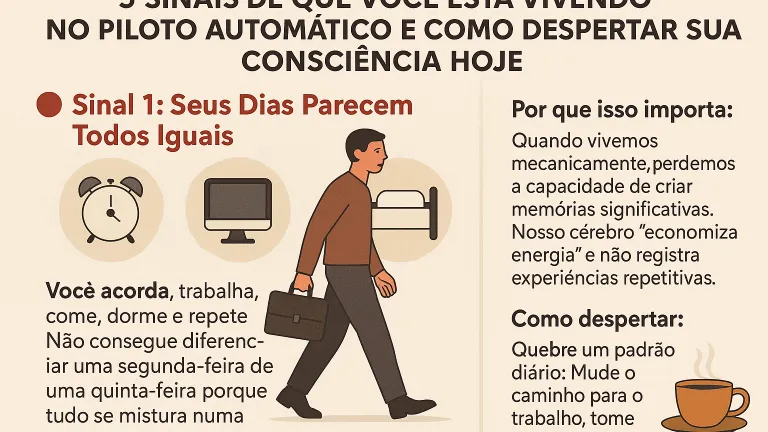
# 5 Signs You’re Living on Autopilot and How to Awaken Your Consciousness Today
Introduction: The Silent Epidemic of Autopilot Mode
Have you ever arrived at work without remembering the route you took? Finished a meal without tasting it? If the answer is yes, you’re not alone. We live in an era of constant distraction, where millions of people go through their days in a semi-conscious state, operating on what we call “autopilot.”
Autopilot is a mental state where we perform tasks and make decisions without full attention or deliberate awareness. It’s as if our mind is absent while the body executes mechanical and repetitive movements. Although this brain mechanism evolved to help us save mental energy on routine tasks, when it becomes the default mode of operation, we pay a high price: we lose the richness and depth of human experience.
According to research from Harvard University, we spend approximately 47% of our waking time with our minds wandering, disconnected from the present moment. This inattentive state not only diminishes our quality of life but is also directly related to lower levels of happiness and personal satisfaction.
In this article, we will explore five revealing signs that you are living on autopilot and, more importantly, practical and effective strategies to awaken your consciousness and regain control of your life today. Just as we learn to conserve valuable resources in our daily lives, we also need to learn to conserve and value our most precious mental and emotional resources: attention and awareness.
Sign 1: You Don’t Remember the Details of Your Day
One of the clearest indicators that you are functioning on autopilot is the inability to recall specific details of your day. By the end of the afternoon, you try to remember what you did in the morning, and everything seems like a vague blur. The hours pass, but you can’t pinpoint specific moments or meaningful conversations.
This phenomenon occurs because, when operating on autopilot, our brain is not truly recording experiences consciously. We are physically present but mentally absent. It’s like driving a car on a familiar road: you reach the destination but don’t consciously remember each turn, each sign, or each landscape along the way.
Neuroscience explains that memory formation requires attention. When we don’t genuinely pay attention to what we’re experiencing, our hippocampus – the brain region responsible for memory consolidation – doesn’t receive the necessary signals to archive these experiences. The result? Entire days that simply vanish as if they never existed.
How to Awaken from This Pattern:
Implement the practice of “conscious journaling” throughout the day. Set discreet alarms on your phone at three different times (morning, afternoon, and evening), and when they ring, pause for 60 seconds. Observe where you are, what you’re doing, how you’re feeling physically and emotionally. Mentally or in a notebook, note three specific details of that moment: a color you see, a sound you hear, a sensation you feel.
Another powerful technique is the practice of detailed gratitude. Instead of just thinking “I’m grateful for this day,” specify: “I’m grateful for the crunchy texture of the breakfast toast, for the kindness of the colleague who held the door for me, and for the warmth of the sun on my skin during lunch.” This specificity forces your mind to truly pay attention and record experiences.
Sign 2: Your Meals Are Unconscious and Rushed
How many times have you eaten while looking at your phone, watching TV, or working on the computer? If this describes most of your meals, you are experiencing one of the most common symptoms of living on autopilot: unconscious eating.
Eating on autopilot means swallowing food without really tasting it, chewing mechanically without noticing textures, and finishing the meal without even remembering what you ate. This behavior has consequences beyond the loss of sensory experience – studies show that unconscious eating is associated with overweight, poor digestion, and a dysfunctional relationship with food.
Researchers at Cornell University found that people who eat distracted consume, on average, 25% more calories than those who eat mindfully. This happens because the brain doesn’t adequately register satiety signals when focused on other activities.
Moreover, unconscious eating represents a deep disconnection from the present moment and our own body. When we eat without awareness, we miss the opportunity to nourish not only our physical body but also our human need for rich sensory experiences and mindful presence.
How to Awaken from This Pattern:
Practice “eating meditation” even if it’s just for one meal a day. Before you start eating, pause for a moment. Visually observe your food: the colors, the shapes, the arrangement on the plate. Smell the aromas. When you take the first bite, chew slowly, focusing on the textures and flavors.
Establish a simple rule: no screens during meals. No phone, no TV, no computer. If you eat alone, use this time to be truly present with the experience. If you eat with others, use it for genuine connection with the people around you.
Another valuable practice is the “gratitude pause” before meals. It doesn’t have to be religious – simply acknowledge for a few seconds the entire chain of events, people, and natural resources that made that meal possible. Just as we should have awareness about our relationship with the environment, we also need awareness about our relationship with food.
Sign 3: You Live in the Past or Future, Rarely in the Present
A revealing sign that you are on autopilot is realizing that your mind is constantly in another time: reliving past conversations, ruminating over old mistakes, or anxiously worrying about the future. Meanwhile, the only moment that truly exists – the now – goes unnoticed.
This pattern of temporally displaced thinking is extremely common in our society. We live in regrets of the past or anxieties about the future, but rarely fully inhabit the present moment. The problem is that life happens only in the now. The past is gone, and the future doesn’t exist yet. When we live mentally outside the present, we are literally missing our life.
The American Psychological Association points out that excessive rumination about the past is strongly associated with depression, while excessive worry about the future is linked to anxiety. Both represent an escape from the present moment and an automatic functioning of the mind.
When operating on temporal autopilot, we lose the ability to respond appropriately to what is happening now. Our reactions are based on old scripts or imaginary projections, not the current reality. This compromises our ability to make conscious decisions, genuinely connect with others, and experience spontaneous joy.
How to Awaken from This Pattern:
Practice “sensory anchoring” whenever you notice your mind wandering to the past or future. The technique is simple but powerful: consciously identify five things you can see, four you can touch, three you can hear, two you can smell, and one you can taste. This exercise, based on the five senses, brings your awareness immediately back to the present moment.
Establish “presence anchors” throughout the day – routine activities that you will transform into reminders to return to the present. For example, every time you wash your hands, use those 30 seconds to be completely present: feel the water temperature, the soap’s glide, the sound of running water. Every time you cross a doorway, pause and breathe consciously three times.
Also, try the practice of naming thoughts: when you notice you’re ruminating on the past, simply note mentally “thought about the past” without judgment. When you’re worried about the future, note “thought about the future.” This simple act of naming creates a healthy distance between you and your thoughts, reminding you that you are not your thoughts – you are the observer of them.
Sign 4: Your Social Interactions Are Superficial and Inattentive

Do you participate in conversations while mentally being somewhere else? Pick up your phone while someone is talking to you? Respond with “uh-hum” without really hearing what the person said? If so, your social interactions are happening on autopilot, and this has a significant cost to your relationships and quality of life.
Autopilot listening is when we are physically present in a conversation, but our mind is distant – planning what we will say next, thinking about our own concerns, or simply daydreaming. We are not truly listening; we are just waiting for our turn to speak.
This pattern is particularly harmful because human relationships are fundamental to our well-being. Research from the Harvard Medical School consistently shows that the quality of our relationships is one of the main predictors of happiness and longevity. But genuine relationships require genuine presence – something impossible when we are operating on autopilot.
Moreover, when we interact inattentively, the people around us feel it, even if unconsciously. They sense that we are not really there, and this creates a feeling of disconnection and devaluation that gradually erodes the quality of relationships.
How to Awaken from This Pattern:
Practice “deep listening” consciously. When al
