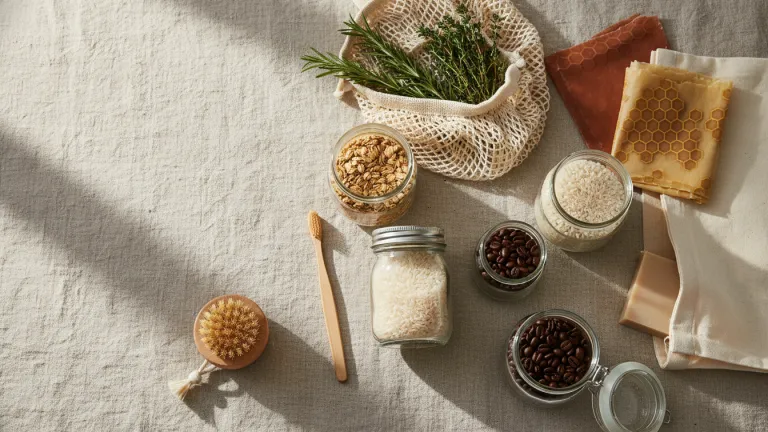
Imagine opening a drawer and finding only what is necessary. No accumulated packaging, no empty containers waiting for a destination, no guilt when throwing something away. This image, which for many seems utopian, is exactly the starting point of the Zero Waste movement — a lifestyle philosophy that is gaining strength in Brazil and around the world as a concrete response to the solid waste crisis.
Brazil generates a significant amount of urban waste annually. According to the Panorama of Solid Waste in Brazil, published by the Brazilian Association of Public Cleaning and Special Waste Companies (Abrelpe), the country produced over 80 million tons of urban solid waste annually in the latest available surveys — and a significant portion still ends up in dumps or landfills, far from any form of reuse. This scenario has enormous environmental, social, and economic costs, from groundwater contamination to methane emissions, a gas with a global warming potential much higher than CO₂.
The good news is that you don’t have to wait for public policies to start changing this scenario. Zero Waste is, above all, a change in mindset — and it begins with small choices made today, in your home, at work, and in your neighborhood.
What Is the Zero Waste Movement
The concept of Zero Waste (or Zero Waste in English) was systematized by the Zero Waste International Alliance (ZWIA), an organization that defines the goal as: preserving all resources through responsible production, consumption, reuse, and recovery of products, packaging, and materials, without burning them and without discharges that pollute the soil, water, or air, in a way that threatens the environment or human health.
In practice, Zero Waste does not literally mean producing no waste — that would be impossible in modern living standards. It means, indeed, reducing waste to the maximum extent possible, questioning every item that enters your life, and creating habits that prioritize the cycle: refuse, reduce, reuse, recycle, and compost.
The movement is inspired by the principles of the circular economy, which proposes replacing the linear “extract-produce-discard” model with a cycle where materials and products remain in use for as long as possible. Institutions like the Ellen MacArthur Foundation have documented the economic and environmental benefits of this approach on a global scale.
The 5 Rs Philosophy of Zero Waste
The most well-known hierarchy of the movement was popularized by American activist Bea Johnson, author of the book Zero Waste Home, and organizes priorities in this order:
- Refuse what you don’t need (unnecessary freebies, plastic straws, disposable bags)
- Reduce what you consume, buying less and more consciously
- Reuse what already exists, repairing, exchanging, or repurposing
- Recycle only what could not be avoided by the previous steps
- Compost organic waste, turning it into compost
The order matters: refusing and reducing always come before recycling, because recycling also consumes energy and resources.
Why Zero Waste Is Important Now
The plastic waste crisis is one of the most visible consequences of rampant consumption. Scientific research published in recent years has identified microplastics in previously untouched environments — from Arctic snow to ocean depths. The United Nations Environment Programme (UNEP) has consistently highlighted the need to reduce virgin plastic production as part of the solutions to the climate and biodiversity crisis.
In Brazil, the National Solid Waste Policy (PNRS), Law No. 12,305/2010, establishes goals and responsibilities for manufacturers, distributors, retailers, and consumers. Nonetheless, implementation progresses unevenly across the country. This means that individual and community action remains a fundamental engine of change while broader policies mature.
Besides the direct environmental impact, adopting Zero Waste tends to generate financial savings. Buying less, choosing durable products, and avoiding disposables reduces monthly spending on items that literally go to waste.
How to Start: A Step-by-Step Guide
Starting can seem intimidating, but the key is progressiveness. You don’t need to transform everything at once.
- Audit your waste. For a week, observe what you discard. Separate by category: plastic, organic, paper, glass, metal, reject. This reveals your biggest points of waste.
- Start with the kitchen. It’s where most household waste is generated. Plan weekly meals, make shopping lists, and avoid overbuying.
- Eliminate the easiest disposables first. Replace plastic straws with stainless steel or bamboo versions, swap disposable bags for eco-bags, and use reusable bottles.
- Set up a bulk shopping kit. Glass jars or fabric (smaller eco-bags) allow you to buy rice, beans, cereals, and other items without packaging at markets and bulk stores, increasingly present in Brazilian cities.
- Start a compost bin. Organic waste represents a considerable part of household garbage. Composting can be done in apartments with compact worm bins or in houses with garden composters.
- Discover selective collection and reverse logistics points in your city. Batteries, electronics, expired medications, and cooking oil have their own disposal channels — separating them correctly makes a big difference.
- Involve family or housemates. Habit changes are easier and more lasting when shared.
Zero Waste at Home: Priority Areas
Low-Waste Bathroom
The bathroom is often neglected but contains many plastic packages. Some practical replacements:
- Shampoo and conditioner bars (no plastic bottles needed)
- Solid deodorant or alum stone
- Bamboo toothbrush with recycled nylon bristles
- Cloth pads or menstrual cup
- Bar soap or solid soap instead of liquid soap in plastic packaging
Conscious Shopping at the Market
- Prefer products with glass packaging, which are infinitely recyclable without quality loss, unlike plastic
- Choose larger packages instead of smaller versions of the same product (generates less waste per unit)
- Prioritize local and seasonal products — besides reducing the carbon footprint of transportation, they usually have less packaging
- Bring your own bags, jars, and even boxes to the market
Clothing and Fashion
The textile industry is one of the most polluting in the world. Some concrete actions:
- Buy less and choose durable pieces
- Explore thrift stores, swap meets, and second-hand clothing platforms
- Repair before discarding
- Donate what you no longer use to institutions or clothing banks
Composting: Turn Waste into Resource
Composting is one of the pillars of Zero Waste and one with the most immediate impact. Organic waste sent to landfills produces methane during anaerobic decomposition — a gas with a global warming potential significantly higher than CO₂ in short time horizons, according to IPCC data.
By composting at home, you:
- Divert waste from the landfill
- Produce high-quality compost for plants and gardens
- Reduce the weight and volume of waste leaving your home
For apartment dwellers, a worm bin (vermicomposting) is the most practical solution. Stacked plastic boxes with Californian worms process fruit scraps, vegetable peels, and coffee grounds without generating bad odors when well managed. There are detailed tutorials online and kits available in specialized stores and marketplaces.
For those with a backyard, composting in piles or open composters is simple: just alternate layers of green matter (moist, like food scraps) with brown matter (dry, like shredded leaves and cardboard) and turn periodically.
Zero Waste Goes Beyond Home: Community and Engagement
Adopting Zero Waste individually is powerful, but the impact multiplies when change reaches the community. Talk to neighbors about collective composting in condominiums, propose selective collection points at work or school, and participate in local cleanup and awareness initiatives.
You can also track the collective impact of your actions by calculating your carbon footprint step by step — a concrete way to visualize how small behavioral changes add up to make a difference. And if you want to go further, participating in cleanup efforts is one of the most direct ways to act in your territory and build networks of people with the same values.
Common Mistakes for Beginners
Frequent Mistake Why It’s a Problem What to Do Instead Focusing only on recycling Recycling comes after refusing and reducing Apply the 5 Rs in the correct order Buying many “sustainable” products at once Generates unnecessary consumption and new waste Replace gradually when the item runs out Seeking immediate perfection Causes frustration and abandonment Celebrate every small change Ignoring organic waste They are a large part of household waste Start composting as soon as possible Acting only at home and not engaging others Limits the reach of change Share learnings without pressure Conclusion: Your First Step Is Already a Victory

Zero Waste is not a perfect destination — it’s a path of increasingly conscious choices. Every refused package, every item repaired instead of discarded, every lighter garbage bag leaving your home is a real contribution to a healthier planet.
In 2026, we live in a time when tools, information, and support communities are more accessible than ever. You don’t need a big house, a lot of money, or abundant free time. You just need the willingness to start — today, with what you have.
Choose a single habit from this list, put it into practice this week, and see what changes. Then add another. And another. This is how a revolution begins: in small daily decisions, repeated with intention.
The planet thanks you. And you will thank yourself too.
Back To Top
- Involve family or housemates. Habit changes are easier and more lasting when shared.
- Discover selective collection and reverse logistics points in your city. Batteries, electronics, expired medications, and cooking oil have their own disposal channels — separating them correctly makes a big difference.
- Start a compost bin. Organic waste represents a considerable part of household garbage. Composting can be done in apartments with compact worm bins or in houses with garden composters.
- Set up a bulk shopping kit. Glass jars or fabric (smaller eco-bags) allow you to buy rice, beans, cereals, and other items without packaging at markets and bulk stores, increasingly present in Brazilian cities.
- Eliminate the easiest disposables first. Replace plastic straws with stainless steel or bamboo versions, swap disposable bags for eco-bags, and use reusable bottles.
- Start with the kitchen. It’s where most household waste is generated. Plan weekly meals, make shopping lists, and avoid overbuying.
- Reduce what you consume, buying less and more consciously
