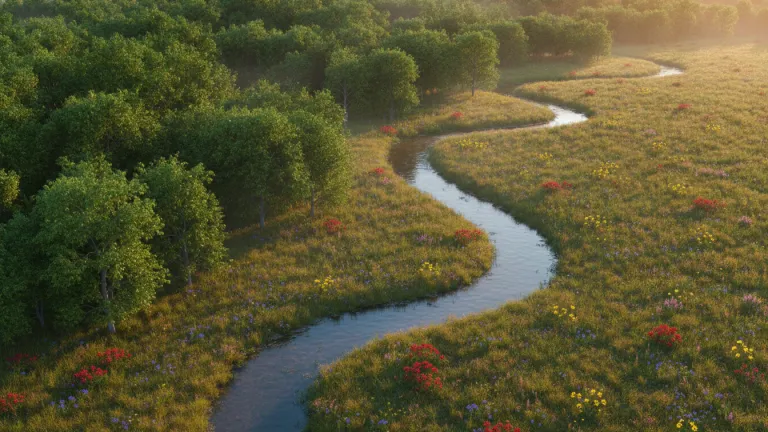
Imagine waking up in the morning, making coffee, and walking to the window. Outside, there’s a tree. A bird sings on its branches. Below, ants carry fallen leaves. In the moist soil, invisible fungi work silently. All of this — the tree, the bird, the ants, the fungi, the soil, yesterday’s rain, today’s sunlight — is connected in ways that go far beyond what the eyes can see. This living, dynamic system has a name: ecosystem.
The word may seem technical, reserved for biology textbooks or National Geographic documentaries. But understanding what an ecosystem is might be one of the most useful things anyone can do — whether you live in a big city, farm in the countryside, or are a student seeking answers about the world around you. Because when we understand how ecosystems work, we begin to see why our everyday choices truly matter: what we eat, what we throw away, how we use water.
In this article, we’ll explore the concept of an ecosystem in a clear way, without unnecessary jargon, with examples from Brazil and around the world. And of course, we’ll show how this knowledge can inspire concrete actions in your life.
What Is an Ecosystem: A Simple and Direct Definition
In simple terms, an ecosystem is a system formed by the interaction between living beings (fauna, flora, fungi, microorganisms) and the non-living elements of the environment — such as water, soil, sunlight, temperature, and atmospheric gases — in a given space.
The concept was formalized by British ecologist Arthur Tansley in 1935, but the idea that living beings depend on the environment and on each other is much older, present in indigenous cultures around the world for millennia.
An ecosystem can be:
- Immense, like the Amazon Rainforest, which covers more than 5 million km² and is estimated to harbor about 10% of all known species on the planet.
- Medium-sized, like a coastal mangrove or a palm swamp in the Cerrado.
- Small, like a puddle, an urban garden, or even a well-maintained aquarium.
Size doesn’t define importance. What matters is the web of relationships that exists within that space.
The Components of an Ecosystem: Who Are the Players
Every ecosystem is composed of two major groups of elements:
Abiotic components (the non-living)
These are the “settings” and “resources” of the ecosystem:
- Sunlight
- Water (rain, rivers, air humidity)
- Soil and its minerals
- Temperature and climate
- Atmospheric gases (oxygen, carbon dioxide, nitrogen)
Biotic components (the living)
These are the “actors” of the ecosystem, divided into three main roles:
- Producers: plants, algae, and some microorganisms that perform photosynthesis, transforming solar energy into organic matter. They are the foundation of everything.
- Consumers: animals that feed on producers (herbivores) or other animals (carnivores and omnivores). Humans are included here.
- Decomposers: fungi, bacteria, and other organisms that break down dead organic matter and return nutrients to the soil. They are nature’s “recyclers” — without them, the world would be covered in corpses and piled-up leaves.
These three groups form what we call the food chain, and when several chains intersect, they form a food web — much closer to reality, since most animals have more than one food source.
How Energy Flow Works in an Ecosystem
One of the most fascinating things about ecosystems is how energy flows through them — always in one direction, from the sun to producers, from producers to consumers.
This is called the energy flow, and it follows a fundamental rule of ecology: at each “step” of the food chain, most of the energy is lost as heat. That’s why ecosystems support many more plants than herbivores, and many more herbivores than predators at the top.
On the other hand, biogeochemical cycles — like the water, carbon, and nitrogen cycles — work differently: they are circular. The carbon atoms that are now in your cells have already been in dinosaurs, in ancient forests, at the bottom of the ocean. Nature doesn’t waste matter; it continuously recirculates it.
This understanding is crucial for comprehending climate change: when we burn fossil fuels or deforest, we are disrupting the natural carbon cycle, releasing into the atmosphere amounts of CO₂ that took millions of years to be stored.
Brazil’s Major Ecosystems: A Living Heritage
Brazil is one of the countries with the greatest diversity of ecosystems in the world. Knowing them is a source of pride — and a reason to want to protect them.
| Ecosystem | Main Location | Key Characteristic |
|---|---|---|
| Amazon | Northern Brazil | World’s largest tropical rainforest |
| Cerrado | Central Brazil | Most biodiverse savanna on the planet |
| Atlantic Forest | Eastern Coast | One of the most threatened biomes in the world |
| Pantanal | Mato Grosso and Mato Grosso do Sul | World’s largest continental wetland |
| Caatinga | Northeast | Only biome exclusive to Brazil |
| Pampa | Southern Brazil | Temperate grasslands rich in grass species |
| Mangroves | Coastline | Nursery for marine species and coastal barrier |
The Atlantic Forest, for example, has already lost more than 85% of its original coverage according to data from MapBiomas and SOS Mata Atlântica. What remains — fragments scattered along the coast — still harbors extraordinary biodiversity, including species that exist nowhere else in the world.
Why Ecosystems Are Essential to Our Lives
Healthy ecosystems aren’t just “an environmentalist thing.” They sustain functions that no human technology can completely replace — what scientists call ecosystem services.
Among the main ones:
- Climate regulation: Forests store carbon and influence rainfall. The Amazon, for example, generates the so-called “flying rivers” — moisture currents that irrigate much of Brazil and South America.
- Water purification: Riparian forests (vegetation along riverbanks) filter pollutants and regulate river flow.
- Pollination: Bees, butterflies, bats, and birds pollinate about 75% of global food crops, according to the FAO (Food and Agriculture Organization of the United Nations).
- Pest control: Natural predators regulate insect and rodent populations, reducing the need for pesticides.
- Human health: Many medicines are derived from compounds discovered in organisms from natural ecosystems.
- Food security: Healthy soils, rich in microbial life, are the foundation of agriculture.
When an ecosystem is degraded, these services are lost — and the cost to society can be immense. Understanding this helps us realize that protecting nature is, above all, a matter of collective intelligence.
What Threatens Ecosystems Today
The Intergovernmental Panel on Climate Change (IPCC) and the Intergovernmental Science-Policy Platform on Biodiversity and Ecosystem Services (IPBES) indicate that ecosystems are under increasing pressure on a global scale. The main threats include:
- Deforestation and land use change: The conversion of forests into pastures and monocultures is the leading cause of biodiversity loss.
- Climate change: Rising temperatures alter rainfall patterns, cause extreme events, and threaten species that cannot adapt quickly enough.
- Pollution: Plastics in the oceans, pesticides in soils and groundwater, and air pollution compromise entire food chains.
- Invasive species: Animals and plants introduced outside their natural habitat can destabilize local ecosystems.
- Overexploitation: Predatory fishing, illegal hunting, and uncontrolled mineral extraction deplete resources and destroy habitats.
The good news is that ecosystems have recovery capacity — called resilience — as long as pressures are reduced in time. Areas that have been reforested and protected around the world show that nature, when left alone (and sometimes with a little help), regenerates.
What You Can Do: Practical Actions to Support Ecosystems
Understanding ecosystems doesn’t have to stay theoretical. Here are concrete actions anyone can take:
- Use less plastic: Plastics reach oceans and rivers, affecting aquatic ecosystems. See how to start at Menos Plástico em Casa: Por Onde Começar.
- Reuse food: Less waste means less pressure on agricultural soils. Get inspired at Reaproveitar Restos de Comida Salva Dinheiro e o Planeta.
- Plant a tree or tend a garden: Even on urban balconies, plants create micro-ecosystems and shelter pollinators.
- Support producers who practice sustainable agriculture: Organic markets and products with responsible sourcing labels help preserve healthy soils.
- Dispose of waste properly: Improperly discarded waste ends up in rivers, mangroves, and oceans.
- Save water: Aquatic ecosystems depend on water volume and quality. Every drop counts.
- Value urban green spaces: Parks and squares are real urban ecosystems — visiting them and fighting for their preservation is both a political and environmental act.
- Stay informed and share knowledge: The more people understand what an ecosystem is, the more social pressure exists for public policies that protect them.
Conclusion: You Are Already Part of an Ecosystem

Here is the most beautiful — and most important — truth about all of this: you are not outside ecosystems, looking at them. You are part of them.
The oxygen you breathe right now was produced by plants and algae. The water in your glass passed through rivers, clouds, soils, and other living beings before reaching you. The food on your plate grew from living soil, pollinated by insects, irrigated by rains regulated by distant forests. We are all connected in a web that extends far beyond what we can see.
This awareness doesn’t need to generate guilt or anxiety. It can instead be a source of motivation and belonging. Every conscious choice — no matter how small it may seem — reverberates through this web. And when many people make conscious choices at the same time, ecosystems have a chance to recover, species have a chance to survive, and human communities have a chance to thrive in a more balanced way.
Start with what’s within your reach. Observe the nature around you more closely. And remember: caring for the planet isn’t a sacrifice — it’s self-care in its broadest form.
