Sustainable Transportation: Which Option Makes the Most Sense?
Have you ever stopped to think about how many tons of CO₂ are released into the atmosphere just to get you to work, school, or the grocery store? The transportation sector is one of the largest contributors to greenhouse gas emissions worldwide — and also one of the fields where individual choices have a real and measurable impact. The good news is that in 2026, there have never been so many accessible and smart alternatives for getting around more responsibly.
But “sustainable transportation” doesn’t necessarily mean abandoning your car tomorrow morning and cycling in the rain. It means understanding the environmental cost of each option, comparing them honestly, and finding the combination that works for your life. After all, sustainability that doesn’t fit into people’s real routines doesn’t change the world.
In this article, we’ll explore the main transportation alternatives available in Brazil — from electric buses to bicycles, including electric cars and ride-hailing services — and help you understand which one makes the most sense for your profile, your city, and your carbon footprint. Shall we?
Why Transportation Is a Central Climate Problem
The transportation sector accounts for a significant share of global greenhouse gas emissions. According to data from the IPCC (Intergovernmental Panel on Climate Change), transportation represents about 16% of global GHG emissions, with most originating from road vehicles powered by fossil fuels.
In Brazil, the scenario has important particularities. The Brazilian electricity matrix is predominantly renewable — with hydroelectric, wind, and solar power accounting for most generation — which makes electrifying transportation an especially powerful strategy here. At the same time, the country still has a very significant fleet of combustion vehicles and a public transportation system that varies greatly in quality from city to city.
Another point worth noting: the environmental impact of transportation goes beyond CO₂. Air pollution in cities, noise, soil impermeabilization with asphalt and parking lots, and resource consumption for manufacturing vehicles are factors that enter the equation of real sustainability. That’s why the analysis needs to be broader than just “does it emit smoke or not.”
Public Transportation: The Option with the Best Collective Cost-Benefit
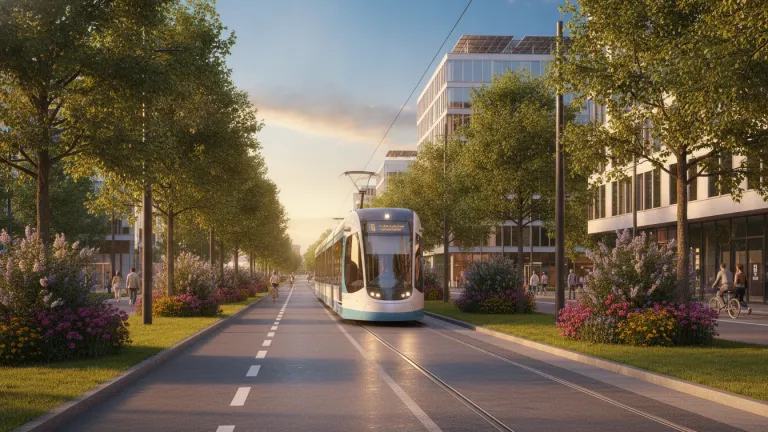
When talking about sustainable urban mobility, public collective transportation continues to be the alternative with the greatest impact at scale. A crowded city bus can transport dozens of people consuming a fraction of the energy that would be spent if each passenger traveled in their own car.
In recent years, several Brazilian cities have expanded fleets of battery electric buses. São Paulo, Curitiba, and Belo Horizonte already operate lines with electric buses, and the trend of expanding these fleets has been gaining momentum. Electric buses eliminate direct emissions at the point of operation and, combined with Brazil’s renewable electricity matrix, have a considerably smaller carbon footprint than their diesel equivalents.
The metro and urban train are even more efficient in terms of emissions per passenger-kilometer. Cities like São Paulo and Rio de Janeiro have relevant metro networks, although still insufficient to meet all demand.
Why choose public transportation:
- It’s the option with the lowest per capita emissions on crowded urban routes
- It reduces the total number of vehicles in circulation and congestion
- It has a lower financial cost for the user
- It frees the passenger from driving, allowing them to use the time differently
The real limitation is coverage and service quality, which varies greatly between cities and neighborhoods. In regions with efficient public transportation, it should be the first choice.
Bicycle and Active Mobility: Zero Emission, Double Benefit
The bicycle is, under almost all environmental criteria, the form of transportation with the lowest impact on the planet. It doesn’t emit pollutants, doesn’t consume fuel, takes up little space, and also promotes physical and mental health.
Brazil has made progress in cycling infrastructure in some capitals. São Paulo significantly expanded its network of bike lanes over the last decade, and bike-sharing systems (like Bike Itaú) have democratized access in several cities. Electric bicycles (e-bikes) are also gaining popularity, being a great solution for longer routes or terrain with hills, eliminating the excuse of sweating.
Active mobility — walking and cycling — works very well for trips of up to 5 to 8 km, which correspond to a huge portion of daily commutes in cities. According to urban mobility studies, a large part of car trips made in Brazilian cities cover distances that would be perfectly viable by bicycle.
Cycling makes more sense when:
- Your daily commute is up to 8–10 km (or more with an e-bike)
- There is minimally safe cycling infrastructure along the way
- Your city’s climate is favorable most of the year
- You want to combine transportation with physical activity
Electric Car: When Is It Worth It?
The electric car is experiencing accelerated growth in Brazil. According to ABVE (Brazilian Electric Vehicle Association), the market for electric and plug-in hybrid vehicles has shown consistent expansion, with more models being launched and prices gradually becoming more accessible — although they still represent a considerable investment.
The great advantage of electric vehicles in Brazil is exactly our energy matrix. Charging a car with energy from renewable sources results in much lower emissions over the vehicle’s life cycle than fueling a gasoline or ethanol car. Important to remember: battery manufacturing has a relevant environmental cost, but life cycle studies show that this “debt” is offset throughout the vehicle’s use.
Brazilian ethanol deserves a special mention: it’s a biofuel produced domestically, with a relatively favorable carbon balance compared to pure gasoline. Flex-fuel cars running on ethanol have lower emissions than their gasoline equivalents — but they still emit CO₂ from the tailpipe, and ethanol’s sustainability depends on the agricultural practices involved.
An electric car makes sense if:
- You need the car frequently and travel medium or long distances
- You have a place to install a charger at home or work
- You can afford the initial cost of the vehicle
- You want to significantly reduce your individual carbon footprint in transportation
An electric car doesn’t solve everything if:
- It’s used only to replace trips that could be made on foot, by bike, or by public transportation
- The energy used to charge it comes mostly from fossil sources (which is not the case in most regions of Brazil)
Ride-Hailing Apps and Shared Mobility
Services like Uber, 99, and similar ones occupy an ambiguous space in the discussion about sustainable mobility. On one hand, they can replace the need to own a car — which is positive, since a parked car represents an underutilized resource with a high production cost. On the other hand, studies indicate that ride-hailing trips can, in some contexts, increase the total number of kilometers driven in cities, especially due to drivers’ “empty” trips between rides.
The most sustainable mode within apps is pooling or shared rides, where multiple passengers share the same vehicle on similar routes. It brings the app closer to the concept of collective transportation.
In 2026, some platforms already offer filters to choose drivers with electric or hybrid vehicles, which can be a conscious choice criterion for those who use these services frequently.
How to Build Your Sustainable Transportation Strategy
There is no single formula. The best strategy is one that reduces emissions within the real possibilities of your life. Here’s a step-by-step guide to think about this:
- Map your trips: write down the main routes you take during the week — distance, frequency, and purpose.
- Identify what can change immediately: short trips (up to 3 km) that you make by car can become walks or bike rides today.
- Evaluate available public transportation: research the lines that serve your main route. Often the system is more efficient than we imagine.
- Consider multimodal combinations: bike to the metro station, metro to downtown, walk to the final destination — this combination is very common in well-structured cities.
- If you need a car, share: before taking the car alone, see if there are colleagues on the same route.
- Plan your vehicle change with criteria: if you’re going to buy a new car soon, it’s worth comparing electric and hybrid vehicles with the conventional models you’re considering.
- Calculate your transportation footprint: online tools and ecological footprint calculators help understand the real impact of your trips — learn more at Ecological Footprint: what it is and how to calculate yours.
Quick Comparison of Transportation Options
| Transportation Mode | CO₂ Emissions | Financial Cost | Urban Viability |
|---|---|---|---|
| Walking / Bicycle | Practically zero | Very low | High (short trips) |
| Metro / Train | Very low | Low | High (where available) |
| Electric bus | Low | Low | Growing |
| Diesel bus | Moderate (per capita) | Low | High |
| Electric car | Low (life cycle) | High (initial) | High |
| Flex car (ethanol) | Moderate | Medium | High |
| Gasoline car | High | Medium | High |
| App (solo ride) | High (with empty km) | Medium | High |
Conclusion: Every Kilometer Counts
The transition to more sustainable transportation doesn’t require perfection — it requires movement. Every trip you take by bicycle instead of car, every time you opt for the metro instead of taking your own vehicle, represents a real choice with real impact. And when thousands of people make these choices together, the collective effect is transformative.
Start with the simplest: observe your trips this week and identify a single route that could be done more sustainably. Just one. From there, the habit builds naturally.
If you want to go further and understand how transportation fits into all your environmental choices, it’s worth preserving the environment with simple daily actions — because mobility is just one piece of a more conscious lifestyle. The planet appreciates every kilometer thought through with care.
