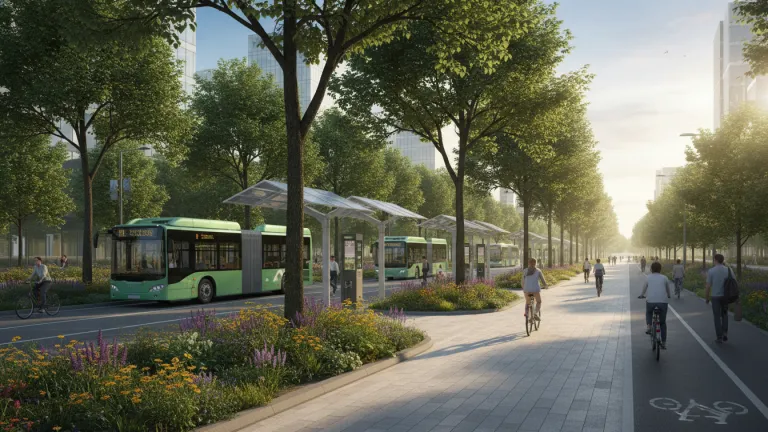
Why Rethink How We Move Around the City?
Every time you start your car engine to travel a few kilometers in traffic, you’re making a decision that goes beyond the final destination. The transportation sector is one of the largest contributors to greenhouse gas emissions globally — and in Brazil, this reality is no different. According to the Climate Observatory, road transport accounts for a significant portion of national CO₂ emissions, with gasoline and diesel combustion being the main culprits in this equation.
The good news is that there have never been so many alternatives available. From electric bikes to renewed public transport, electric vehicles, and the simple rediscovery of walking, 2026 offers a menu of options more varied than any previous generation had access to. The question is no longer “is there another option?” — but rather “which option makes the most sense for me now?”.
This article gathers the main sustainable transportation alternatives, with real data, honest advantages and disadvantages, and practical tips for you to start changing your commuting habits today. After all, every trip is a choice — and choices accumulate.
The Real Problem: Why Transportation Matters So Much for the Climate
The transportation sector is responsible for about 23% of global energy-related CO₂ emissions, according to data from the International Energy Agency (IEA). In urban contexts, this translates into congestion, air pollution, and deteriorating quality of life in cities.
In Brazil, road transport dominates the transportation matrix — both for freight and passengers — making the country particularly vulnerable to fluctuations in fossil fuel prices and associated climate impacts. Cities like São Paulo and Rio de Janeiro are among the most congested in Latin America, with residents losing hours of their day in private vehicles.
Besides carbon emissions, there are other less-discussed impacts:
- Noise pollution, affecting mental health and sleep quality
- Urban heat islands, intensified by asphalt and vehicles
- Sedentary lifestyle, worsened by car dependency
- Inequality of access, as poor public transport penalizes low-income populations
Understanding these impacts helps us appreciate the alternatives more clearly.
Active Transportation: Walking and Cycling Are Underestimated
The most sustainable way to get around remains the one that doesn’t rely on any fuel: the human body itself.
Walking: Simple and Powerful
Trips up to 2 km on foot are feasible for most people in good health and represent zero emissions, zero cost, and even bring proven cardiovascular health benefits. The challenge, especially in Brazil, is infrastructure: uneven sidewalks, lack of greenery, and insecurity reduce the appeal of walking in cities.
Urban Cycling: Consistent Growth
The use of bicycles as a means of transportation has been growing in several Brazilian cities, driven by the expansion of bike lanes and the popularization of bike-sharing systems. Cities like São Paulo, Rio de Janeiro, Curitiba, and Fortaleza have expanded their cycling networks in recent years.
A conventional bicycle has virtually zero carbon footprint during use. An electric bicycle (e-bike) consumes electricity but still has much lower emissions than a car — and extends the travel range for people facing hilly terrain or longer distances.
Advantages of cycling:
- Low maintenance cost
- Flexible schedule
- Benefits to physical and mental health
- Ease of parking
- Reduced congestion
Real limitations:
- Road safety still precarious in many cities
- Long distances and hot weather can be barriers
- Limited capacity for carrying loads and passengers
Public Transport: The Most Efficient Per Passenger
From an environmental standpoint, well-utilized public transport is unbeatable in terms of efficiency per transported passenger. A full bus emits a fraction of the CO₂ that would be generated if each passenger traveled in their own car.
The major obstacle in Brazil is the quality and coverage of the service. When public transport is slow, overcrowded, and unreliable, people naturally migrate to cars. Therefore, the fight for quality public transport is also an environmental fight.
Metro and Train: Efficiency Champions
Rail systems are the mass transit modes with the lowest emissions per passenger-kilometer, especially when powered by renewable energy. Brazil has been expanding its networks, but there is still a huge deficit relative to the demand of large metropolises.
Electric Buses and the Ongoing Transition
Several Brazilian capitals have been investing in the electrification of bus fleets. São Paulo, for example, has set goals to expand its fleet of electric buses in the coming years. Electric buses eliminate local particulate pollution and, when charged with renewable energy, have much lower life-cycle emissions than diesel versions.
How to make the most of public transport:
- Use route apps to plan trips in advance
- Combine modes: bike + metro is a powerful combination
- Avoid peak hours when possible
- Prefer lines with newer and less polluting vehicles
Electric Vehicles: A Necessary Transition with Important Nuances
Electric vehicles (EVs) are often presented as the ultimate solution for sustainable transport. The reality is more nuanced — but still quite promising, especially in the Brazilian context.
Why Brazil Has an Advantage in This Transition
Brazil’s electricity matrix is predominantly renewable, with a focus on hydroelectric generation and a growing share of wind and solar energy. This means that charging an electric vehicle in Brazil results in significantly lower emissions than in countries with more coal-dependent matrices.
What to Consider Before Opting for an EV
- Manufacturing emissions: the production of lithium batteries has a real environmental impact, including lithium, cobalt, and nickel mining. This initial “carbon debt” is recovered over the vehicle’s use.
- Battery disposal: still a developing challenge in Brazil, with evolving regulations.
- Charging infrastructure: expanding but still concentrated in major cities and the South and Southeast regions.
- Initial cost: still high for most Brazilians, although prices are falling.
In terms of life-cycle emissions, comparative studies indicate that electric vehicles generally emit less CO₂ than combustion equivalents, even considering manufacturing — and this advantage increases over time with the use of renewable energy.
Combustion Cars: How to Reduce Impact While the Transition Happens
Not everyone can abandon their private car today. But there are ways to use the car more responsibly while the transition to more sustainable modes advances.
Practices That Make a Real Difference:
- Carpooling: sharing a car with coworkers or neighbors can halve (or more) the per capita emissions of a trip
- Regular vehicle maintenance: well-tuned engines, correctly inflated tires, and clean filters reduce fuel consumption
- Efficient driving: smooth acceleration, anticipating braking, and constant speed can save up to 20-30% in fuel
- Reducing unnecessary trips: consolidating errands, working from home when possible, and preferring delivery for some purchases can eliminate trips
- Ethanol instead of gasoline: in the Brazilian context, sugarcane ethanol has a more favorable emissions balance than conventional gasoline, according to data from Embrapa and the sugar-energy sector
Shared and Multimodal Mobility: The Future of Cities
The logic of “one car per person” is gradually being replaced by a more fluid model: using the right mode for each type of trip.
Car-sharing platforms, electric scooters, and bicycles allow people to access different means of transport without the need for ownership. This reduces the number of vehicles on the streets and optimizes the use of each one.
Examples of efficient multimodal combinations:
- Bicycle to the metro station + metro to the destination
- Bus to the center + walk to the final destination
- Shared car only for long trips or with cargo
How to Choose the Right Mode for You: Practical Guide
There is no one-size-fits-all solution. The best choice depends on your city, routine, physical condition, and available infrastructure. Use this guide as a starting point:
- Map your trips — note all the routes you take for a week and the distance of each
- Identify the shortest trips — those up to 2-3 km are the easiest to replace with walking or biking
- Check available infrastructure — are there bike lanes? Nearby metro lines? Bike-sharing points?
- Calculate the real costs of the car — include fuel, maintenance, insurance, taxes, and parking; many are surprised by the total value
- Try one alternative per week — no need to change everything at once; start with a specific route
- Evaluate after a month — what worked? What needs adjustment?
Mode CO₂ Emission User Cost Infrastructure Dependence Walking Zero Zero Low (sidewalks) Bicycle Almost zero Very low Medium (bike lanes help) Metro/Train Very low Low High Electric bus Low Low High Electric car Low to medium High (acquisition) Medium (charging) Combustion car High Medium to high Low Conclusion: Every Trip Is an Opportunity
Transforming transportation is one of the most direct paths individuals, companies, and governments have to reduce emissions and improve urban quality of life. It’s not about giving up comfort — it’s about redefining what comfort means when we include clean air, time in traffic, and long-term health in the calculation.
Small changes accumulated by millions of people have real weight. Replacing two or three car trips a week with biking, public transport, or walking already makes a measurable difference — for the climate, the budget, and personal well-being.
If you want to deepen your sustainable living journey beyond transportation, also explore how food choices impact the planet — another field where daily decisions have enormous consequences.
The transportation of the future is being built today — and you can be part of it with every conscious trip you choose.
Back To Top - Identify the shortest trips — those up to 2-3 km are the easiest to replace with walking or biking
- Map your trips — note all the routes you take for a week and the distance of each
- Regular vehicle maintenance: well-tuned engines, correctly inflated tires, and clean filters reduce fuel consumption
- Battery disposal: still a developing challenge in Brazil, with evolving regulations.
- Manufacturing emissions: the production of lithium batteries has a real environmental impact, including lithium, cobalt, and nickel mining. This initial “carbon debt” is recovered over the vehicle’s use.
- Urban heat islands, intensified by asphalt and vehicles
