You open the kitchen drawer and find plastic bags stuffed inside other plastic bags. You look under the sink and see dozens of empty cleaning product bottles. You go to the supermarket and come back with fruit wrapped in styrofoam trays covered in plastic film. If this scene sounds familiar, you’re not alone — it repeats in millions of households every single day.
The problem with disposable plastic goes far beyond clutter at home. Produced on an industrial scale since the mid-20th century, single-use plastic has become one of the biggest environmental challenges of our time. Large volumes of plastic waste end up in landfills, rivers, and eventually the ocean — where they break down into microplastics that have already been found in fish, drinking water, and even human blood. To better understand where this material ends up, check out our article on plastic in the oceans: what happens to it.
The good news is that change starts at home, with small and consistent choices. You don’t need to transform your routine overnight or spend a lot of money. In this article, you’ll find a practical, honest, and actionable guide to reducing plastic in your life — starting today.
Why reducing plastic at home truly matters
Before talking about solutions, it’s worth understanding the scale of the problem. Brazil is one of the largest producers of solid waste in Latin America. According to the Panorama of Solid Waste in Brazil, published by the Brazilian Association of Public Cleaning and Special Waste Companies (Abrelpe), the country generates tens of millions of tons of waste per year — and plastic represents a significant portion of that total.
Globally, the situation is also concerning. The United Nations Environment Programme (UNEP) points out that only a small fraction of the plastic produced worldwide is actually recycled. Most of it goes to landfills, is incinerated, or ends up in the natural environment. Single-use plastic — bags, straws, food packaging, disposable cups — is the main culprit in this equation.
The good news, from an environmental standpoint, is that the household is one of the places where consumers have the most control. By reducing the amount of plastic entering your home, you directly decrease your waste footprint, encourage the market for more sustainable alternatives, and even save money in the long run.
Conduct a plastic audit in your home
The first step to changing any habit is understanding what needs to change. Before rushing out to buy alternative products, take a moment to observe where plastic appears in your routine.
How to map your household plastic consumption
- Set aside a bag or box for an entire week to collect all the plastic waste you would normally throw away.
- At the end of the week, empty the bag and sort the items by category: food packaging, personal care products, cleaning products, shopping plastics (bags, tape, bubble wrap).
- Identify the three largest groups. These are the ones that deserve your priority attention.
- Ask yourself: is there a viable alternative for each of these items? What would be the cost and effort of making the change?
This simple exercise often surprises people. Many discover that the bulk of the plastic they discard comes from just two or three habits — and that makes the change much more manageable.
Kitchen: where most household plastic waste originates
The kitchen is, in most homes, the main source of plastic waste. Packaging from processed foods, supermarket bags, plastic wrap, and water bottles account for a huge portion of household trash.
Practical substitutions for the kitchen
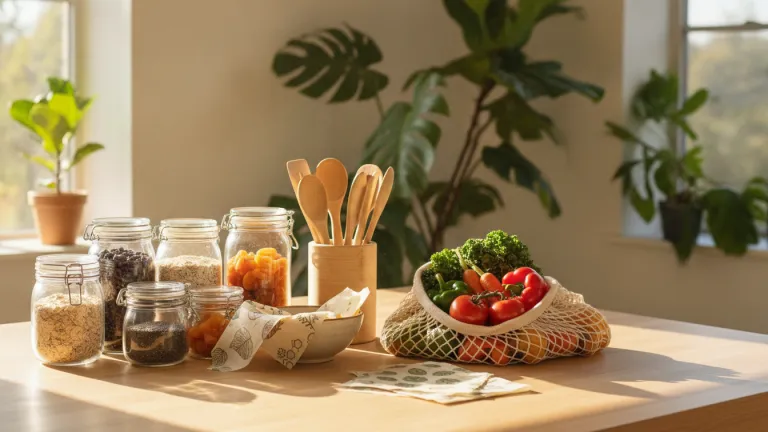
- Reusable bags: always carry two or three cloth or non-woven bags in your purse or car. The habit forms in just a few weeks.
- Glass or stainless steel containers: gradually replace plastic storage containers. Glass is more durable, doesn’t absorb odors, and can go in the oven.
- Food-grade silicone lids and wraps: these work as substitutes for plastic wrap (PVC) to cover bowls and leftovers.
- Buy in bulk: farmers’ markets, neighborhood stores, and bulk shops allow you to buy rice, beans, cereals, nuts, and even solid shampoo without packaging. Bring your own containers.
- Unpackaged fruits and vegetables: whenever possible, choose loose items instead of styrofoam trays wrapped in plastic.
- Reusable water bottle: a good stainless steel or glass bottle lasts for years and eliminates daily PET bottle consumption.
Bathroom: a hidden reservoir of disposable plastic
The bathroom is often underestimated in household plastic assessments. Shampoos, conditioners, liquid soaps, toothpastes, deodorants, makeup containers — all of this generates a constant stream of plastic packaging.
Sustainable alternatives for personal care
- Solid shampoo and conditioner: available at pharmacies, natural stores, and online shops, they last longer than liquids and don’t require a plastic bottle.
- Bar soap: the classic bar soap is, by nature, a more sustainable alternative to liquid soap in a plastic bottle.
- Bamboo toothbrush: the handle is biodegradable (the bristles are usually still nylon — check the composition before buying).
- Toothpaste tablets or powder: there are options with and without fluoride available on the market, some in glass or paper packaging.
- Refills and concentrates: many beauty and personal care brands now offer refills or concentrated versions that reduce packaging volume.
- Safety razor with replaceable blades: reusable metal models generate much less waste than disposable plastic razors.
Household cleaning: reduce plastic without sacrificing efficiency
Cleaning products are major generators of plastic packaging. Dish soap, fabric softener, disinfectant, all-purpose cleaner, bleach — each comes in its own bottle, and most go straight to the trash when empty.
Strategies for cleaning your home with less plastic
- Buy refills or concentrates: concentrated cleaning products yield much more than ready-to-use versions. You buy less often and generate less packaging per use.
- Use baking soda and vinegar: for general surface cleaning, glass, and drain unclogging, baking soda and white vinegar handle many situations without requiring a new plastic bottle.
- Make your own mixtures: water + vinegar + a few drops of essential oil make an effective all-purpose cleaner for surfaces. Store in a glass bottle with a spray nozzle.
- Choose cellulose or natural fiber sponges: synthetic sponges release microplastics with every use. Cellulose or natural loofah sponges are more sustainable alternatives.
- Cloth dish towels and reusable cleaning cloths: these replace rolls of paper towels wrapped in plastic.
Shopping and conscious consumption: change where plastic enters
A large portion of the plastic that arrives at home comes with your purchases. Thinking about how and where you shop is just as important as what you do with the packaging afterward.
Shopping habits that reduce plastic
- Make a list before you leave: shopping with a list reduces impulse purchases and, consequently, the volume of packaging entering your home.
- Choose larger packages: buying family-size or bulk quantities reduces the ratio of packaging to product consumed.
- Support local businesses: farmers’ markets, neighborhood bakeries, and butcher shops often offer fresh products with less packaging than supermarkets. It’s worth exploring this option — there are also economic and social benefits to consuming locally.
- Check the labels: packaging with recyclability seals or made from post-consumer recycled plastic has a lower impact than conventional options.
- Avoid products with excessive packaging: when a product comes with three unnecessary layers of plastic, that’s a red flag — consider reconsidering the purchase or sending feedback to the brand.
What to do with the plastic you already have at home
Reducing is the top priority — but what about the plastic already in your home or that will inevitably still come in?
The 5Rs hierarchy applied to household plastic
| Priority | Action | Practical Example |
|---|---|---|
| 1st | Refuse | Don’t accept a plastic bag at the store |
| 2nd | Reduce | Buy fewer individually packaged items |
| 3rd | Reuse | Use plastic containers to organize drawers |
| 4th | Recycle | Properly separate for selective collection |
| 5th | Redirect | Eco-points, cooperatives, voluntary drop-off locations |
Ideally, recycling should be the last option before disposal — not the first. Recycling consumes energy and isn’t always feasible: in Brazil, recycling infrastructure is still uneven across regions. That’s why refusing and reducing always take priority.
Conclusion: small choices, big collective impact

No individual change will solve the plastic waste crisis alone — that requires structural, regulatory, and industrial transformations. But consumers play a real role in this equation: as buyers, as shapers of household habits, and as citizens who pressure the market with their choices.
Start with the highest-impact areas you identified in your audit. Don’t try to change everything at once — choose one or two substitutions per month and let the habit solidify before moving on to the next. Over time, what seemed laborious becomes automatic.
Every water bottle you don’t buy, every bag you refuse, every glass container you choose instead of plastic represents a concrete decision. And concrete decisions, repeated by many people, move markets and policies.
How about starting this week? Choose one substitution from the list above, apply it for 30 days, and see how you feel. Share your experience with people you know — habit change is contagious, in a good way.
