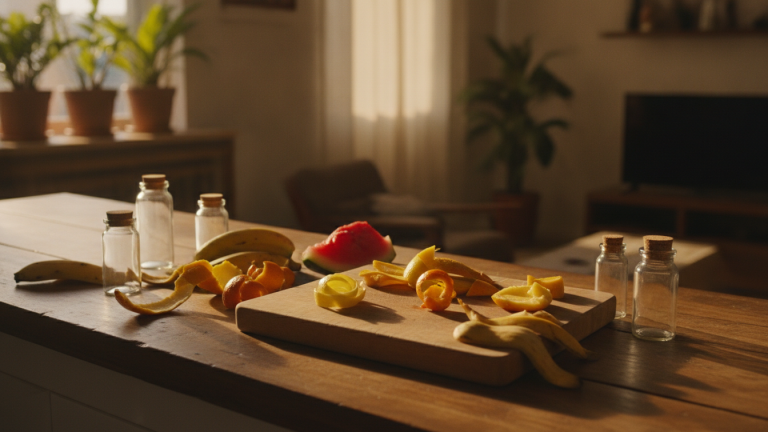
You come home from the market with a bag full of fruit, peel a mango or orange, and toss the peel straight into the trash without thinking twice. This scene happens in millions of Brazilian homes every day. According to Abrelpe data, organic waste represents more than half of everything that goes to the country’s landfills, and much of that material is food scraps that could have a second use.
Living in an apartment seems like an obstacle: no backyard, no worm bin in the garden, no space. But the reality is that fruit peels have practical uses that fit perfectly in a small kitchen, without smell, without mess, and without complication. By the end of this text, you’ll know how to transform banana, orange, lemon, and other fruit peels into useful daily products, saving money and reducing the trash you generate.
The idea isn’t to become a sustainability expert. It’s to do one simple thing today, see the result, and gradually build small habits over time.
Why throwing away fruit peel is a bigger waste than it seems
Brazil is one of the world’s largest fruit producers. With so much consumption, the amount of discarded peels is enormous, and most of them end up in landfills. There, mixed with other waste, these peels decompose without oxygen and release methane, a gas with warming potential far superior to CO2, according to IPCC data.
Law 12.305/2010, known as the National Solid Waste Policy (PNRS), establishes that organic waste should have proper disposal, such as composting. In practice, however, most Brazilian municipalities still don’t offer specific collection for this material. That means it’s up to each resident to take the initiative.
When you reuse a lemon peel to clean the sink or use a banana peel to fertilize a plant in your apartment, you’re following exactly the spirit of the law: giving better disposal to waste before it becomes trash. And you even come out ahead.
What you can do with common fruit peels in Brazil
The good news is that you don’t need to buy anything special to get started. The uses below use fruit that you already buy at the market or supermarket.
Orange and lemon peel
The peel of these citrus fruits has natural oils with cleaning power and a smell that repels insects. You can use them in at least three practical ways:
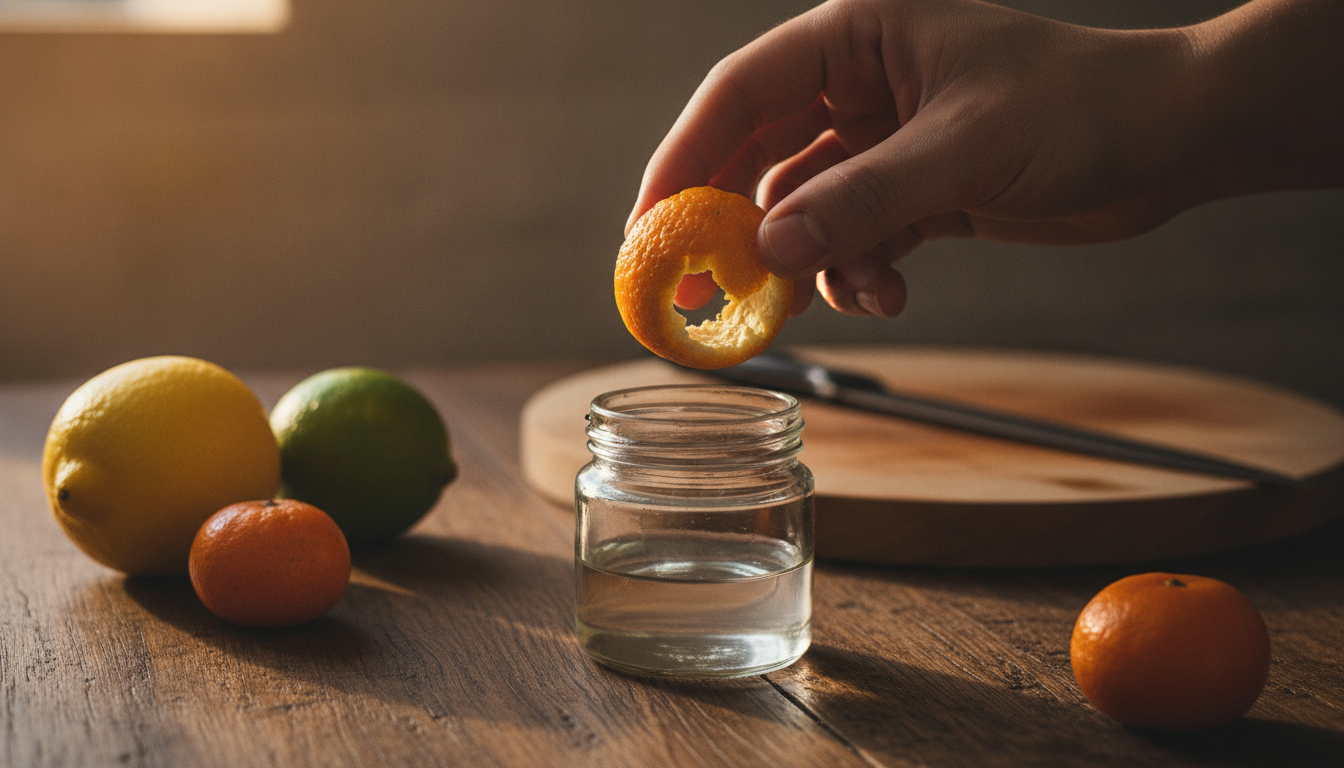
- Homemade all-purpose cleaner: place orange or lemon peels in a jar with white vinegar and let sit for two weeks. The result is an efficient cleaning product for countertops, stove, and bathroom.
- Degreaser for dishes: rub the inside of the peel directly on greasy pans; the citric oil helps dissolve dirt.
- Ant repellent: distribute pieces of orange or lemon peel in the cracks where ants enter. They avoid the smell.
Banana peel
Banana peel is perhaps the most versatile and least utilized. Rich in potassium, magnesium, and other minerals, it serves:
- Fertilizer for pots and apartment plants: chop the peel into small pieces and bury it shallow in the pots. It decomposes in a few weeks and releases nutrients directly into the soil.
- Shoe and leather polish: run the inside of the peel (the white part) on shoes, bags, or leather belts and then polish with a dry cloth. The result is a real shine.
- Plant polishing: for decoration plant leaves that accumulate dust, gently pass the inside of the peel. It works without leaving residue.
Watermelon and pineapple peel
Larger peels have culinary uses that many people don’t know about. The white part of watermelon can become candy, preserves, or be sautéed as a vegetable. Pineapple peel, when boiled with cinnamon and cloves, becomes a refreshing drink (the famous pineapple juice with peel, popular in the Northeast). Embrapa has already studied the integral use of Brazilian tropical fruits precisely because of the nutritional value of these discarded parts.
How to make a citric cleaner at home: step by step
This is one of the most practical uses because it replaces an industrialized product you buy every month.
What you’ll need:
- Orange, lemon, or tangerine peels (as much as you accumulate over a few days)
- Plain white vinegar (the cheapest on the market works)
- A jar with a lid (can be reused from olives or palm hearts)
Active prep time: 5 minutes Waiting time: 14 days Approximate cost: just the vinegar, which costs around R$ 3 to R$ 5 per liter at Brazilian markets
Step by step:
- Wash the fruit peels before using, especially if they’re not organic.
- Place the peels in the jar until it fills about two-thirds of the space.
- Fill with white vinegar until all peels are covered.
- Cap the jar and leave in a cool, dark place for 14 days.
- After two weeks, strain the liquid and discard the peels in organic trash or in a plant pot.
- Dilute the resulting liquid in water in a ratio of 1 part concentrate to 1 part water.
- Transfer to a spray bottle (can be reused from another product) and use normally.
The smell of vinegar goes away when the product dries. The citric concentrate has real efficiency on light grease and everyday dirt.
Composting in an apartment: viable or myth?
Many people dismiss composting because they think they need outdoor space. You don’t. There are compact worm bins made for apartments that work on a balcony, utility area, or even in the kitchen, without smell, if managed correctly.
You put the fruit peels (avoiding excess citrus, which is more acidic), mix with shredded paper or cardboard, and the worms do the work. The result, a few weeks later, is a rich fertilizer that feeds your plants. The city of São Paulo, for example, has municipal programs that distribute or sell subsidized worm bins to residents.
If the worm bin seems too big a step right now, start with cleaning and direct fertilizing uses in pots. The important thing is to reduce what goes to the trash, little by little.
Common mistakes that prevent peel utilization
Some simple habits prevent the process and make people give up before seeing results.
- Not washing the peels: peels with pesticide residue or dirt can contaminate the final product. Always wash before using.
- Mixing moldy peels: if the peel is already deteriorated, discard it. Only fresh peels work well for cleaning and fertilizing.
- Leaving peels exposed at room temperature for many days: without storing in the refrigerator or in vinegar jar, peels rot quickly and attract flies. Store them refrigerated while accumulating quantity to use.
- Expecting a “perfect” product: the citric cleaner doesn’t need exact proportions. Experiment, adjust the dilution according to dirt, and learn as you go.
How much you can save with these habits
It’s hard to give a precise number because it depends a lot on each home’s consumption. But you can reason with concrete examples.
| Product replaced | Estimated average monthly cost | Cost with homemade version |
|---|---|---|
| All-purpose cleaner spray | R$ 8 to R$ 15 | Vinegar cost (R$ 2 to R$ 4) |
| Fertilizer for pots (small bag) | R$ 10 to R$ 20 | Zero (peels you’d already have) |
| Leather polish | R$ 15 to R$ 30 | Zero |
It’s not a fortune, but over the course of a year, the sum starts to appear. And the real gain isn’t just financial: it’s the satisfaction of using less plastic, generating less trash, and realizing that your apartment can function a little more in closed cycles.
This logic of better using what already exists appears in several other sustainable habits, like saving water at home with small daily changes, where each individual gesture adds up with others and creates real results.
Frequently asked questions about fruit peel utilization
Can I use peels from pesticide-treated fruit to make cleaner?
Yes, but carefully. Rinse the peels well with water and baking soda before using. If you have access to organic fruit, prefer it for this purpose. The maceration process in vinegar helps reduce residues, but doesn’t completely eliminate all pesticides.
Won’t banana peel in the pot attract flies or fungi?
It will if it’s exposed on the soil surface. Bury the chopped peel at least two centimeters deep and mix with the soil. That way it decomposes without exposing smell and without attracting insects.
Does the citric cleaner work on all surfaces?
It works well on stainless steel, ceramic, porcelain, and plastic. Avoid using on natural stone like marble and granite, as the vinegar acid can damage the surface over time. For these cases, use only water and neutral soap.
How long can I store the finished cleaner?
The concentrate (before diluting) lasts up to three months in a sealed jar outside the refrigerator. After diluted in the spray bottle, use within four weeks to ensure efficiency. If the smell changes or strange cloudiness appears, discard and make a new batch.
Start with one peel today
You don’t need to change everything at once. Next time you peel an orange or banana, save the peel in a clean container in the refrigerator. In two or three days, you’ll have enough to start the citric cleaner or fertilize a pot.
This kind of small change, done consistently, is what really transforms habits. And the more you experiment, the more obvious it becomes that your kitchen trash has much more value than it seemed.
