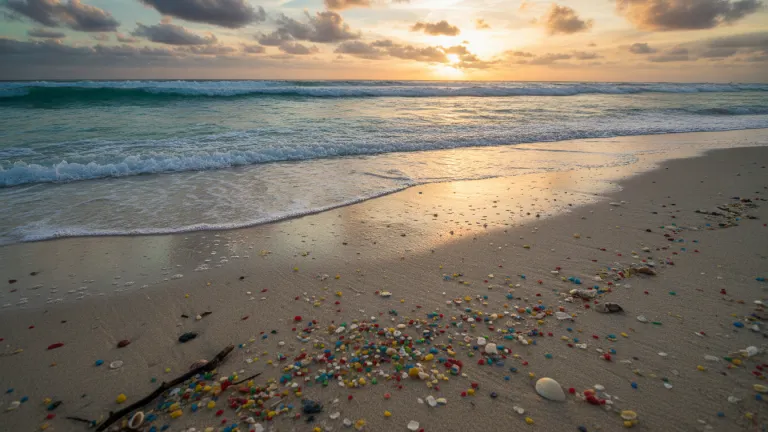
You open a bottle of mineral water, take a sip, and think you’re doing something simple and healthy. But scientific studies published in recent years have revealed something disturbing: even that water may contain plastic particles invisible to the naked eye, called microplastics. They’re in the food you eat, the air you breathe, the rain that falls on your head, and increasingly, inside your own body.
This topic is no longer exclusive to documentaries about distant oceans. In 2026, microplastics are recognized as one of the most urgent environmental and public health issues on the planet — and available data indicates the problem runs deeper than we imagined just a decade ago. The contamination is global, democratic in the worst possible sense, and spares no known ecosystem.
The good news is that understanding the problem is the first step toward action. And there’s much each person can do, in daily life, to reduce their contribution to this crisis. In this article, we’ll explain what microplastics are, where they come from, what real risks they pose, and most importantly, what’s within your reach to change this situation.
What are microplastics and where do they come from
Microplastics are plastic particles less than 5 millimeters in diameter — many of them visible only with the aid of a microscope. They fall into two main categories:
- Primary microplastics: manufactured already in small size for industrial or commercial use. Examples include microbeads used in facial scrubs, toothpastes, and cosmetic products, as well as plastic resin pellets used as industrial raw material.
- Secondary microplastics: resulting from the fragmentation of larger plastic items — bottles, bags, packaging, fishing nets, synthetic clothing — that degrade over time through the action of sun, wind, waves, and physical abrasion.
There’s also a subcategory called nanoplastics, particles smaller than 1 micrometer, which can penetrate cells and the blood-brain barrier. Science is still in the early stages of understanding their effects.
Sources of microplastics in the environment are varied:
- Washing clothes made from synthetic fabrics like polyester, nylon, and acrylic (each wash cycle can release hundreds of thousands of microfibers)
- Tire wear on roads (considered one of the largest land-based sources of microplastics)
- Fragmentation of plastic waste in landfills, beaches, and water bodies
- Paints, coatings, and construction materials
- Degradation of fishing nets and equipment
The scale of the problem: where microplastics have already been found
The omnipresence of microplastics is perhaps the most striking fact of this crisis. Researchers have detected them in places we imagined were untouched:
- At the top of Mount Everest, at nearly 9,000 meters altitude
- In the depths of the Mariana Trench, the deepest point in the oceans
- In the Arctic and Antarctica, in extremely remote regions
- In rain samples collected from rural and urban areas around the world
- In honey, sea salt, beer, and drinking water
- In human blood, lungs, liver, placenta, and breast milk, according to studies published in scientific journals such as Nature Medicine and Environment International
The United Nations Environment Programme (UNEP) considers plastic pollution — of which microplastics are an inseparable part — one of the three major global environmental crises, alongside climate change and biodiversity loss.
What are the real risks to human health
Here it’s important to be precise: science is still investigating the long-term effects of microplastic exposure in the human body. There’s no definitive consensus on diseases directly caused by them in humans. But the warning signs are serious enough to demand attention.
What science already indicates based on existing studies:
- Microplastics can act as vectors for toxic chemical substances, such as plasticizers (bisphenol A, phthalates) and flame retardants, which have endocrine-disrupting effects
- In animal studies, microplastic exposure has been associated with inflammation, liver damage, hormonal changes, and reproductive impairment
- A study published in 2024 in the New England Journal of Medicine found microplastics in fatty plaques in coronary and carotid arteries, and associated their presence with higher cardiovascular risk in the analyzed patients
- Plastic microfibers have been detected in human lung tissue, raising hypotheses about chronic inflammation
The WHO (World Health Organization) has already recognized the need for more urgent research on the topic. The precautionary principle applies here: even without absolute certainty, the evidence justifies preventive action.
The impact on ecosystems and wildlife
Marine and terrestrial wildlife suffer well-documented impacts from microplastics. Fish, seabirds, turtles, and mammals ingest them by mistaking them for food or by consuming already contaminated prey.
Quais animais ameaçados de extinção no Brasil em 2026? — many of them already face the additional pressure of plastic contamination, especially marine species like manatees and sea turtles.
Documented effects on wildlife include:
- False sense of fullness, leading to malnutrition
- Intestinal obstruction
- Reduced fertility in species studied in laboratories
- Transfer of associated pollutants along the food chain
Microplastics also affect soil and the microorganisms that live in it, potentially interfering with the decomposition of organic matter and nutrient cycles — essential functions for agriculture and ecosystem balance.
What you can do today: practical and accessible actions
Here’s the most important part: change begins with everyday choices. No individual action solves the problem by itself — robust public policies and industry responsibility are necessary — but reducing your exposure and contribution to plastic pollution is real and possible.
Actions to reduce your microplastic generation
- Prefer clothing made from natural fibers — organic cotton, linen, wool, and silk release far fewer microfibers than polyester and acrylic.
- Use a special washing bag — bags like the Guppyfriend are designed to capture microfibers during the washing of synthetic clothes.
- Reduce single-use plastic — reusable bottles, cloth bags, and returnable packaging cut plastic fragment generation at the source.
- Avoid cosmetics with plastic microbeads — look for terms like polyethylene, polypropylene, or nylon in the ingredient list. Apps like Beat the Microbead help identify these products.
- Filter your tap water — good quality filters can remove some of the particles present. Still, this doesn’t eliminate the problem at its source.
- Reduce consumption of ultra-processed foods packaged in plastic — besides health benefits, it decreases demand for plastic packaging.
- Proper waste disposal — plastic in the wrong place becomes microplastic faster. Separate for selective collection whenever available.
What to push for collectively
- Support initiatives and legislation to reduce single-use plastics
- Prefer brands that use sustainable packaging and disclose their environmental policy
- Participate in beach, river, and park cleanup events — every kilogram of plastic collected is plastic that won’t become microplastic
The role of public policies and industry
The definitive solution to the microplastics crisis cannot fall solely on the consumer. Governments and industry have a central and irreplaceable role.
In March 2022, representatives from 175 countries at the United Nations Environment Assembly approved a resolution to begin negotiations for a binding global treaty against plastic pollution — a process still in development that, when completed, could be one of the most important environmental agreements since the Paris Agreement.
In Brazil, the National Solid Waste Policy (Law No. 12,305/2010) already provides for shared responsibility mechanisms and reverse logistics — but its implementation still faces significant challenges.
The transition to a circular economy, where materials are reused and recycled instead of discarded, is the most promising structural path to reduce plastic generation and, consequently, microplastics.
Conclusion: small gestures, real impact

Microplastics are a real problem, documented by science and present in our daily lives in ways we’re still learning to understand. But knowledge is a powerful tool. Knowing what they are, where they come from, and how they spread already puts you in a better position to make more conscious choices.
Every reusable bottle that replaces a disposable one, every cotton garment chosen instead of polyester, every refusal of unnecessary packaging — all of this is concrete and real. Multiplied by millions of people, it carries weight.
Also take care of your diet and home environment with the same spirit: living sustainably doesn’t have to be complicated. Small habit changes, made consistently, add up to something significant — for you, for your family, and for the planet we all share.
Microplastics have reached places we never imagined. But our capacity to act, to choose differently, and to push for structural changes also knows no limits.
