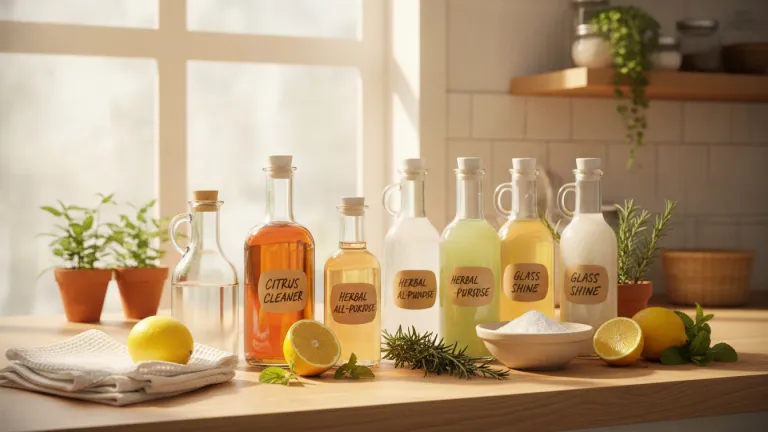
Why switching to eco-friendly cleaning products makes a real difference
Have you ever stopped to read the back of a degreaser or fabric softener bottle? The ingredient list is usually long, filled with unpronounceable names and substances that end up directly in rivers and groundwater after draining down the sink. Synthetic surfactants, artificial fragrances, preservatives, and dyes: most of these compounds are not easily degraded by the environment and can harm aquatic organisms, contaminate soils, and accumulate in the food chain.
The good news is that there’s a simple, inexpensive, and effective solution within reach: make your own cleaning products at home using natural, safe, and widely available ingredients. Beyond reducing the chemical load entering ecosystems, you eliminate disposable plastic packaging—one of today’s biggest environmental villains—and save money on your household budget.
This article brings together practical recipes, safety tips, and explanations behind each ingredient so you understand why they work, not just how to use them. After all, when we understand the logic, it’s much easier to adapt, innovate, and maintain the habit long-term.
The real problem with conventional cleaning products
To understand the value of the homemade alternative, it’s worth knowing what’s at stake. Conventional household cleaning products generally contain three categories of concerning substances:
- Synthetic surfactants (such as sodium lauryl sulfate and EDTA): they’re efficient at cleaning, but persist in aquatic environments and can interfere with fish and invertebrate reproduction.
- Synthetic fragrances and phthalates: associated with endocrine disruption in mammals, according to assessments by the European Chemicals Agency (ECHA).
- High concentrations of chlorine and ammonia compounds: when disposed improperly or mixed together, they can generate toxic gases and compromise treated water quality.
Beyond chemical composition, there’s the packaging problem. Brazil generates tens of millions of tons of solid waste annually, and plastic packaging for hygiene and cleaning products represents a relevant share—much of it without proper recycling. By making products at home and reusing glass or resistant plastic bottles, you cut this cycle at the root.
Key ingredients: what each one does
Before moving to recipes, get to know the basic ingredients that form the foundation of virtually all homemade cleaning products. They’re easy to find in supermarkets, pharmacies, and natural product stores, with accessible costs.
| Ingredient | Main Function | Where to Find |
|---|---|---|
| Baking soda | Mild abrasive, neutralizes odors, removes light grease | Supermarkets, pharmacies |
| White vinegar | Acetic acid: descales, cuts grease, antimicrobial | Supermarkets |
| Hydrogen peroxide 10 vol | Disinfectant and mild bleach | Pharmacies |
| Coconut or Castile soap | Natural and biodegradable surfactant | Supermarkets, natural stores |
| Tea tree essential oil | Natural antifungal and antibacterial | Natural stores, pharmacies |
| Lemon (juice or peel) | Natural citric acid, removes stains and descales | Supermarkets |
| Grain or isopropyl alcohol | Disinfectant and rapid drying | Pharmacies |
Important note: vinegar and baking soda, when mixed together, neutralize each other chemically (acid + base = salt + water + CO₂). They work better applied separately or in sequence, not together in the same formula, contrary to what many internet recipes suggest.
Practical recipes: how to make your eco-friendly cleaning products
All-purpose cleaner for surfaces
This is the workhorse of household cleaning. It works on countertops, sinks, tiles, and tables.
- In a spray bottle (preferably glass or HDPE), pour 250 ml of filtered water.
- Add 250 ml of white vinegar.
- Add 20 drops of tea tree essential oil (or lavender for a milder scent).
- Close, shake gently, and label the bottle with the preparation date.
- Use directly on surfaces, spray, wait 1 minute, and wipe with a damp cloth.
Shelf life: up to 3 months in a cool, dark place. Do not use on marble or polished granite surfaces, as acetic acid can damage the stone over time.
Exfoliating paste for stovetop and sinks
Ideal for removing stubborn grease without scratching surfaces.
- In a small container, mix 4 tablespoons of baking soda with 2 tablespoons of liquid coconut soap.
- Add 10 drops of lemon essential oil to enhance grease-cutting and aroma.
- Stir until you get a homogeneous paste.
- Apply with a sponge or cloth over the surface, scrub in circular motions, and rinse with water.
Tip: prepare small amounts at a time, as the mixture with soap may lose consistency after a few days.
Bathroom disinfectant with alcohol and tea tree
- Combine 300 ml of 70% isopropyl alcohol (or grain alcohol diluted to 70%) with 200 ml of water.
- Add 30 drops of tea tree essential oil.
- Transfer to spray bottle and apply to toilet seats, faucets, and doorknobs.
- Let sit for 2 minutes before rinsing or drying.
70% alcohol is recognized as an effective antimicrobial agent by the National Health Surveillance Agency (ANVISA), being widely used in hospital settings.
Natural fabric softener
- Add 200 ml of white vinegar to the fabric softener compartment of your washing machine instead of conventional product.
- To add fragrance, mix 15 drops of lavender essential oil into the vinegar before putting it in the machine.
The acetic acid in vinegar neutralizes soap residues left on fibers, leaving clothes soft without vinegar smell after the spin cycle (which completely evaporates during drying).
Streak-free glass cleaner
- Mix 300 ml of water, 100 ml of 70% isopropyl alcohol, and 1 teaspoon of white vinegar.
- Transfer to spray bottle.
- Apply to glass and wipe with crumpled newspaper or microfiber cloth in circular motions.
Safety first: what never to mix
Making homemade products is safe when you follow some basic chemistry rules. See what never to combine:
- Vinegar + hydrogen peroxide in the same bottle: together they form peracetic acid, which can be corrosive and irritating to airways.
- Baking soda + acids (vinegar, lemon): the reaction produces CO₂ and negates the effectiveness of both; use them separately.
- Alcohol + hydrogen peroxide in high concentrations: can be flammable and irritating.
- Any homemade product + commercial products with chlorine (bleach): unpredictable and potentially toxic reactions.
Always label your bottles with the product name and preparation date, keep away from children, and store in a ventilated area.
Real savings and environmental impact: the numbers make sense
While it’s difficult to cite an exact savings percentage without knowing each family’s consumption profile, it’s fair to say based on market price comparisons that the basic ingredients for homemade cleaning (baking soda, vinegar, coconut soap, and essential oil) cost, together, a fraction of what is spent monthly on equivalent conventional products—especially when bought in larger packaging and reused continuously.
From an environmental perspective, the gains are concrete:
- Less plastic disposed: each reusable bottle eliminates months or years of disposable packaging.
- Fewer chemicals in sewers: ingredients like vinegar and baking soda have far superior biodegradability compared to synthetic surfactants.
- Lower VOC emissions (volatile organic compounds): artificial fragrances and synthetic solvents contribute to indoor air pollution, a problem recognized by the World Health Organization (WHO).
If you want to go beyond cleaning and think about other more conscious consumption habits, it’s worth reading about how conscious shopping changes your habits and the planet.
Tips for maintaining the habit and involving your family
Changing an established routine is the biggest challenge. Some strategies that work in practice:
- Start with just one product: choose the all-purpose cleaner, use it for two weeks, and evaluate. Don’t try to replace everything at once.
- Set up a green cleaning station: reserve a corner of your kitchen or laundry room with your ingredients organized, labeled bottles, and a sheet with your favorite recipes.
- Involve children: preparing the all-purpose cleaner is a safe and educational activity for older kids—and a way to build environmental awareness from an early age.
- Reuse packaging: glass sauce jars, resistant plastic containers, and old spray bottles are excellent containers.
- Buy ingredients in bulk: baking soda and vinegar in larger packaging cost less per gram and generate less packaging per capita.
- Share the recipes: teach a neighbor, post on social media, form a group in your neighborhood—collective impact is always greater than individual.
Conclusion: a small step, a genuine impact
Making cleaning products at home won’t solve all of the planet’s environmental problems—and it would be dishonest to claim otherwise. But it’s a concrete, accessible action that anyone can start today, without spending much, without needing special equipment, and without sacrificing cleaning effectiveness.
Each bottle of conventional product not purchased is one less plastic package in the system, one less set of synthetic substances in sewers, and one more step toward a more environmentally friendly household routine for those living in the house and for the surrounding environment.
Start with the all-purpose cleaner this week. Note what worked, adjust what needs changing, and when you feel confident, try the next recipe. The transformation of habits happens exactly this way: one bottle at a time.
And if you want to expand your positive footprint on the planet even further, also explore how to offset your carbon footprint and where to start—because every conscious choice adds up with the others.
