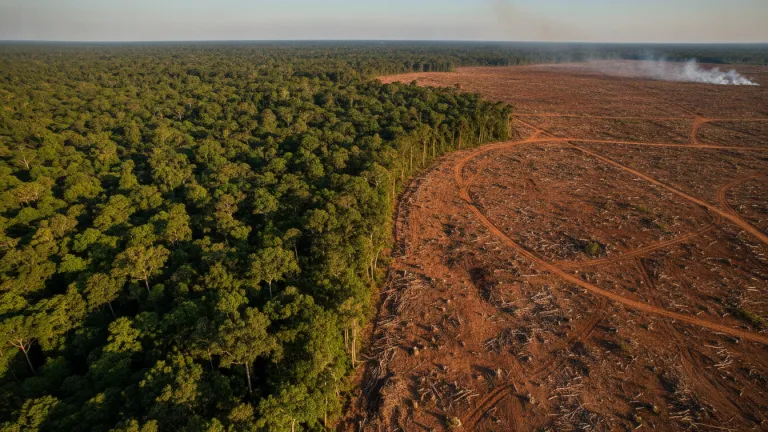
The Amazon is sending warning signals that the entire world needs to hear. In recent years, scientists have documented something that was once just theory: the richest tropical forest on the planet may be approaching a point of no return, a threshold beyond which significant parts of the Amazon would cease to sustain themselves as forest and transform into savanna. This is not science fiction — it’s what researchers from Brazil’s National Institute for Space Research (INPE) and universities around the world have been discussing with growing urgency.
Amazon deforestation is not just a local environmental problem. Every hectare of forest cleared releases carbon stored for decades, interrupts hydrological cycles that supply farms and cities thousands of kilometers away, and eliminates species that science hasn’t even catalogued yet. When we talk about deforestation in the Amazon, we’re essentially talking about climate changes that affect rainfall in São Paulo, temperatures in Buenos Aires, and sea levels in Bangladesh.
This article exists to explain these impacts clearly and honestly — without paralyzing catastrophism, but also without softening the seriousness of what’s happening. And, more importantly, to show what each person can do, starting today, to be part of the solution.
The Scale of the Problem: What Deforestation Data Reveals
The Brazilian Amazon covers about 4 million km² and represents the largest continuous tropical forest in the world. According to historical data from INPE, the biome has lost hundreds of thousands of km² in recent decades. The PRODES system (Project for Monitoring Deforestation in the Legal Amazon by Satellite), which INPE has operated since the 1980s, is Brazil’s official reference for measuring these losses year by year.
Between 2019 and 2022, annual deforestation rates rose significantly again, reaching levels not seen since the mid-2000s. Starting in 2023, with changes in federal environmental policy, the numbers showed a significant decline, which was internationally recognized. Still, any deforestation above zero in a forest that takes decades to recover represents an enormous debt to the future.
It’s important to remember that official deforestation only measures clear-cutting — completely removed areas. Forest degradation, caused by fires, illegal logging, and fragmentation, affects even larger areas and often doesn’t appear in the main statistics. Research published in journals like Science and Nature indicates that degradation can emit carbon volumes comparable to total deforestation, making the problem even larger than the raw data suggests.
Deforestation and Climate: The Connection Few Explain Properly
How the forest regulates regional and global climate
The Amazon functions as an enormous water pump. Trees absorb water from the soil and release it into the atmosphere through transpiration — a process called evapotranspiration. This vapor forms clouds that generate rain, not only within the forest but in distant regions. Scientists call this phenomenon “flying rivers.”
Studies coordinated by researchers like Antonio Donato Nobre from INPE show that these aerial rivers transport moisture to southern and southeastern Brazil, feeding the rains that supply agriculture and water reservoirs. When large expanses of forest are cleared, this mechanism weakens. The result can be more severe and prolonged droughts in regions that depend on these rains.
The Amazon’s role in global carbon
Amazon vegetation stores enormous amounts of carbon in tree biomass and soil. When a tree is felled and burned, this carbon is released as CO₂ — the main greenhouse gas responsible for global warming. Brazil is one of the world’s largest emitters when deforestation is counted, and the Amazon represents the most significant portion of these national emissions.
The IPCC (Intergovernmental Panel on Climate Change) recognizes in its reports that protecting tropical forests is one of the most effective and lowest-cost strategies for mitigating climate change. Protecting the Amazon, therefore, is not a matter of romantic preservationism — it’s climate mathematics.
The Point of No Return: When Forest Becomes Savanna
The concept of the Amazon “tipping point”
One of the most discussed topics in current climate science is the possibility that the Amazon could cross a tipping point beyond which degradation processes would become self-sustaining, without the need for more direct human deforestation. Articles published in high-impact scientific journals, including work led by Thomas Lovejoy and Carlos Nobre, suggest that deforestation of approximately 20 to 25% of the original forest could trigger this transition in significant parts of the biome.
INPE estimates indicate that cumulative historical deforestation of the Brazilian Amazon has already surpassed the 20% mark of original coverage. This doesn’t mean collapse is immediate or inevitable — the forest has resilience — but it does mean that safety margins are narrowing. Combining deforestation with rising temperatures caused by global warming further reduces this margin.
Consequences for biodiversity
The Amazon is home to about 10% of all known species on the planet, according to estimates from the IUCN and Brazilian research institutes. Habitat fragmentation — when large forest areas are cut into smaller pieces by roads and farms — is one of the greatest threats to biodiversity, often more lethal than the total deforestation of a smaller area. Species that need large territories, such as jaguars and giant otters, are the first to disappear.
Social Impacts: Who Suffers Most from Deforestation
The effects of deforestation are not abstract and don’t affect everyone equally. Indigenous peoples and traditional communities are the most vulnerable, as they depend directly on the forest for subsistence, culture, and identity. FUNAI and organizations like ISA (Socio-Environmental Institute) continuously document how pressure on indigenous territories increases along with deforestation fronts.
Additionally, deforestation favors the spread of diseases. Research associates the advance of deforestation with increased malaria cases in agricultural frontier areas, as clearing soil and creating degraded environments favor the reproduction of vector mosquitoes.
Finally, there’s the long-term economic impact. More severe droughts, partially caused by the loss of flying rivers, affect electricity generation at hydroelectric plants — which still account for a significant portion of Brazil’s electrical matrix, according to ANEEL data — and harm harvests, making food more expensive for the entire population.
Real Solutions: What’s Actually Working in Practice
There’s no shortage of examples showing that reversing trends is possible. Brazil has demonstrated this before: between 2004 and 2012, deforestation rates in the Amazon fell by more than 80% thanks to a combination of satellite monitoring, enforcement, market pressure, and public policies like the Action Plan for Prevention and Control of Deforestation in the Amazon (PPCDAm). This reduction is considered one of the largest greenhouse gas emission reductions in modern history.
Initiatives like the program Reforestation: What It Is and Why It Saves Lives are gaining increasing scale, with companies, governments, and civil society organizations planting native trees and restoring degraded areas. Forest restoration, when done with native species and appropriate techniques, can recover much of the ecological functions of the original forest over decades.
What You Can Do: Practical and Accessible Actions
Changing the Amazon’s fate requires public policies and corporate decisions — but consumer and citizen power is real and documented. Here are concrete actions that make a difference:
- Reduce beef consumption: extensive cattle ranching is historically the main direct driver of deforestation in the Amazon. Reducing consumption, even partially, reduces the demand that pressures the forest.
- Check product origins: look for certifications like the Rainforest Alliance seal or verify if food companies have public zero-deforestation commitments in their supply chains.
- Support forest protection organizations: NGOs like WWF Brazil, ISA, and Imazon have concrete monitoring and protection projects. Donations, even small ones, help maintain operations.
- Apply pressure as a consumer and citizen: sign petitions, participate in public consultations, and demand clear positions on environmental protection from candidates and elected representatives.
- Offset your emissions responsibly: when choosing carbon offset projects, prioritize those that are certified and traceable. Learn more about this in Carbon Neutrality: What It Is and How It Works.
- Share quality information: combating environmental misinformation is a real form of activism. Share reliable sources like INPE, IPCC, and recognized research institutes.
- Choose committed products and brands: the market responds to conscious choices. The more consumers demand environmental transparency, the more companies adapt.
Why There’s Still Reason for Hope
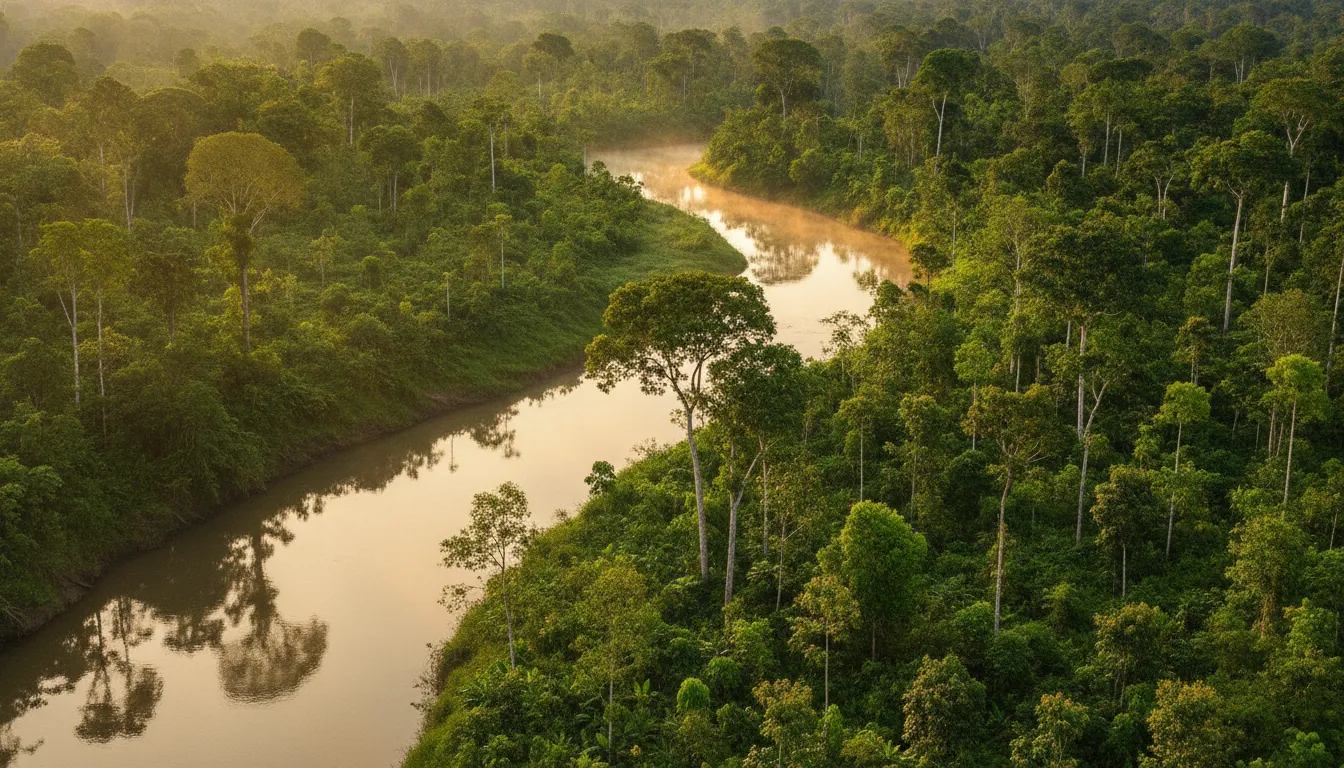
It would be dishonest to end this article pretending the problem isn’t serious. It is. But it would be equally dishonest to ignore what recent history teaches us: the Amazon has been under even greater pressure in terms of annual deforestation rates, and the numbers dropped dramatically when there was political will and social engagement.
Climate science is clear that every fraction of a degree of warming avoided matters, every hectare of forest preserved matters, every species kept in its habitat matters. We don’t need perfection — we need consistent progress.
The Amazon is not just the “lungs of the world,” an already worn-out metaphor. It is the heart of a climate system on which we all depend, whether you live in Manaus, São Paulo, or anywhere else on the planet. Protecting it is, at the same time, an act of justice for the peoples who live there and an investment in the only possible future for all of us.
Start with what’s within your reach. Inform yourself, choose better, apply more pressure. The forest — and future generations — will thank you.
