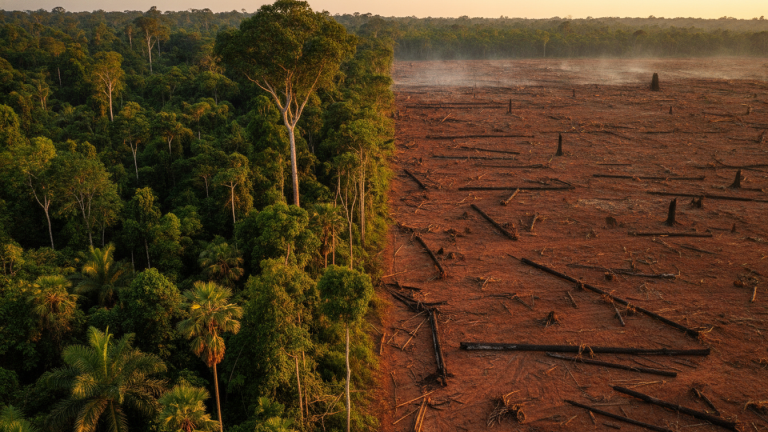
The Day the Amazon Stopped Raining in Your Backyard
Imagine waking up in São Paulo or Cuiabá and noticing that the dry season lasted weeks longer than usual. Or that rains arrived late, damaging the harvest of those who plant beans and corn in Brazil’s interior. This scenario is no longer hypothetical: it’s what researchers from INPE and Brazilian universities have been documenting as a direct consequence of Amazon deforestation. The forest is not just a green postcard. It’s a climate machine that regulates temperature, distributes rainfall, and keeps alive a cycle that you depend on, even if you live a thousand kilometers away from it.
Throughout this article, you’ll understand why what happens in the Amazon affects the climate where you live, what the real numbers of the problem are, and most importantly, what an ordinary person can do to avoid feeding this process unknowingly.
How the Amazon Functions as a Giant Water Pump
The Amazon is home to the world’s largest tropical forest. According to INPE data, it covers more than five million square kilometers in Brazilian territory alone. Trees of this size continuously transpire water: each large tree releases hundreds of liters of water vapor per day, and this vapor rises, forms clouds, and generates rain. Scientists call this process flying rivers, air currents of moisture that move from north to south and east to west, supplying regions far beyond the forest.
When we deforest a large section of this forest, this mechanism weakens. Fewer trees mean less vapor, fewer clouds, and consequently less rain in other states. The Center-West and Southeast regions are most affected by this change. Researchers from USP and Cemaden have already published studies showing that reduced rainfall in the interior of São Paulo and in the states of Paraná and Mato Grosso do Sul is related to the advance of deforestation in the Deforestation Arc, a region that stretches from southern Pará to northern Mato Grosso.
Deforestation Numbers Every Brazilian Should Know
Talking about deforestation without numbers is talking into the void. According to INPE, the Brazilian Amazon biome lost about 11,568 square kilometers of forest in 2022, according to the Prodes system. In subsequent years, rates fluctuated, with significant declines recorded in 2023 and 2024 as a result of reinforced enforcement actions by the federal government and Ibama. Nevertheless, the accumulated deforested area represents an enormous scar that doesn’t recover quickly.
To get an idea of what this means: when mature forest is cut down, it releases into the atmosphere the carbon that was stored in wood, roots, and soil. According to the IPCC, tropical forests store gigantic amounts of carbon, and tropical deforestation accounts for a significant portion of global greenhouse gas emissions each year. In Brazil, according to data from the Emissions Estimates System of the Climate Observatory, deforestation was for a long time the country’s largest emission source, ahead of even the transportation sector and agriculture separately.
What Changes in the Climate When the Forest Falls
Deforestation affects the climate through two pathways simultaneously. The first is local and regional: without trees, soil heats up more, humidity drops, and the rainfall regime changes. Cities like Alta Floresta in Mato Grosso already register higher average temperatures than thirty years ago, a pattern documented by Inmet weather stations.
The second pathway is global. Carbon released by deforestation goes into the atmosphere and intensifies the greenhouse effect. Understanding the difference between global warming and climate change helps you see that deforestation doesn’t just make the planet uniformly hotter: it disrupts entire patterns of precipitation, winds, and seasons. You can feel this in the form of hotter summers in Porto Alegre, prolonged droughts in the Northeast, or unseasonable frosts in the South.
Biodiversity also plays a role in this. The Amazon concentrates a huge part of the planet’s animal and plant species, according to IUCN surveys. When the forest retreats, species that exist nowhere else in the world disappear before they’re even studied. And the loss of biodiversity has a direct effect on food security, since pollinators, natural predators of pests, and wild plants that feed commercial species depend on intact ecosystems.
Why Deforestation Continues and Who’s Behind It
Deforestation in the Amazon doesn’t happen by accident. According to Imazon and MapBiomas reports, the main causes are the expansion of extensive cattle ranching, opening areas for soy planting, and illegal gold mining. A smaller but relevant portion comes from illegal timber extraction and land speculation.
This means that consumption decisions made far from the forest have a direct impact on it. The cattle that became your steak might have been raised on open pasture in an area that was forest five years ago. The soy that feeds chickens in European farms might have been planted on recently deforested land. This isn’t about individual guilt, but understanding that production chains connect your plate to the forest.
What You Can Do Today, Without Living in the Amazon
The good news is that there are concrete and accessible actions. Some involve consumption, others involve political pressure and choosing where your money goes.
In your shopping and eating:
- Reduce beef consumption. You don’t need to eliminate it: reducing meat consumption gets easier with small steps and already makes a real difference in demand for deforested pasture.
- Prefer products with traceability seals, such as Embrapa’s Carbon-Neutral Beef or verifiable origin certifications.
- Shop at the local market and ask where the product comes from. This seems small, but it creates demand for short and transparent supply chains.
With your money:
- Research whether the bank where you have an account invests in companies linked to deforestation. Organizations like Conectas and the Rainforest Action Network publish periodic reports on this.
- If you have savings or investments, consider ESG funds or banks with documented socio-environmental policies.
With your voice:
- Vote and hold officials accountable. Ibama enforcement policies, budget for the Amazon Fund, and strengthening of the Rural Environmental Registry depend on political decisions that respond to public pressure.
- Share verified information. Misinformation about deforestation exists and hinders pressure for real change.
In daily life:
- Reduce paper and wood waste at home. Use both sides of paper, buy furniture made from FSC-certified wood.
- Support NGOs and territorial protection projects of indigenous peoples. INPE data show that demarcated indigenous lands have much lower deforestation rates than areas without formal protection.
Frequently Asked Questions About Deforestation and Climate
Does Amazon deforestation really affect those who live in the South or Southeast?
Yes, and directly. Researchers from INPE and IAG-USP have shown that flying rivers, moisture currents generated by the forest, supply rainfall to states like São Paulo, Paraná, and Rio Grande do Sul. With less forest, these currents weaken and droughts become more frequent and intense in these regions.
Deforestation has already decreased. Is the problem solved?
No. Drops in deforestation rates are important, but already destroyed areas don’t recover in decades. Moreover, INPE experts warn of the risk of a tipping point, beyond which the biome can no longer maintain its own rainfall cycle, regardless of how much reforestation occurs. Protecting what remains is urgent.
Does planting trees solve the problem?
It helps, but doesn’t replace primary forest. A forest with hundreds of years of ecological succession has biodiversity, soil structure, and carbon storage capacity far superior to any recent planting. Reforestation is necessary, but protecting what still exists is more effective and cheaper.
Can I offset my carbon footprint by donating to forest projects?
Compensation can be part of a strategy, but it doesn’t eliminate the need to reduce emissions at the source. Choose projects with recognized certification, such as Verra or Gold Standard, and be skeptical of vague promises without independent auditing.
One Small Action to Start This Week

Choose one day of the week to eat without red meat. Just one day. Invite someone to do the same. It seems small, but multiplied by millions of people, this gesture reduces pressure on extensive livestock farming that still advances on the forest. And the forest, when it stands, keeps raining in your backyard, cooling your city, and storing the carbon that the planet can no longer afford to throw into the air.
